An imperturbable demeanor comes from perfect patience. Quiet minds cannot be perplexed or frightened, but go on in fortune and misfortune at their own private pace like a clock during a thunderstorm.—Robert Louis Stevenson
No chimney in the condo, but pieced stockings hung from the bookcase! I made the green one for Gary years ago, but the red and pink one on the right is brand new and for me. Both are lined in velvet and pieced with cotton, silk, and scraps of a red gilt and silk damask I bought in San Francisco for Ian’s madrigal costume twenty-five years ago.
We invited people in the building for a visit and had a lovely time. It gave me an excuse to bake cakes and shortbread, but talk was the major event. It was so good to sit down and have a conversation with our interesting and talented neighbors.
This is a 2016 post from my old college class blog:
I said [That is, me, Jan Priddy] the first few paragraphs of this op-ed twenty-seven times to you, one at a time. It took me four days of conferences to explain to each of you that the papers you are currently writing are not about proving how right you are, but about reviewing several reasonable and sincere concerns and finding a solution that is about doing the right thing, not finding a hero or taking sides.
We live in a big, diverse society. There are essentially two ways to maintain order and get things done in such a society — politics or some form of dictatorship. Either through compromise or brute force. Our founding fathers chose politics.
Politics is an activity in which you recognize the simultaneous existence of different groups, interests and opinions. You try to find some way to balance or reconcile or compromise those interests, or at least a majority of them. You follow a set of rules, enshrined in a constitution or in custom, to help you reach these compromises in a way everybody considers legitimate.
The downside of politics is that people never really get everything they want. It’s messy, limited and no issue is ever really settled. Politics is a muddled activity in which people have to recognize restraints and settle for less than they want. Disappointment is normal.
But that’s sort of the beauty of politics, too. It involves an endless conversation in which we learn about other people and see things from their vantage point and try to balance their needs against our own. Plus, it’s better than the alternative: rule by some authoritarian tyrant who tries to govern by clobbering everyone in his way.
As Bernard Crick wrote in his book, “In Defence of Politics,” “Politics is a way of ruling divided societies without undue violence.”
Over the past generation we have seen the rise of a group of people who are against politics. These groups — best exemplified by the Tea Party but not exclusive to the right — want to elect people who have no political experience. They want “outsiders.” They delegitimize compromise and deal-making. They’re willing to trample the customs and rules that give legitimacy to legislative decision-making if it helps them gain power.
Ultimately, they don’t recognize other people. They suffer from a form of political narcissism, in which they don’t accept the legitimacy of other interests and opinions. They don’t recognize restraints. They want total victories for themselves and their doctrine.
This antipolitics tendency has had a wretched effect on our democracy. It has led to a series of overlapping downward spirals:
The antipolitics people elect legislators who have no political skills or experience. That incompetence leads to dysfunctional government, which leads to more disgust with government, which leads to a demand for even more outsiders.
The antipolitics people don’t accept that politics is a limited activity. They make soaring promises and raise ridiculous expectations. When those expectations are not met, voters grow cynical and, disgusted, turn even further in the direction of antipolitics.
The antipolitics people refuse compromise and so block the legislative process. The absence of accomplishment destroys public trust. The decline in trust makes deal-making harder.
We’re now at a point where the Senate says it won’t even hold hearings on a presidential Supreme Court nominee, in clear defiance of custom and the Constitution. We’re now at a point in which politicians live in fear if they try to compromise and legislate. We’re now at a point in which normal political conversation has broken down. People feel unheard, which makes them shout even louder, which further destroys conversation…
—“The Governing Cancer of Our Time” by David Brooks, FEB. 26, 2016 in The New York Times
Nearly eight years ago. And, mind you, David Brooks is a Republican. (This is why Obama was not able to put a centrist on the Supreme Court and why we got that sniveling whiner instead nominated by Trump. Brooks doesn’t mention McConnell who really ramped up the crazy. Even McConnell must be sorry about this by now.) Brooks was scared even before the election. Is this a little scary, given what is happening in Congress today? It should be making us all worried.
I left my first job at Taco Bell on Aurora Avenue North in 1970 because my boss said the people shot at Kent State got what they deserved. My second job was at DJ’s Sound City at Northgate in Seattle but my boss had an eye for another employee and when the business began to fail, she was the only one not laid off. In 1972, the University of Washington’s University Book Store hired me for the Music Department, a job for which I was eminently unqualified. Think bins of LPs and a scattering of cassettes tapes—that long ago. I would work there for most of the next four years while completing two studio art degrees. Despite having abandoned guitar, I learned a lot about music during those years.
And I met an old woman named Florence.
This is not a recent photo. The sand has mostly moved offshore for the winter, revealing the basalt “cobbles” beneath. Yesterday afternoon Gary and I found 9 bits of seaglass while searching only a few hundred yards north and south. I will add a current photo if we have a break in the rain.Continue reading →
A month and three days since my fall and everything seems to be functioning. No coffee since mid-October. sigh I cut back on salt. Cut wine from 30 glasses/ month to 2. I did not stop running after the Bridge Crossing—ran yesterday on schedule. I am typing without pain on my new Mac. I am hoping to find an actual doctor in Portland. The crows are flocking in our eastern view from the condo. I have resisted ordering yarn on sale or fabric from Liberty of London. I have enough. And November was National Novel Writing Month.
This morning I passed 50,000 words on NaNo. I’ve given up on the plan to stitch ornaments to go in the holiday cards. We stayed home last weekend and I was supposed to be stuffing squashes and making applesauce this afternoon. Instead I spent four hours recreating the emergency manual for our condo because I only had the pdf and could not figure out how to revise it. So the document got another complete edit, which is a good thing, and I sent a brand new pdf off to the man who did most all the original work. And I looked up photos of my classes.
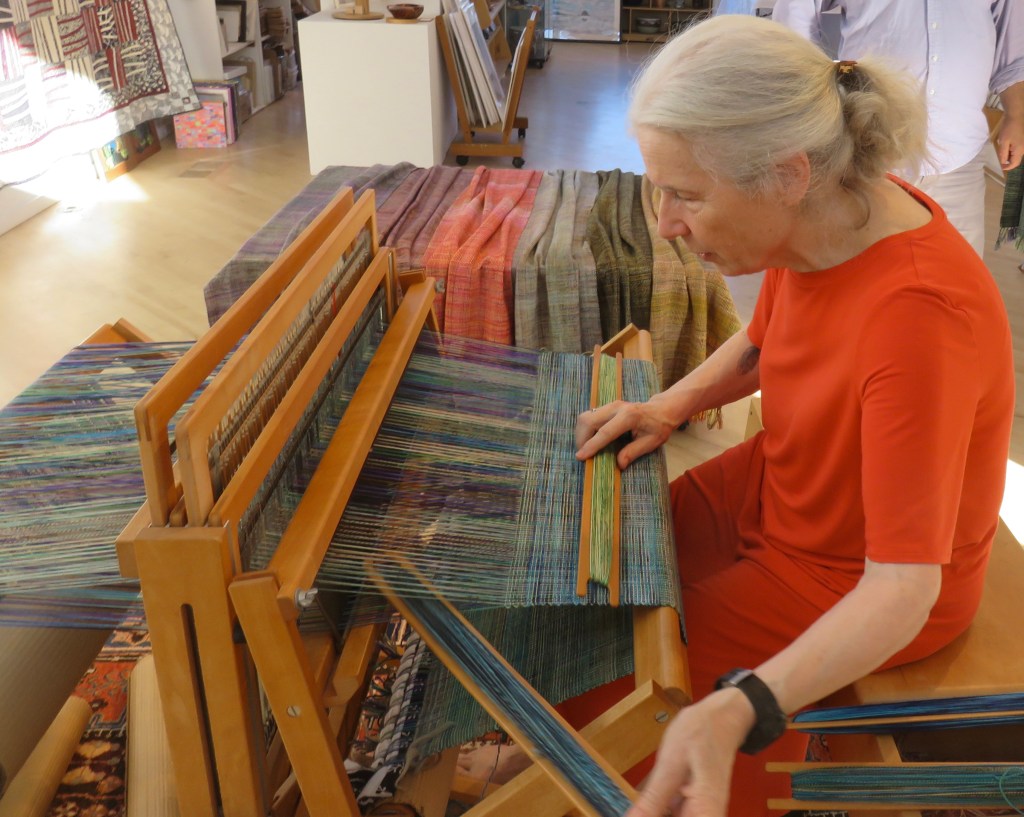
Weaving during the opening of the textile show last month at Cannon Beach Arts Association Gallery. A former student bought the one I am weaving in this photo, thank you, Josh. Gary wants credit for the photo. Thank you, Gary.Continue reading →
NOTE: I should be working on fiction just now, but one of my shawls found a home far away from here, I am reminded of thankfulness, and I’m sharing an assignment I enjoyed doing myself over and over again.
My husband Gary worked in and managed a farmers’ cooperative for over nineteen years. It was a United Grocers store, but as manager he brought in products from many vendors. It’s been twenty-five years since he left that job, but he still has an eye for the way stores are stocked. When I ask him to pick up a particular product, he looks for the UPC number [the barcode] to be certain he gets exactly hat I want. While we were waiting for servicing on our car, I walked into a Hispanic grocery in Hillsboro. Even I knew he would admire the produce. It took some coaxing to convince him “you have to see this” because he wanted to get back to the car. He declared it wonderful. The whole store made him smile.
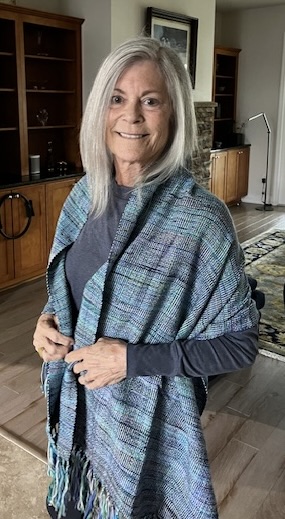
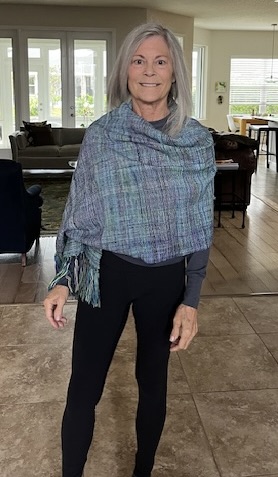
Kathy in Florida was visiting in Cannon Beach last month and bought this shawl on faith—I had barely begun weaving it in the gallery, but she liked the colors and trusted.Continue reading →
“Janet Sobel (May 31, 1893 – November 11, 1968), born Jennie Olechovsky, was a Ukrainian-born American Abstract Expressionist painter whose career started mid-life, at age forty-five[2] in 1938. Sobel pioneered the drip painting technique that directly influenced Jackson Pollock. She was credited as exhibiting the first instance of all-over painting seen by Clement Greenberg, a notable art critic.”—Wikipedia
When her father was killed in a pogrom, she, with her midwife mother and siblings immigrated to the United States. Here she married quite young, raised five children, and began painting at age 37. In the following years she created a revolutionary way to paint and to approach painting.
Two problems with this. The easy one; I did in fact know Janet Sobel’s name, though I am inclined to misspell it and like generations of students taking Art History in college we never studied a single female painter. The stickier issue is that a someone already wrote this essay.
The day before yesterday, I attended Portland Book Festival 2023. I heard two discussions, toured both floors of booths, talked to a couple of editors, met an interesting woman, and didn’t get very wet in the rain.
1:50am. The power blinked off and back on a few minutes ago. We were already awakened by the gale blowing harsh music through the eaves. It must be November.
We’re wondering about the pelicans. There are a dozen fishing just offshore. In the past twenty years, we’ve often had pelicans around for months. The confusing bit is that it’s November. Pelicans should be long gone by now. There’s something else too.





 IMPERFECT PATIENCE