An imperturbable demeanor comes from perfect patience. Quiet minds cannot be perplexed or frightened, but go on in fortune and misfortune at their own private pace like a clock during a thunderstorm.—Robert Louis Stevenson
Arctostaphylos ura-usi is the scientific name of kinnikinnic, an evergreen trailing plant related to the broad-leaf evergreen tree we called “madrona” when I was a girl, Arbutus menziesii, and more distantly to Gualtheria shallon, salal. Kinnikkinnik is found across North American and was smoked, though that’s not something I’ve ever tried. The name kinnikinnik, derived from the Unami Delaware /kələkːəˈnikːan. is enough to make me fond of that plant; I recall climbing a madrona when I was no more than five and tearing open a plastic packet of soy sauce to rub on the smooth red skin where the papery bark had already flaked away; and this morning, I picked and ate what are nearly the last of the salal berries on my way off the beach from a long run this morning.
This is not a cheery post. I am going to rant about health care. A bit. You don’t want to read my complaints. It’s what old people do, complain about their health. Except I’m not going to complain about my health; this is about my health care. In the mean time, enjoy the herons on the shore.
Our Zora used to lick the butter. If we left it uncovered we’d come down in the morning to find tiny grooves in butter from her cat tongue.
When Gary or I confront something neither of us is willing to admit we did, we say, “The cat did it.” It is a none-too-subtle admission of fault. Sometimes we don’t remember breaking a glass (nearly always Gary) or losing track of something (mostly me), or which of us cut a sandwich on the baking cabinet (me again), or we’d like to blame our children or housebreakers. It was me or it was Gary who did whatever it was because we are the only two living in our house. But even when we are certain who “done it”, we might say: The cat did it. Mind you, we were saying this when we had one or the other cat, and we’ve not stopped saying it merely because our last cat left the planet some years ago. We could have blamed our dog Yeti, but she would have been offended. The cats did not care.
This vine grows on the corner just west of our condo. It has orange trumpet-shaped flowers, and is one of my favorite volunteers. To find out what it is, I did a Duck-Duck-Go search for “orange trumpet-shape flower vine.” As it turns out, that’s exactly what it is: Orange Trumpet Vine (Campsis radicans). It is considered a noxious and invasive species, and “should be planted only where it can be contained” but this one is growing out of a crack in concrete, so I think we’re safe. Someone has recently hacked it back to half size. It’s still huge but with fewer buds.Continue reading →
If I stood close to the window of my classroom and looked hard west, I saw the estuary and beyond was the Pacific Ocean. The waves seemed to march endlessly to shore, but after the Alaska earthquake in 1964, a friend of mine saw water draw back below any low tide he’d ever seen, the seabed exposed before the tsunami pushed east and took out bridges and houses.
The last “great quake” in the Cascadia subduction zone, a magnitude of at least 9, took place more than three hundred years ago. It’s likely that most every human soul on what would later be called the Oregon coast drowned.
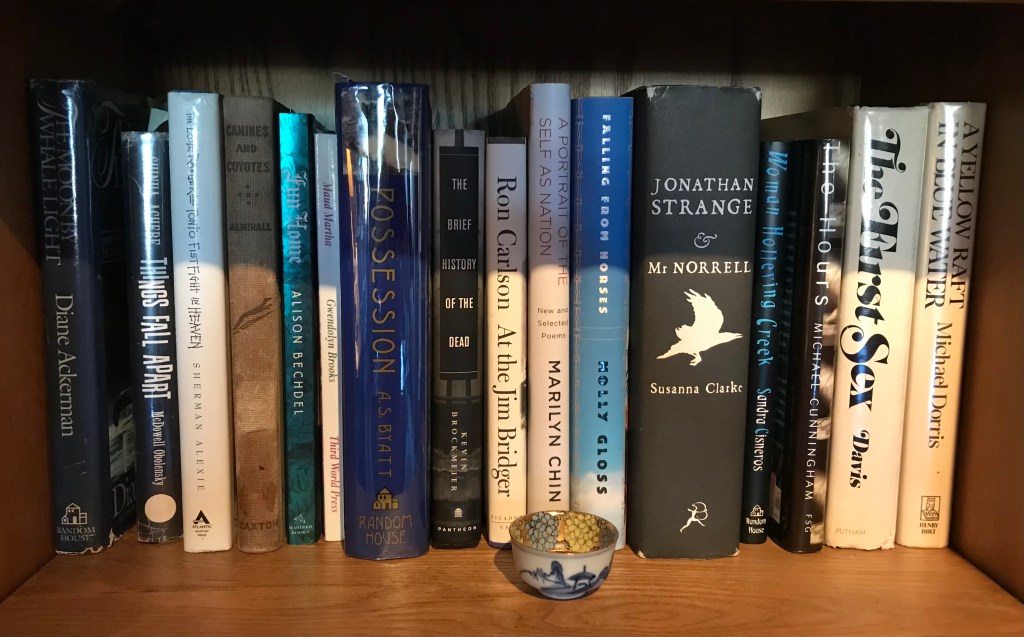
I pledge on Goodreads to read 52 books each year but generally read more. (I actually read 33 from TNYT list, but I didn’t like them all.) My list of “bests” is almost entirely different.
For years, most of my life, I claimed I’d never been sexually assaulted, and I even believed that was true. I’m angry about it now. And even so, I get it.
“We say of some things that they can’t be forgiven, or that we will never forgive ourselves. But we do—we do it all the time.”
—the last line from Munro’s last book, Dear Life (2013)
I suspect that Alice Munro had been abused herself, most women of her generation and before were [and mostly still are], and she accepted the inevitability of just getting on with life. I’m not making excuses for bad parenting here, but I keep reading younger people and men condemning Munro as if she’d been the abuser herself. She officially found out about the abuse when her daughter was 25. Her ex-husband found out when their daughter was 9 and told no one.
All sympathy with their youngest daughter.
Jenny Munro, daughter of the 2013 Nobel Prize Laureate in Literature Alice Munroe of Canada, receives the Nobel Prize in her place from Sweden’s King Carl XVI Gustaf, during the Nobel Prize award ceremony at the Stockholm Concert Hall in Stockholm, Tuesday, Dec. 10, 2013. The Nobel awards are always awarded on Dec. 10, the anniversary of Alfred Nobel’s death in 1896. The prizes for laureates in medicine, chemistry, physics, economics and literature are awarded in the Swedish capital Stockholm, whilst the Nobel Peace Prize is awarded on the same day in Oslo, Norway.—FRANK AUGSTEINContinue reading →
Okay, “hate” is too strong. We have mixed feelings for a holiday we both loved as kids. Now we are aware of dangers to our health, sleep, and wildlife. We have legitimate concerns about injuries and the risk to property. We won’t even pretend that the people making all this noise care what they are doing or know how to do it safely.
Gary set up a decoy fort on the sand out front (we don’t go out on the 4th anymore) in order to, hopefully, discourage tourists from building a fire against a new huge drift log. (It’s illegal to burn drift logs, illegal to burn a fire bigger than a beach chair, and illegal to leave a fire unattended, but that doesn’t stop it happening.) This morning the robins sang, the seagulls returned, and we hope our local bats are okay.
That cloud of smoke? Toxic. Fireworks contain poisonous chemicals. Recent and not-so recent research reveals they “emit lead, copper, and other toxins” and “pyrotechnic display particles can produce adverse effects in mammalian cells and lungs” and. Search “toxins in fireworks.”Continue reading →
The first time I ran the Hood to Coast relay, I was not expecting 96° on my first leg. Six miles in the heat of day was entirely new to me. I ran in the mornings in temperatures below the 60s. But I was in the middle of my life and managed to maintain about 9-minute miles even in heat. I did see people drop on the course, and one poor runner had collapsed from heat exhaustion. Someone tried to hold her up without getting wet himself while someone else trained a fire hose on her.
After the residency I feel a little bit like I’ve had a firehose on me for a week. Yes, that tired. But good too.
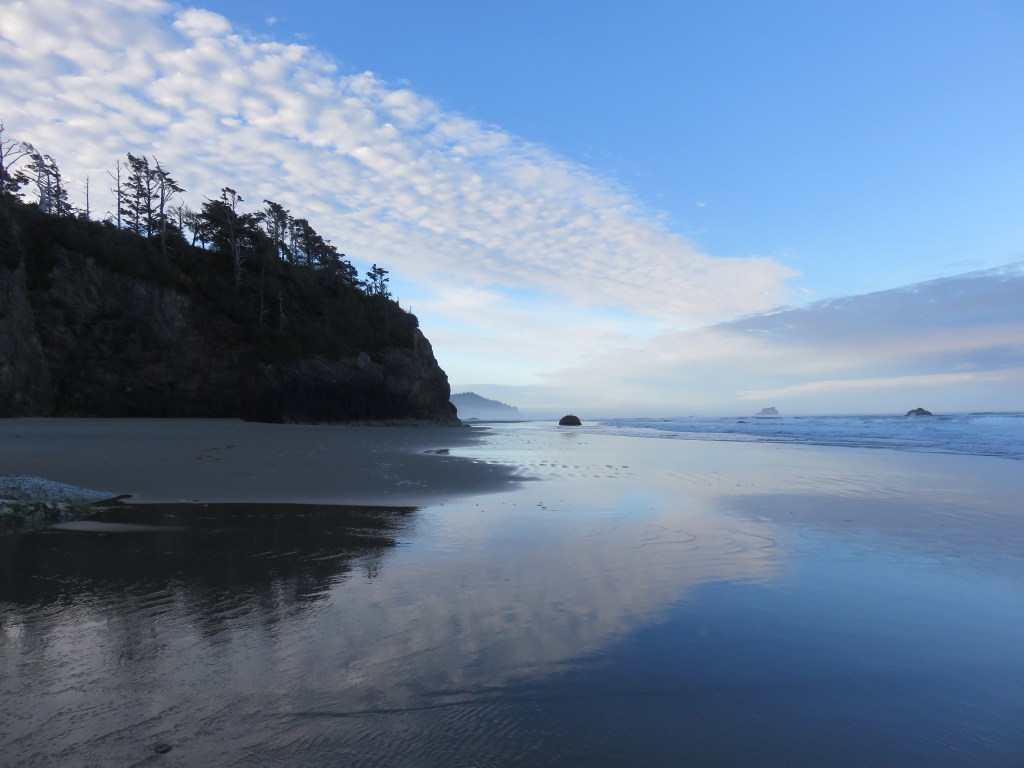
I know most people prefer the sun, but I was grateful to find beach weather when we got home! It’s restful weather.
The first time I ran the Hood to Coast relay, I was not expecting 96° on my first leg. Six miles in the heat of day was entirely new to me. I ran in the mornings in temperatures below the 60s. But I was in the middle of my life and managed to maintain about 9-minute miles even in heat. I did see people drop on the course, and one poor runner had collapsed from heat exhaustion. Someone tried to hold her up without getting wet himself while someone else trained a fire hose on her.
After the residency I feel a little bit like I’ve had a firehose on me for a week. Yes, that tired. But good too.
I know most people prefer the sun, but I was grateful to find beach weather when we got home! It’s restful weather.
The first time I ran the Hood to Coast relay, I was not expecting 96° on my first leg. Six miles in the heat of day was entirely new to me. I ran in the mornings in temperatures below the 60s. But I was in the middle of my life and managed to maintain about 9-minute miles even in heat. I did see people drop on the course, and one poor runner had collapsed from heat exhaustion. Someone tried to hold her up without getting wet himself while someone else trained a fire hose on her.
After the residency I feel a little bit like I’ve had a firehose on me for a week. Yes, that tired. But good too.
I know most people prefer the sun, but I was grateful to find beach weather when we got home! It’s restful weather.
In case you are unfamiliar, this is what in 1850 the British called a “monkey-puzzle tree” and some Native peoples called pewen (scientists call it Araucaria araucana), which is native to central and southern Chile and western Argentina. Because it resembles prehistoric species, it is also sometimes called an “animate fossil.” It has long been a seed-grown garden tree in west coast US gardens, including Seattle, where I spent most of my childhood and knew this tree as a child. It is usually dioecious, with the male and female cones on separate trees. Midway up and nearer the top in the photo are the cones that, on female trees, produce seeds similar to over-sized pine nuts. These seeds have been gathered and consumed by indigenous peoples through the millennia, and the trees themselves are sacred to some indigenous Mapuche. The Chilean pine has been protected in Chile since 1972. All logging was banned in 1990 and its conservation status was listed as Endangered by the IUCN in 2013. [The species is protected under Appendix I of the Convention on International Trade in Endangered Species (CITES) meaning international trade (including in parts and derivatives) is regulated by the CITES permitting system and commercial trade in wild sourced specimens is prohibited.]
Several of my students went on to Pacific University, but that is not the reason I am fond, of course. Today is the last day of events scheduled for the MFA residency.




 IMPERFECT PATIENCE