An imperturbable demeanor comes from perfect patience. Quiet minds cannot be perplexed or frightened, but go on in fortune and misfortune at their own private pace like a clock during a thunderstorm.—Robert Louis Stevenson
I was reading an article about why older people need more friends and suggestions about how to find them (do something different, take up a hobby or join a club) when a woman we met on the beach a couple of times this week and chatted to, rang our garage doorbell and offered her contact information.
Life is wonderful that way sometimes. Full up with wonder.
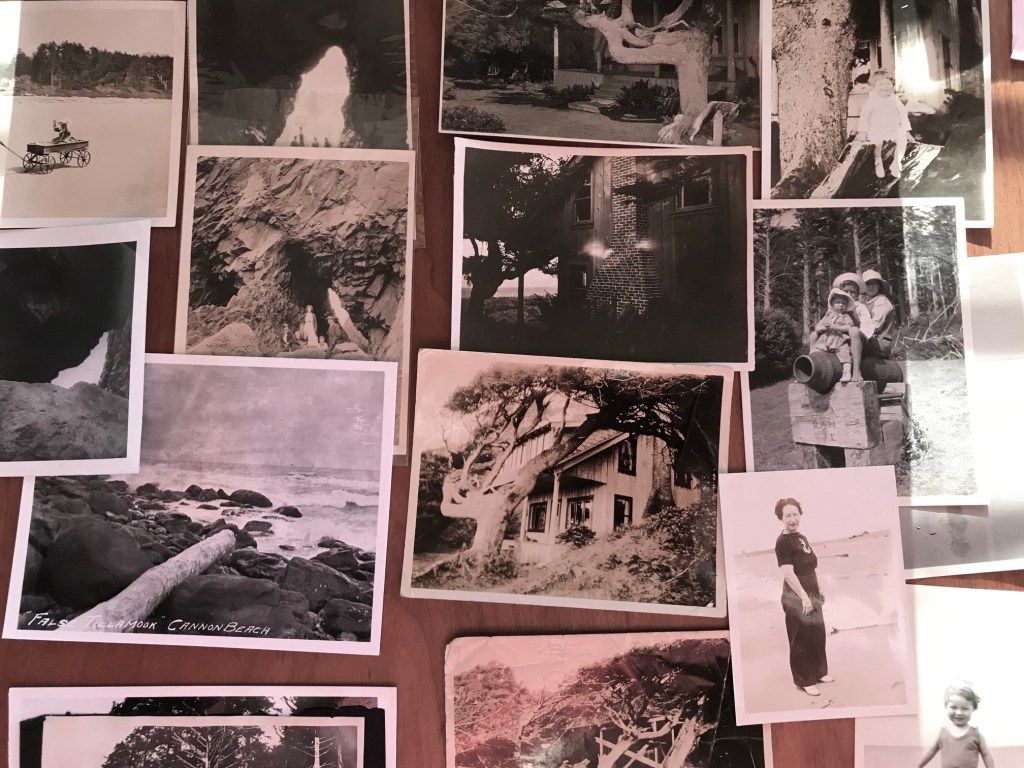
Early snapshots from my family’s summers at Arch Cape. One at left is dated 1913 when this was still called Cannon Beach. In the middle is the old “beach house” my family used Memorial Day to Labor Day until the 1940s. At right is the first cannon found onshore in 1846 (rediscovered in 1898 according to Wikipedia), my grandmother Fay Fletcher Jackson Smith just after the Great War, and my Aunt Marcia as a toddler in 1925. Gary insists we sort them all by the end of summer. He warns: “It’s going to take weeks.”Continue reading →
When I was showing dogs back in the 1970s, we had an unpopular bloodline, an unpopular “type” of Afghan Hound. Our dogs were descended from early imports out of Afghanistan and specifically from a Dutch kennel, van de Orange Menage of Eta Pauptit who was a horsewoman to start with. She cared about soundness. She insisted that her dogs be functional. Their feet and frame, the musculature and minds of dogs from the vdOM kennel were consistently tough. They were smart during a period when Afghans were being bred to be flashy. Sturdy when during a period where breeders were choosing fine bones and narrow heads, what a local breeder bragged was “swan”-like.
Our dogs were strong.
I’m not certain who this is, he’s not one of our pups but what most of ours looked like at five or six weeks. The black edging mostly grows out, leaving a black-masked red dog. Gary’s dog Manny looked like this. Grown, he had ears red as an Irish Setter. In the afghan I crocheted out of different colors of Afghan hair, it’s easy to pick out Manny’s ears. While a black mask on an otherwise red or gold or cream dog was the typical color of early Afghan Hounds, it wasn’t trendy when I was showing dogs of that color.Continue reading →
I took guitar lessons in my teens, and that was a long time ago. The late 60s. I still have the guitar, an unusually sweet Aria nylon-string that I haven’t played in fifty years. Gary cares for it. My lessons from Cathy Mack at Shoreline Music focussed on Childe ballads that Joan Baez was singing. I could finger-pick along with singing “The Trees They Do Grow High” and “The Cherry Tree Carole.” Anyone could play “the House of the Rising Sun” and pretty much every garage band of the day covered that one, though it really only made sense with a woman singing it.
Somehow, that brings me to “Jolene.”
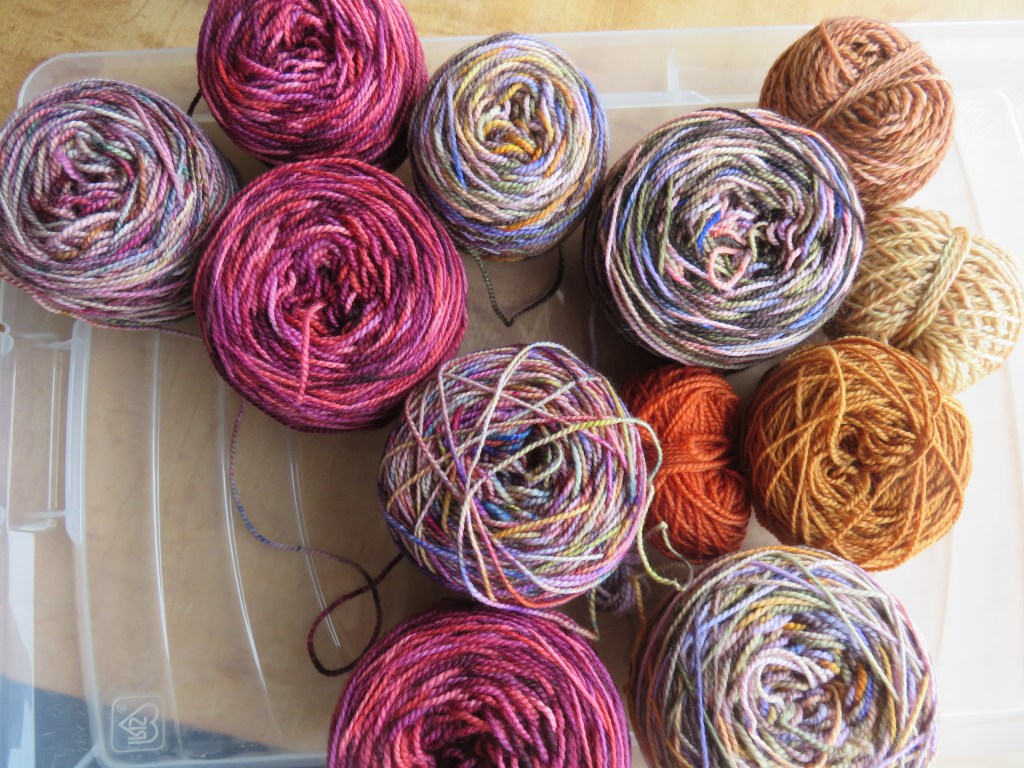
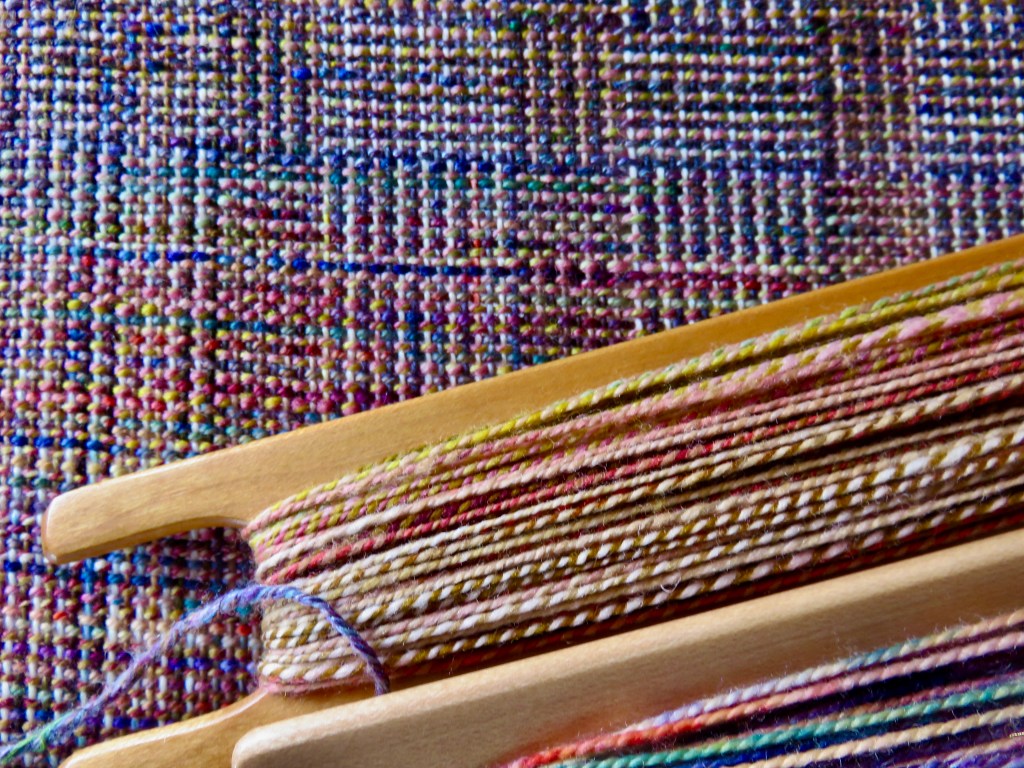
Here are the skeins for the next warp I’m winding. The “Rose Petal” warp is Koigu, which, despite my efforts to find something else, works best as warp and fringe. I’m not sure where that leftover bit of bittersweet orange will land. The weft will be almost entirely handspun. My goal over the last couple of years has been to weave down my stash. I had eight medium bins and a large one. I now have just two medium bins left plus handspun, and I am highly skilled craftsperson in my weaving, not an artist.Continue reading →
During my next-to-lastone of my MFA residencies an Advisor commented, to me and another student, that he thought people who believed in the Bible were “stupid”. Though I am not a literal believer, I was both shocked and offended. “It is a beautiful and important book,” I think I said, though this was seventeen years ago, “it contains wisdom. Have you even read it?” Religions always reflect wisdom, definitions of right and wrong, warnings and promises. There is ample evidence that most people and in all times have believed in truths beyond themselves and personal experience. It is not the only reason most of the characters in my novel are clearly people of faith.
When I was a girl and at least into my teens the conventional wisdom and current science contended that only “man is the toolmaker” and this capacity distinguishes human being from the “lower animals.”
That definition changed. Wikipedia: “Nearly all chimpanzee populations have been recorded using tools, modifying sticks, rocks, grass and leaves and using them for hunting and acquiring honey, termites, ants, nuts and water.” Awareness of that toolmaking ability among chimpanzees was demonstrated in work of primatologist and anthropologist Jane Goodall, a fact Wikipedia notably fails to note. She corrected what we thought we knew about humanity.
I had thought I would stop running after last year’s Bridge run—a 10k over the Columbia River. But even before I completed that run, slower than I’d hoped, I knew I wouldn’t stop. I love running and I’ve missed it terribly in the past when injury kept me walking. Then, after nearly four years of perfect health, Gary and I went to a movie in a theater last month and caught Covid. Coming back has been tough. So I began to wonder if quitting was coming up on me, like it or not.
I got my regular 2-mile Friday run last week in Portland. More than half that run is downhill, but though my route varies it generally begins and ends on an uphill slope. That was the second time a homeless Black man has paused long enough to tell me “good job!” He said he’d run marathons and missed running but had injured out and most recently been told he would be able to run again. I hope he does.
The poet William Stafford made a 3-mile run part of his morning writing routine. He’d run, come home to write, including an aphorism and a new poem every morning, and then use the rest of the day to revise and do whatever we people do all day. I used to hold out his example to myself. Stafford didn’t write a good poem every day of the year, but by the end he had 365 drafts to choose from and the odds were in his favor that he’d find good ones worth revising. It’s one reason he was as productive as he was with 20,000 words of daily writing and a truly astonishing list of publications. Wikipedia: “The morning of his death he had written a poem containing the lines, ‘ “You don’t have to / prove anything,” my mother said. “Just be ready / for what God sends.” ‘ ” Have a look at his book about writing, Writing the Australian Crawl. I have it somewhere here or there and first read it in 1990, three years before his death, which reminds we that I wasn’t yet running in those days.
Running is easier than waiting, and right now I am waiting to hear about my novel submissions. I reordered and revised that novel three weeks ago, six years on since I began writing it. I informed two presses that I had a new and better draft to share. One promptly wrote back: Yes, please! Then I withdrew all the submissions I could find a way to withdraw. A handful are still out there. I have a half dozen presses on my to-submit list when they open to submissions. One of those opens in January of 2025 and it is a favorite small press from way back. Another closed to submissions for this entire year and I don’t know when or if they will reopen next year. A friend in Seattle is a few months behind me in the same process.
It all takes time.
On April 1st, a crew is coming to tear out a wall of our bedroom condo as part of the process of repiping our entire building. The work won’t be completed before summer. In the mean time I should be knitting but I have recently spent hours completing the “Dusk” warp in two distinctive shawls.
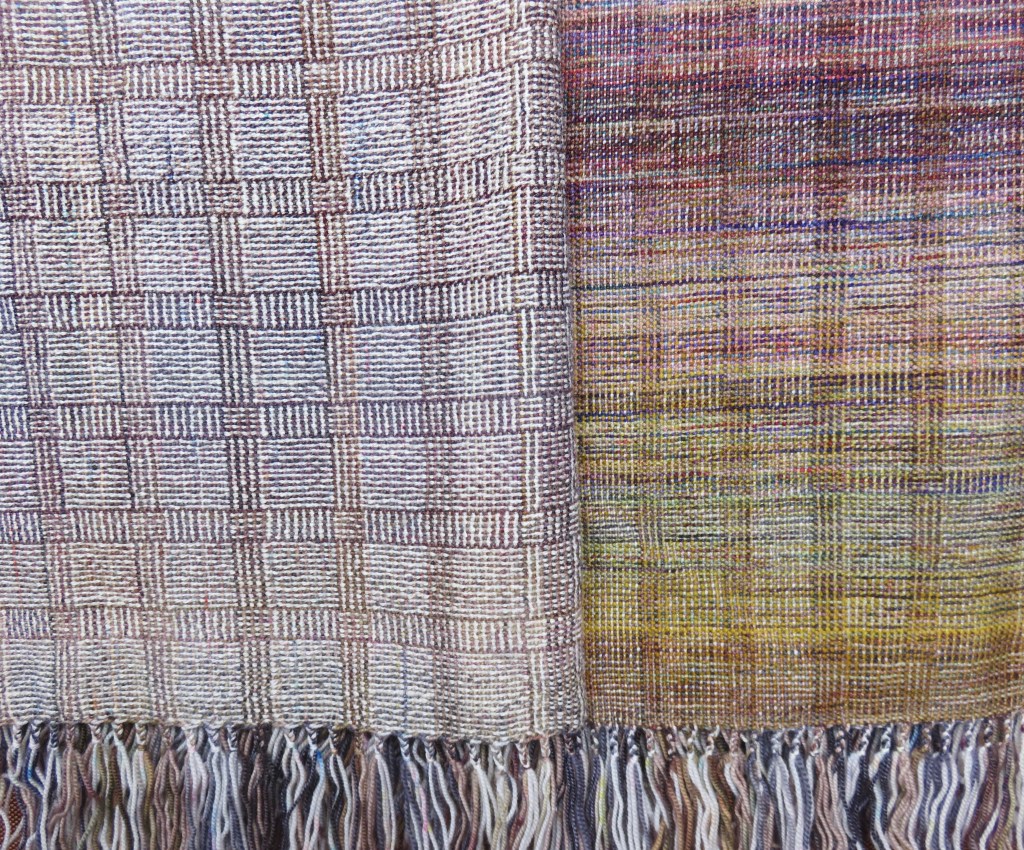
Here is the most recent work from my loom: Two shawls woven on the same hand-dyed Canadian Merino warp. The one on the left has a weft of handspun alpaca and handspun wool with some silk. The one on the right has a particularly delightful hand-dyed yarn with a handspun/hand-dyed that provides the color shifts. Both are soft, but the one with alpaca is more subtle in color and thicker and it blocked out wider than the other.
Depending on when they went to school, elementary teachers were taught different methods of teaching reading. The approach they choose in their classrooms and the terminology defining it keeps changing. They are given a package to teach, proscribed minutes to devote to this effort, and schools often pay a lot of money to provide direction in the manner and method of delivering reading instruction. Every new packaging of education receives a new name. Often the new name describes something that’s been common practice in the past.
I used to call the affection education academics have for recreating terminology every few years “educationalese.” I created a satirical glossary as part of my term project for an Ed Psych class decades ago. [Persuasive writing has had several names over the years: persuasion, argumentative, position paper, essay, etc. It’s all the same thing. You’ll find my glossary below.] Since I mostly have taught high school students, my focus was on writing. In elementary school there is open warfare about how to teach children to read.
Educators around the country have embraced the “science of reading” in their classrooms, but that doesn’t mean there’s a truce in the reading wars. In fact, controversies are emerging about an important but less understood aspect of learning to read: phonemic awareness.
—KQED
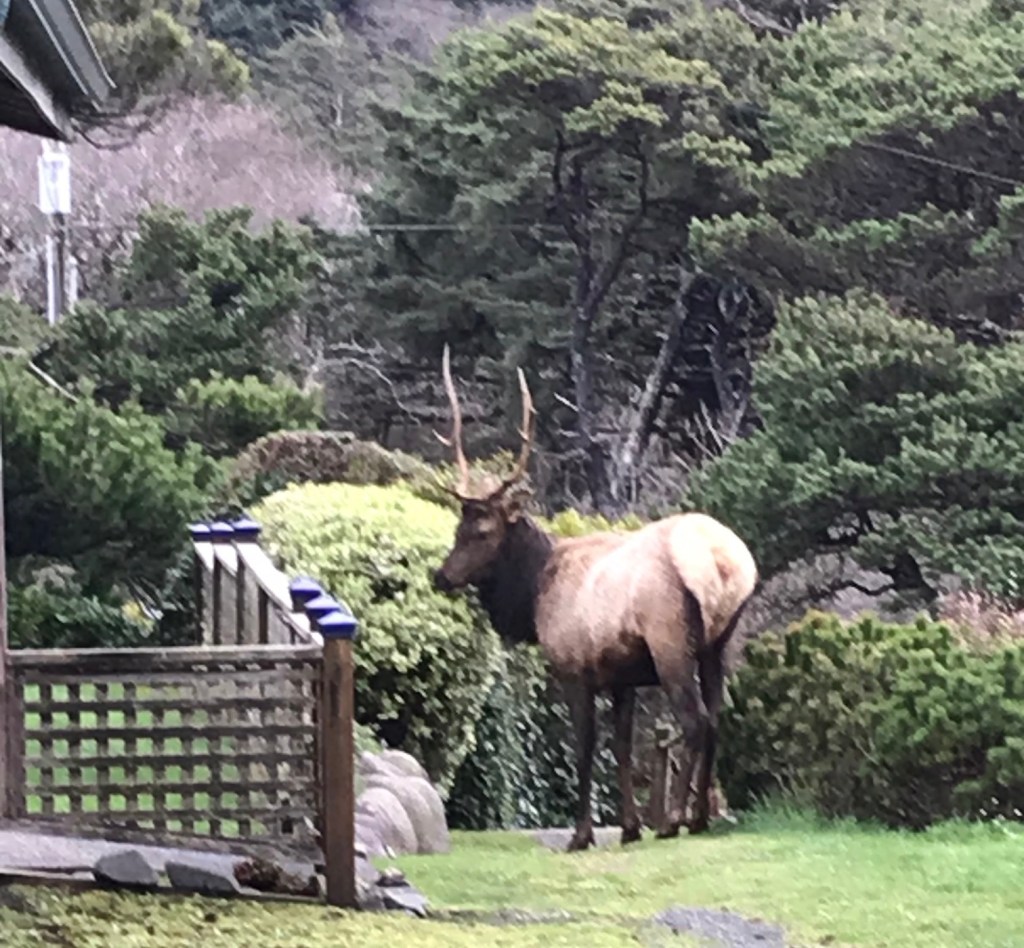
A bull elk that has recently taken up residence in our neighborhood. Gary was standing outside the garage talking to our immediate neighbor Patrick when this fellow walked out of the wetland north of us and crossed over to the yard across the street. Later in the day he is seen chewing on a hedge a few houses away. Yes, Roosevelt elk are big, the largest elk in the world.Continue reading →
Yesterday I shared a meme on my newly revived Facebook page. My friends “liked” or “loved” or “cared” that post. The meme contains a great story. I loved the story and appreciated the “truth” of it at first. But then I thought. The problem is that while the story may or may not be fiction, it certainly contains a lie.
“Lies, damned lies, and statistics” is a phrase describing the persuasive power of statistics to bolster weak arguments, “one of the best, and best-known” critiques of applied statistics. It is also sometimes colloquially used to doubt statistics used to prove an opponent’s point. The phrase was popularized in the United States by Mark Twain, who attributed it to the British prime minister Benjamin Disraeli.
—Wikipedia
A double rainbow over the ocean: the fact is a splintering of light passing through mist. My opinion is “Beautiful!”
I’ve been thinking about lies and opinions lately. People have lied to me, of course. My parents lied about Santa Claus and the Easter Bunny and I figured that out when I was five and bore them no grudge. People admire and nod in response because they think that is polite of them. I might not even want to hear the truth, but I am grown up now and almost never want the lie.
Just yesterday a workman lied to me about transgressing onto our property. And I understood his reasons. He is not well-paid and needs the work and has been told to make nice because my husband is furious about something that had they asked he probably would not have minded.
I have made New Years Resolutions since I was young, really young. I weighed 114 in high school, but most every year my goal was to maintain that weight, or often to lose weight. And I did it after my first child but not the second and not ever again. Soon I had more important goals, more pressing concerns, and more significant ideals than my weight.
I baked my very first chocolate babka today, January 1st. Without a recipe! Half the twisted loaf was gone inside five minutes and there were only the two of us! This is not on my list of goals for 2024.
This story began with a classroom assignment I gave to my students. It was to be very short, but I revised and revised, it became very long, and then was cut back according to the recommendation of two of my best readers.



 IMPERFECT PATIENCE