Died in Portland three years ago today, 22 January 2018 in Portland.
Gary and I attended this memorial on 13 June 2018. Listening to Molly Gloss talk about her early work with Ursula made me cry all over again.
•
•
•
Gary and I attended this memorial on 13 June 2018. Listening to Molly Gloss talk about her early work with Ursula made me cry all over again.
•
•
•
Gary is downstairs listening to a CD from The Searchers, his favorite group from the 60s (they were still playing a year ago). I have spent several days working on a poem for a local event. (With my luck they will not like it, but honest, I couldn’t write a cheerful “pandemic” poem. Others will.) As I sent it off as an email attachment I had word that the gallery is taking down the show the end of the month. They did not sell anything of mine (or from two other people). Yes, disappointing. But the poem . . . here’s the first stanza:
 Birds fell from the sky this past
 summer, a warning as defiling as riots
 and bloody marble, the risk of living
 in dangerous times when all times
 prove dangerous.


A year ago, a hug was just a hug, but now it is a wonderful, a marvelous thing.
Times change, and our needs change too. The BBC interviewed the author of The Boy, the Mole, and Fox, and the Horse in a video, and I am reminded how this slim book touched me when I first read it.
Some dismissed the book as empty calories, as saccharine and forgettable. I didn’t agree when I first read it a year ago. I disagree even more today. As a former student wrote yesterday: It’s been a year.
It’s been a year of illness and isolation, of struggle for many people working in dangerous conditions and without loved ones nearby, of honest words struggling to be heard.
This is one of those books like Winnie the Pooh and The Arrival and The Wolves in the Walls that I wish everyone read.
“Sometimes,” said the horse.
The Boy, the Mole, the Fox and the Horse
“Sometimes what?” asked the boy.
“Sometimes just getting up and carrying on is brave and magnificent.”
by Charlie Mackesy
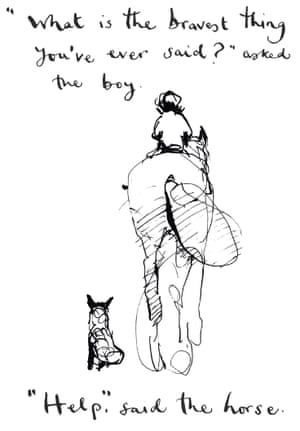
We could all use help about now—or those of us willing to ask.
There is no story here, but many gentle words of wisdom. And a mole who eats all the cake and then it happens again. And a fox. And a horse.
When I was young there were inspirational books all over the place with seagulls and kindergarten. This is like that or better. And the illustrations!
Yesterday, a neighbor’s dog went astray during their walk. We could hear Tim calling and calling. Gary said, “I hear his tags—he’s that way.” Oscar had turned up a side street toward the highway. We could not see him, and I could not hear a thing, but Gary has better ears. He found Oscar in a yard fifty feet from the highway, walked around and shooed him past me. A minute and Oscar heard Tim’s call and went running. It was a good day.
Our sons were both musical in school. Choirs have become particularly touching to us. Another sort of faith from mine, but it speaks me:
The first time he hit her was three weeks after their wedding. She didn’t leave him, she said, because she could not face telling her mother she was right that he was a mistake. Her husband didn’t like her working, so she worked only when he was at sea and had to quit whenever he was home. He made her return the sofa she bought with money she earned. Every once in a while, he beat her up. It was always her fault. I don’t know if their daughter was aware of those occasional beatings, but she left the country for college and never went back.
Another woman I knew did finally leave her husband, packed a quick bag and drove her children away across two states to her brother’s home. There had been beatings, threats. He didn’t like her working. It was always her fault. She called a crisis line when she came home to find all her work clothing cut into pieces on their bed. The crisis worker told her that was a rehearsal, that she would be what her husband cut next, that she should go someplace he could not find her. She discovered during her divorce that he had put his first wife in the hospital. She hadn’t even known he’d been married before.
A woman I did not know was married to a local doctor. Maybe he beat her, maybe he was unfaithful, maybe he was cruel in some other way. I don’t know. I trust she had her reasons for what she did. She left him, moved away, divorced, and began a new life. She came home from work on a day that was not one of his days to see his children, to find he’d murdered both of her daughters and killed himself. His reasoning was to punish her and leave her with nothing.
For years I tried to understand how anyone could come back from that?
People make mistakes. Maybe you could share a few stories of people who suffered from their mistakes. Maybe you have a story of your own. My marriage has been my salvation, but I have made plenty of mistakes.
Everyone falls. Not everyone gets back up and carries on.
I wrote a novel about a woman who makes a bad marriage, but eventually leaves, suffers unbearably, and then must find a way to walk on through life without her daughter. I’m not certain I could do what my fictional character does, I am not certain I could recover. I wrote the novel to figure out how to do it.
My book, variously titled Everybody’s Mother Dies, The Promised Hour, and Painting Over, is not structured like a conventional novel. The bad stuff happens early and through the middle, but that’s not what the story is about. Everyone’s mother dies, everyone experiences loss, everyone makes mistakes. Mine is a novel about what comes after tragedy. It is the story of a woman taking a day at a time, placing one foot in front of another. Maybe that is where we are all going to be in the next year: figuring out how to get on with our lives.
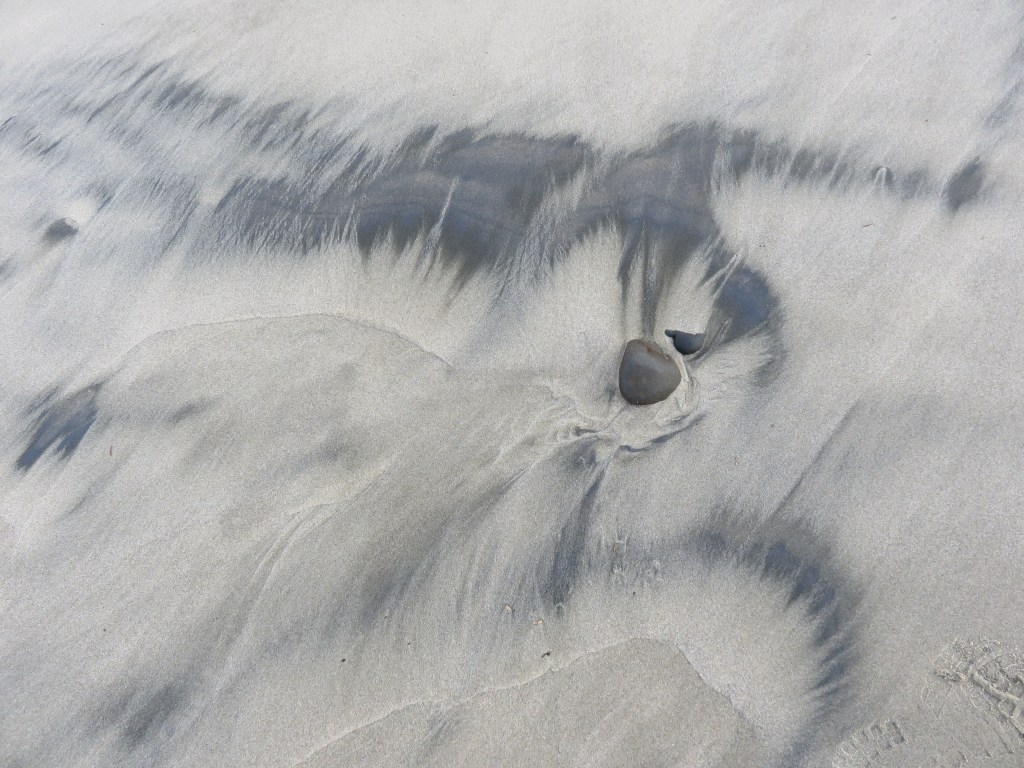
Have I mentioned recently how much I still miss my mom and dad?
•
•
•
We Met a Deer

 We met a deer beside the wooded trail
 over the cape and east of the highway.
 I used to walk that way with my boys
 when they were young and eager.
 It is a long walk for a five year old.
 Miles away.

 Was it even possible to walk home
 the way we’d come? We never did.
 We returned north on the highway
 and through the tunnel, a scary path
 for any age. By then we were exhilarated,
 high on adventure and adrenaline, and eager
 to get home.

 The deer was afraid in her forest. She stood
 silent, still, breathing the same air we held
 in our chests. She willed us not to see.
 We stood still, silent, on the narrow trail
 above her. We watched, holding breath.
 We had been climbing for only a short time,
 up the north slope among alder trees,
 a lighter green than the spruce and hemlock
 we would find higher still.

 There is no leveling off
 on that early path,
 it is all up, then steeply down,
 always up on the right
 as we climb. Moss, ferns, mud,
 the dripping moisture.
 Then the Dark Fortress.
 Here at the crest, the land
 slopes steeply downhill
 on our right. Dry. The path
 nearly level. Evergreens
 grow darkly close together,
 like a crowd of giants’ legs,
 like a maze of massive pillars
 grown black and silent.
 We are near the ocean,
 a hundred meters above
 the highway, but while we stand
 and listen, we hear nothing.
 The ground is thirsty here
 and deep in duff, the dead
 needles of the spruce
 and hemlock trees, dropped
 a thousand million times,
 over a thousand seasons.
 Silent.

 The deer stood silent as if
 her stillness might make her safe.

 And then she turned her head,
 was gone.

 We moved on ourselves. We climbed
 and counted mushrooms. We walked up
 and up and up past creeks and perching birds
 and then through darkness, quiet,
 and finally down and down and down
 and through young alders to pavement
 again. We had listened for the highway,
 for the ocean, for the sound
 of our own footsteps, my little boys
 and me. Everything so still
 and far away. Quiet,

 until we are safe at home, and all
 our chatter and heat returns.
 Milk and brownies as reward
 for our long walk. “And we saw
 a deer,” they say.

 It was years ago. Perhaps my boys
 would not recall that day.
 They are grown men and too far away
 for me to ask.


•
•
•
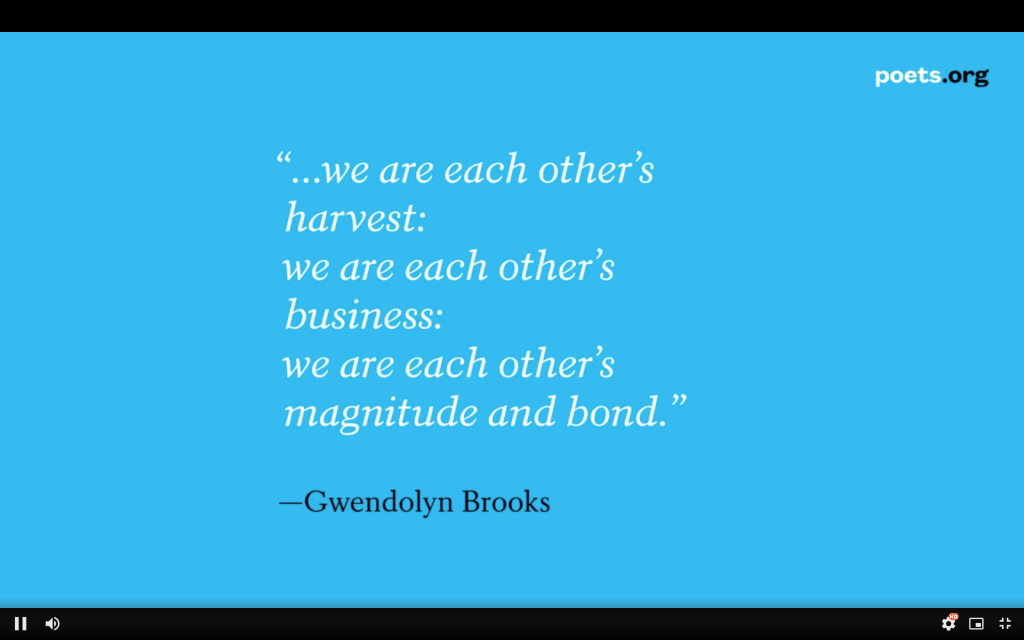
The Academy of American Poets offered an event of poets reading their favorite poems by other poets. Joy Harjo hosted the hour and over four thousand people logged on the hear them live. You can listen my clicking the link in the caption. The meme above is merely a screenshot.
Without Poetry, we lose our way.
—Joy Harjo, U.S. Poet Laureate & Academy of American Poets Chancellor (2019– )
Spring Morning

When it is cold enough at night,
spring's strawberries are sweeter
in the morning.

In the morning I woke before
the sun blushed all across
east and west, a gathering

warmth slid around the Cape
and over Tillamook Head.
Before hard day pushed past,

pink dawn had trailed her fingers
all round the sky. In the morning
I bent to berries'

green tipping over into red.
In that morning, red juice
ran down his chin.
•

Even though I’ve already made the herbed dressing, wild rice and mushroom casserole, twice baked potatoes, cranberry bread, pumpkin pie, I still have to make the Waldorf salad and roast the Brussels sprouts. I bought a wild fillet of sockeye salmon. We will eat flesh this day, our only seafood or meat of the year. I will pan-poach with lemon, garlic, butter, and wine. Or maybe with soy sauce, ginger, toasted sesame oil, and garlic . . . Gary seems to find it funny.
Anyway, I prepared most of this post a couple of days in advance because I didn’t want to be too busy. The holiday cards are all addressed to go out on Monday. I mean to slip handwritten notes into a couple of them. (I always mean to do that and never do.) A few gifts going to people far away are waiting to be wrapped and boxed for mailing. On Sunday I deliver a dozen shawls to the gallery in Manzanita. We have not driven there even once this year!
This morning I found an email from a small yarn company that has gone completely, and successfully, online this year. They offered a long list of of thank-yous to many specific people. The list ended with thanking their customers, like me. But it was the first block of thank-yous that led me to save the email in my covid folder: “Thank you to our fellow taxpayers, Congress, the SBA, and Columbia Bank for loans and grants. Thanks to Washington State for health safety cautions and unemployment benefits, and to the Kitsap Economic Development Council for weekly seminars on how to cope with COVID.” They are optimistic about their future. “Because of you, we are back on our feet, getting stronger, and feeling more determined than ever to make this a 100-year company. Only 80 more years to go.”
Well, I feel gratitude too. Thank you here to a great many people who read my blog, who respond to particular posts, ideas, and questions.
Most of the people I have known in my life have given me something good to keep. Just among my teachers I treasure studio skills and experiences from Del Hansen and Bob Gee when I was still a girl, and thoughtful perspective from Darlene Sherrick and James May, and serious artistic growth with Patti Warashina and “Jack” Marshall and Howard Kottler. They changed my life. Sherrick chose me for Honors History. Harriet Koenig stepped in three times to turn my life: a Design class, a conference, my first teaching job. Thank you.
You are probably avoiding the news, but an architect designed a prank Trump website, and this page is my favorite: https://djtrumplibrary.com/portfolio-item/tax
Happy Thanksgiving! Humor is back!
•
•

Today on Brevity‘s blog, Lindsey DeLoach Jones illustrates “The Lost Art of Pretending: Imagining a Positive American Future” with her daughters’ play. Only by imagining what is possible, can we work toward a positive goal. Her idea of pretending focuses on our need for a “robust moral imagination.”
“We need a collective imagination like the one Martin Luther King shared at the Lincoln Memorial in 1963. King insisted, “Let us not wallow in the valley of despair… Even though we face the difficulties of today and tomorrow, I still have a dream.” At his core, Dr. King was a writer. His dream speech was wishful thinking, yes, but it was backed by action, protest, force of will. One man’s private imagination had untold constructive consequences in the real world. We seem to think we have outgrown this kind of thinking, that hope is for suckers. But to abandon the project of pretending is to abandon any hope for improvement.”
Lindsey DeLoach Jones
•
•
•

Today would have been her 91st birthday. Ursula K. Le Guin was born in 1929. I just read through the story collection, The Wind’s Twelve Quarters, which contains Le Guin’s earliest work and “The Ones Who Walk Away from Omelas.”
We do need her now.
from Brevity January 2018:
As soon as I open a document and before I begin typing, I select ‘Layout’ to indicate margins on my page. The guidelines do not show when I print, but they help me know where I am as I write.
Ursula K. Le Guin helps me know where I am.
She is not gone.
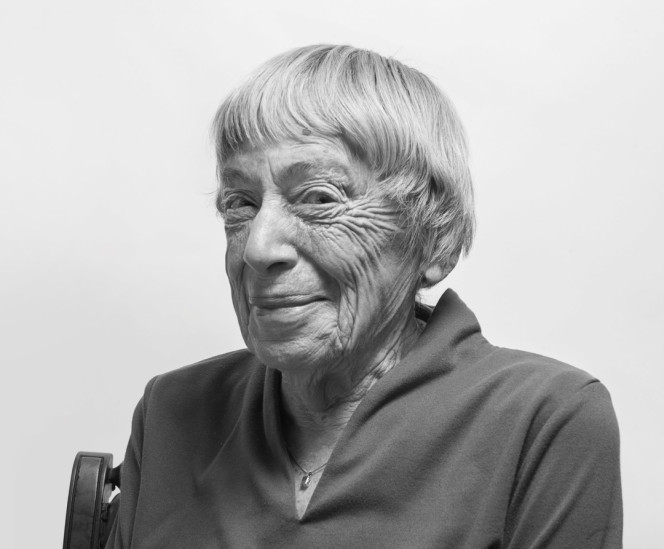
The obituaries are respectful. They list her more obvious accomplishments—the awards, the publications, her activism and generosity to other writers. They want to label her a “popular fantasy” writer, though these are not terms she would have chosen. “Why Are Americans Afraid of Dragons?” she asked in 1974. We dismiss what we consider “unrealistic” in our country, but that is a mistake. In the hands of a philosopher with substantial anthropological credentials, essays and poems, novels and stories are not escapism but challenges to our imagination.
For more than twenty years, I began my Junior English classes with Le Guin’s “The Wife’s Story” (1982) from Buffalo Gals. I read the five pages aloud, and then we talked about the nature of betrayal until the bell rang.
That most famous story, “The Ones Who Walk Away from Omelas” (1973), provokes questions: Would readers walk away or stay in paradise. Are we willing to allow another pay for our perfection? They are troubling questions, but contain another, underlying moral assumption: Must someone pay? In our superstitious faith in balance, do we demand another’s pain for our pleasure?
She gives us the suffering child in the basement because we insist that child exist.
“If you cannot or will not imagine the results of your actions, there’s no way you can act morally or responsibly,” Le Guin said in 2005.
My husband was standing at an information desk in Powell’s Book Store, a couple of years ago, when he recognized Ursula coming up the wide stairs and duck around into the Purple Room.
“There goes Ursula Le Guin,” he said to the millennial behind the counter.
“Who?”
We laughed about this again just the other day. Young sales clerks being what they are, they will learn.
Imagination is not mere child’s play, it is the only way we pursue what is possible, what is grand and just and beautiful.
She should have had the Nobel. She should have lasted longer because we need her here. We should have appreciated her more while we had her. My deepest sympathy to her family, her closest friends, and to all the rest of us.
___
Jan Priddy took classes from Ursula K. Le Guin, took tea in her Cannon Beach kitchen, ferried her to readings, and attended Jane Todd’s writers’ book club where Molly Gloss sat on her right, Ursula next, and Cheryl Strayed on her left. She read her books. They both had two years of Latin in high school and loved the beach.
Crime tenting cities—my side,
your side, my vision, yours.
Sometimes there is a right side.
Sometimes truth clamors beside
us, riding our hearts, crying,
crying in the night to be heard.

In the sweating darkness,
the red lights scream brightness
against the tender stars, the sirens
and screaming, sweat dripping
salty into open mouths,
their righteousness unbolden.

Is there never a time when violence
does not excite, when tears
fail to touch the rim of our glass?
Everything shatters, everything ends,
is that the truth we long to hear
or the angels of our better nature?

So dear to clearing fog, a mist
rises before us as we walk north,
and to the west there is a stone at sea,
a waiting monument to patience,
a vision, a warmth of community.
Our witness crowds the horizon.
•
•
•
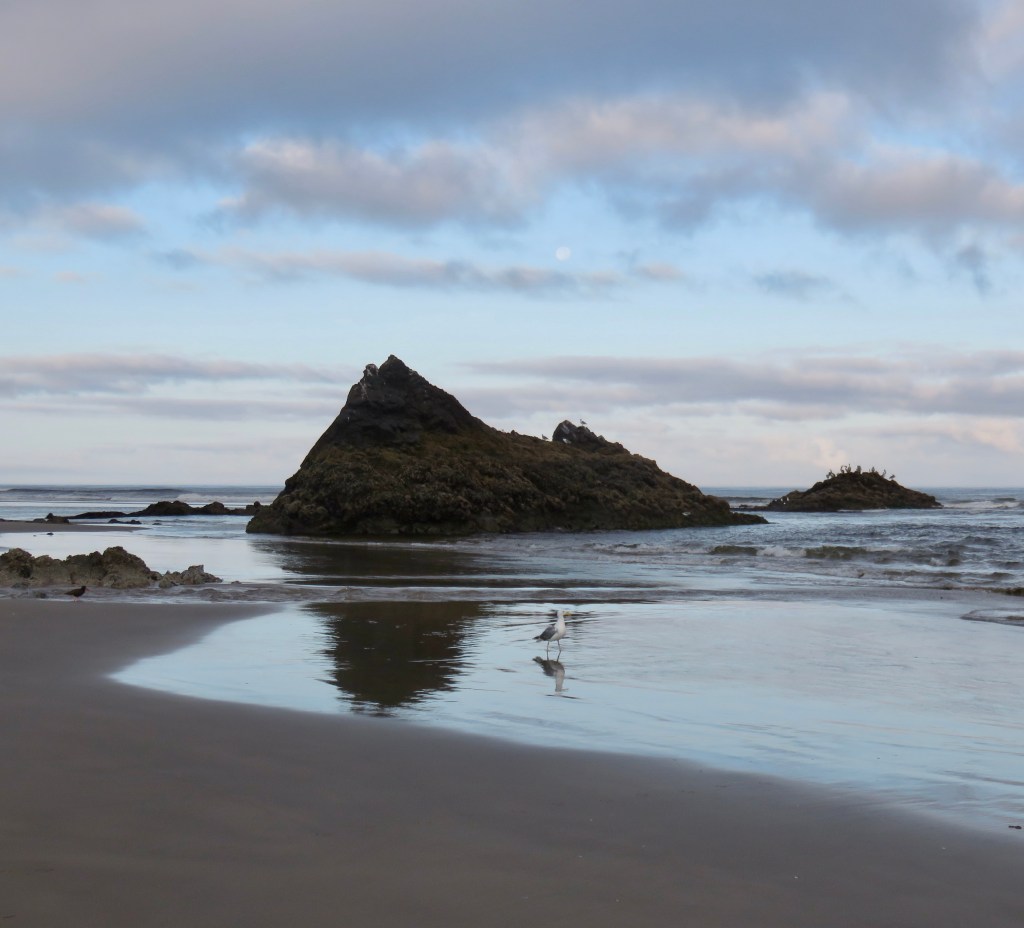
I created this “TEST” with the new Editor for WordPress. I find the “Classic” version I have been using and which suited me perfectly has lost function.
Continue reading IMPERFECT PATIENCE