FOOT by FOOT

Everything is blooming here, other than things that are already nearly done blooming. In the front yard the wild roses and rhododendron and irises are done, but Pink Grootendorst is still setting new buds and so is my favorite double white rugosa. The honeysuckle and salal are still in flower, and the ceanothus is covered in bees, and the other flowers are getting close to opening. Lucifer looks like it will pop a week or two early this year. [I try not to notice the red lines under three botanical names my computer thinks I’ve misspelled.]

The northern half of the front garden. There is a massive lacecap hydrangea at the south that you can’t see. It’s covered in green buds that, in a few weeks, will open up to blue. The richly scented Blanc Double du Coubert and another highly scented pink single are out of the frame too. Three clay pots, two with herbs, and one with a volunteer viola that’s come back for years. We continually fight the ivy and the neighbors’ invasive single red rugosa rubra.
Continue reading →

LOW TIDE

Decades ago now, a friend visiting with us became impatient with talk of high tide and low tide. “What does that even mean?” She was genuinely irritated, as if I’d made it up talk of tides to annoy her.

So I took her to a window and pointed at the Cape: “See where the waves are hitting the headland? Remember that.” And then I literally waited six hours before taking her back to the same window and pointing again at the Cape. “See how the surf is barely breaking on the seastack second out from the headland? What you saw before was high tide; this is low.”

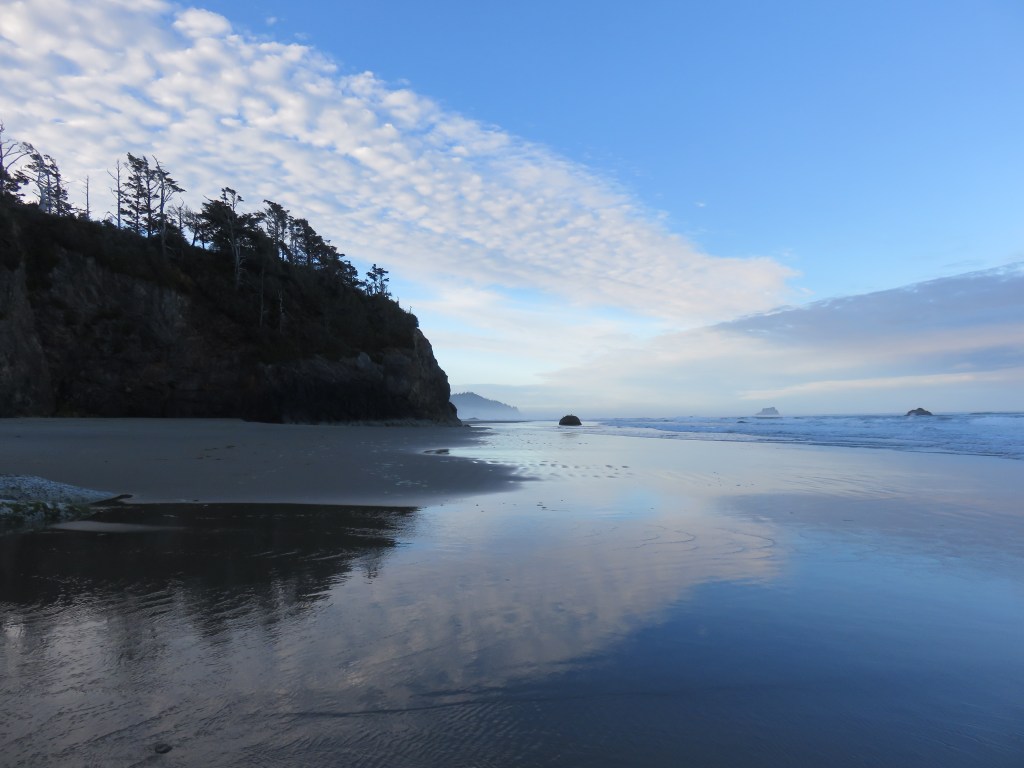
The Cape and the first two seastacks during low tide, but not very low. There are at least two more revealed during a minus tide.
Continue reading →

WHAT we think WE KNOW

The conversation turned to Kurt Cobain, and someone claimed Cobain’s wife killed him like a “typical woman” does. He said it at least twice. Beside me, my husband says he thought, uh-oh.

UNITED NATIONS (AP) — The deadliest place for women is at home and 140 women and girls on average were killed by an intimate partner or family member per day last year, two U.N. agencies reported Monday.

Globally, an intimate partner or family member was responsible for the deaths of approximately 51,100 women and girls during 2023, an increase from an estimated 48,800 victims in 2022, UN Women and the U.N. Office of Drugs and Crime said. …

By contrast, the vast majority of male homicides take place outside homes and families, it said.

But set aside murder for a moment and consider that the comment by my friend suggests that women’s typical behavior is murderous when angry, that unlike men, this cruelty(?) or destructive tendency(?) is uniquely or particularly female. That it’s typical. Well.

Continue reading →

OPTIMISM

I am at heart an optimist. I was reading books about faith and ethics while I was still a child of ten, looking to find my way toward goodness. I was taught and believed and still believe that goodness matters, that what we call goodness is something to pursue and to praise.

This is a jellyfish, the orange west coast “sea nettle”, Chrysaora fuscescens. I have seen this jelly cast on shore my entire life; it is the one my dad warned me about because they do sting like a bee. [The “moon jellies,” water jelly, Aequorea sp., are mostly colorless or blueish and I herded small ones in the water without harm when I was younger.] This one is upside down and much, much larger than any I saw as a child, though not quite as large as the one we found recently that measured more than 22 inches across. The beach is littered with sea nettles just now, mostly broken but also some whole like this one.
Continue reading →

SCIENTIFIC NAMES

Arctostaphylos ura-usi is the scientific name of kinnikinnic, an evergreen trailing plant related to the broad-leaf evergreen tree we called “madrona” when I was a girl, Arbutus menziesii, and more distantly to Gualtheria shallon, salal. Kinnikkinnik is found across North American and was smoked, though that’s not something I’ve ever tried. The name kinnikinnik, derived from the Unami Delaware /kələkːəˈnikːan. is enough to make me fond of that plant; I recall climbing a madrona when I was no more than five and tearing open a plastic packet of soy sauce to rub on the smooth red skin where the papery bark had already flaked away; and this morning, I picked and ate what are nearly the last of the salal berries on my way off the beach from a long run this morning.

Continue reading →

HEALTH care

This is not a cheery post. I am going to rant about health care. A bit. You don’t want to read my complaints. It’s what old people do, complain about their health. Except I’m not going to complain about my health; this is about my health care. In the mean time, enjoy the herons on the shore.

Continue reading →

TSUNAMI

If I stood close to the window of my classroom and looked hard west, I saw the estuary and beyond was the Pacific Ocean. The waves seemed to march endlessly to shore, but after the Alaska earthquake in 1964, a friend of mine saw water draw back below any low tide he’d ever seen, the seabed exposed before the tsunami pushed east and took out bridges and houses.

The last “great quake” in the Cascadia subduction zone, a magnitude of at least 9, took place more than three hundred years ago. It’s likely that most every human soul on what would later be called the Oregon coast drowned.

Continue reading →

RESIDENCY, day 5

A little short of sleep, but went out for a short run at 6am and felt better. At the beach, I run to landmarks, in Portland I count city blocks, but here I run purely for time—measuring my slow ten-minute miles. Gary is coming to see me this morning, and I am ridiculously excited about that. I don’t think I have slept without him since I left this program in 2007. I have managed to make my own coffee, but miss the conversation. I miss him.

The weather forecast was for 63° and “partly sunny” at 8am, but it was already 68° and not a cloud by at that time, so I’m thinking a hot day.

The darkish/blackish blot in the center is a bumblebee—so many all over campus! There are several species of bumblebees native to Oregon, two of them are indistinguishable except under a microscope. I know this from my friend and neighbor Mary Jo, who has such a microscope and reports to bee people at OSU. [The honeybees we sometimes see are all imports gone wild; bees are not what you might call fully domesticated.]
Continue reading →

BEACH SAFETY

Most days Gary and I go out early, but this morning I slept in—going on six when I woke, which is sleeping in for me. We went out for our walk just before seven, which is late for us. We like to get out early to avoid visiting dogs. Really, we go out early because we love having the beach to ourselves. Often, ours are the only human footprints on the sand. We often see wild tracks of coyote, deer, elk, raccoon, and birds.

Wildlife doesn’t scare us. Dogs do sometimes.

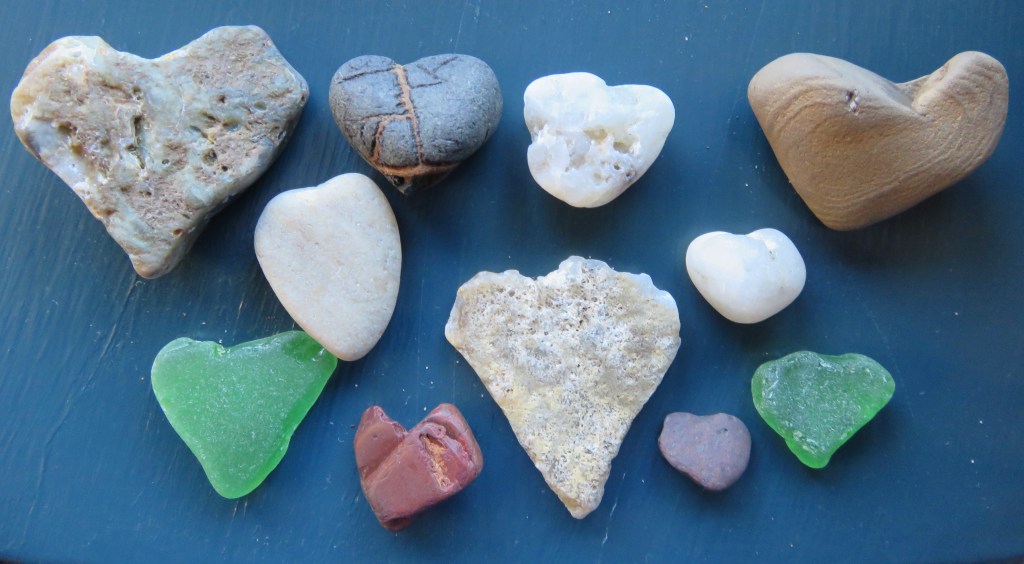
Beach finds. The local bald eagles passed overhead on our walk home this morning, which is the best find of all!

[Gary says he’s afraid of “bats” as carriers of rabies. But bats generally avoid people and so will other wildlife. Or, in the case of elk and raccoons, we have enough sense to avoid them. Only a dog will come right up to a person, bump or charge or bite them for no good reason at all.]

Continue reading →

SALVAGE

Running on the highway, I once found a perfectly serviceable machete. The beach is our more common source of junk.

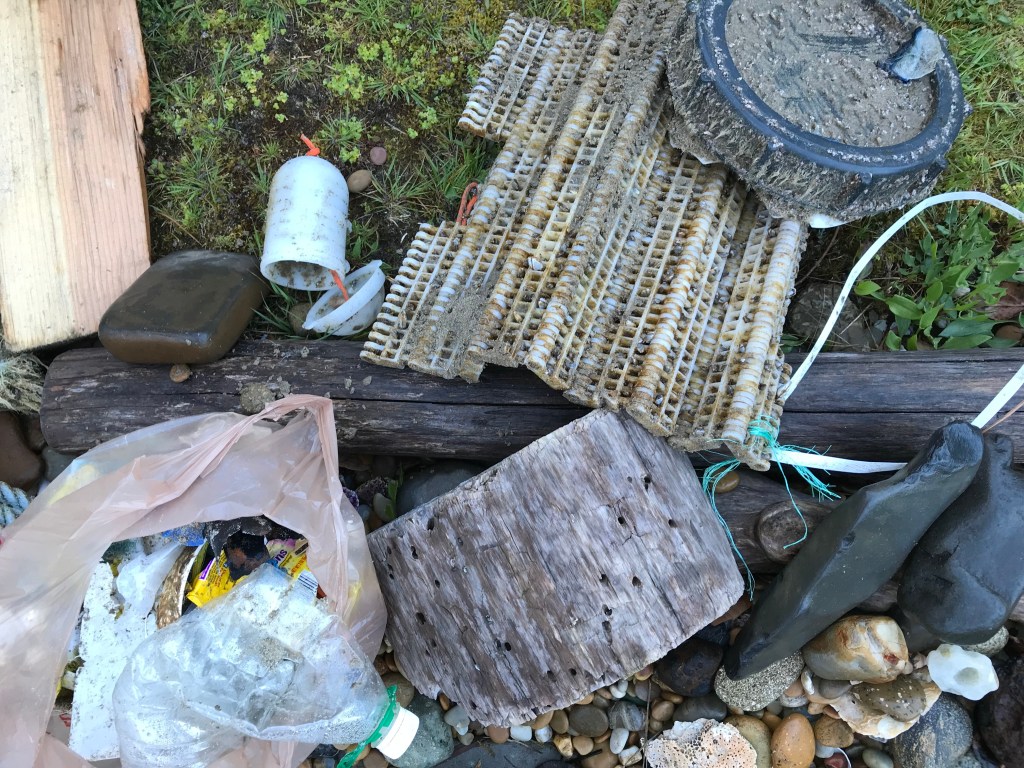
Yesterday was easier. Gary found a commercial grade 3/4 size garbage can kicking around in the creek a little over a half mile north. We almost filled it with plastic trash, including the rubber boot, but we didn’t find the oversize shoe this morning. The thick black lid in the upper right corner [above] was about ten inches across, and half under it, what is that flexible grill-like nylon object? It weighed a ton.

We’ve always gathered litter, but mostly stopped in March 2020. Even then, Gary would pick up dangerous stuff that could hurt someone: syringes and fluorescent light tubes. But we’re back at work.

Continue reading →