An imperturbable demeanor comes from perfect patience. Quiet minds cannot be perplexed or frightened, but go on in fortune and misfortune at their own private pace like a clock during a thunderstorm.—Robert Louis Stevenson
I recently read an insightful article about what can be learned from regret. Before I started reading, I thought of past regrets and how they informed future actions: failing to respond to the cruelty on the bus, failing to confront racism, as a teacher teasing without malice but also without sensitivity. Each of those events taught me to be better next time. There have been next times to be better. Lucky.
There are the once-only times where I made a choice that stuck, the repeated events where I learned to make better choices, the examples that taught me how to move courageously and generously through my life, and the examples that showed me what not to do. In growing from those opportunities: lucky.
I could credit myself with avoiding the worst of the drug scene, the fraught romantic relationships, the dangling desires that might have lead me astray. I could say I turned away in time, credit myself for having better sense than others, boast of my foresight. The truth is mostly about luck.
Everything I know about promotion, bias, and lies I learned from television ads. The pain reliever that claims to alleviate most headaches when taken with a glass of water? My dad pointed out way back in the 1950s that most headaches are caused by dehydration. They only needed the water. My dad taught me habits of skepticism that have served me well throughout my life. I question everything, consider the angles of possible deception, and sometimes I see right through the pitch while only half trying.
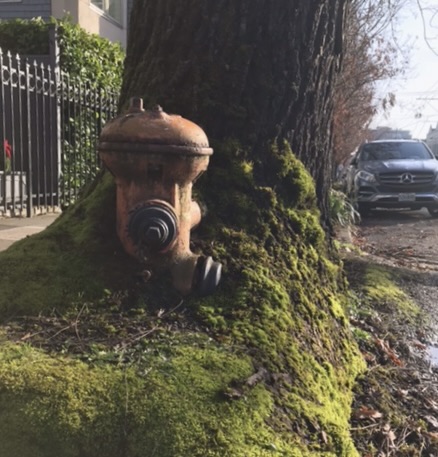
Found on my first run since Covid, the day before yesterday: It’s not your imagination. The base of this tree has grown right around the fire hydrant, which is still seems usable.
Years ago, an educator handed me the new biography, Three Cups of Tea, and assured me it was better than Mountains Beyond Mountains. I had been teaching Pulitzer-winner Tracy Kidder’s book about Dr. Paul Farmer’s campaign to serve the poor in Haiti and elsewhere. Could this memoir be better?
PE was the hardest class for me all the way through public school. Girls were not much encouraged to play sports in the 50s and 60s, of course. Outside the school day, I rode my bike everywhere, climbed trees and a rope all the way to the top of the gym, nearly drowned in Echo Lake, and later learned to swim but not the kick-turn or water skiing (failed both). During the school day I was teased and bullied and sexually assaulted before I was ten. Ellen and I were always chosen last for playground softball. I learned shame and fear in grade school. Junior high was not much better. I was told I had ugly hands, still couldn’t throw, and the play on my name Priddy still led to many chants of “Janice Ugly.” High school was better because I liked the uneven parallel bars and a bio-feedback unit that taught us how to fully relax our body and focus/unfocus our minds. I imagine what I learned then—the only useful thing I ever learned in school PE classes—might be called mindfulness today.
It took me from “Think how the other person must feel” to “Be mindful of how you feel.”
What you might think you see at left in my photograph of this sandstone headland?—yeah, I see it too.
I am about to write about detail from my real life. I ramble. I wade into shallow waters. Be warned.
This is a 2016 post from my old college class blog:
I said [That is, me, Jan Priddy] the first few paragraphs of this op-ed twenty-seven times to you, one at a time. It took me four days of conferences to explain to each of you that the papers you are currently writing are not about proving how right you are, but about reviewing several reasonable and sincere concerns and finding a solution that is about doing the right thing, not finding a hero or taking sides.
We live in a big, diverse society. There are essentially two ways to maintain order and get things done in such a society — politics or some form of dictatorship. Either through compromise or brute force. Our founding fathers chose politics.
Politics is an activity in which you recognize the simultaneous existence of different groups, interests and opinions. You try to find some way to balance or reconcile or compromise those interests, or at least a majority of them. You follow a set of rules, enshrined in a constitution or in custom, to help you reach these compromises in a way everybody considers legitimate.
The downside of politics is that people never really get everything they want. It’s messy, limited and no issue is ever really settled. Politics is a muddled activity in which people have to recognize restraints and settle for less than they want. Disappointment is normal.
But that’s sort of the beauty of politics, too. It involves an endless conversation in which we learn about other people and see things from their vantage point and try to balance their needs against our own. Plus, it’s better than the alternative: rule by some authoritarian tyrant who tries to govern by clobbering everyone in his way.
As Bernard Crick wrote in his book, “In Defence of Politics,” “Politics is a way of ruling divided societies without undue violence.”
Over the past generation we have seen the rise of a group of people who are against politics. These groups — best exemplified by the Tea Party but not exclusive to the right — want to elect people who have no political experience. They want “outsiders.” They delegitimize compromise and deal-making. They’re willing to trample the customs and rules that give legitimacy to legislative decision-making if it helps them gain power.
Ultimately, they don’t recognize other people. They suffer from a form of political narcissism, in which they don’t accept the legitimacy of other interests and opinions. They don’t recognize restraints. They want total victories for themselves and their doctrine.
This antipolitics tendency has had a wretched effect on our democracy. It has led to a series of overlapping downward spirals:
The antipolitics people elect legislators who have no political skills or experience. That incompetence leads to dysfunctional government, which leads to more disgust with government, which leads to a demand for even more outsiders.
The antipolitics people don’t accept that politics is a limited activity. They make soaring promises and raise ridiculous expectations. When those expectations are not met, voters grow cynical and, disgusted, turn even further in the direction of antipolitics.
The antipolitics people refuse compromise and so block the legislative process. The absence of accomplishment destroys public trust. The decline in trust makes deal-making harder.
We’re now at a point where the Senate says it won’t even hold hearings on a presidential Supreme Court nominee, in clear defiance of custom and the Constitution. We’re now at a point in which politicians live in fear if they try to compromise and legislate. We’re now at a point in which normal political conversation has broken down. People feel unheard, which makes them shout even louder, which further destroys conversation…
—“The Governing Cancer of Our Time” by David Brooks, FEB. 26, 2016 in The New York Times
Nearly eight years ago. And, mind you, David Brooks is a Republican. (This is why Obama was not able to put a centrist on the Supreme Court and why we got that sniveling whiner instead nominated by Trump. Brooks doesn’t mention McConnell who really ramped up the crazy. Even McConnell must be sorry about this by now.) Brooks was scared even before the election. Is this a little scary, given what is happening in Congress today? It should be making us all worried.
This morning I passed 50,000 words on NaNo. I’ve given up on the plan to stitch ornaments to go in the holiday cards. We stayed home last weekend and I was supposed to be stuffing squashes and making applesauce this afternoon. Instead I spent four hours recreating the emergency manual for our condo because I only had the pdf and could not figure out how to revise it. So the document got another complete edit, which is a good thing, and I sent a brand new pdf off to the man who did most all the original work. And I looked up photos of my classes.
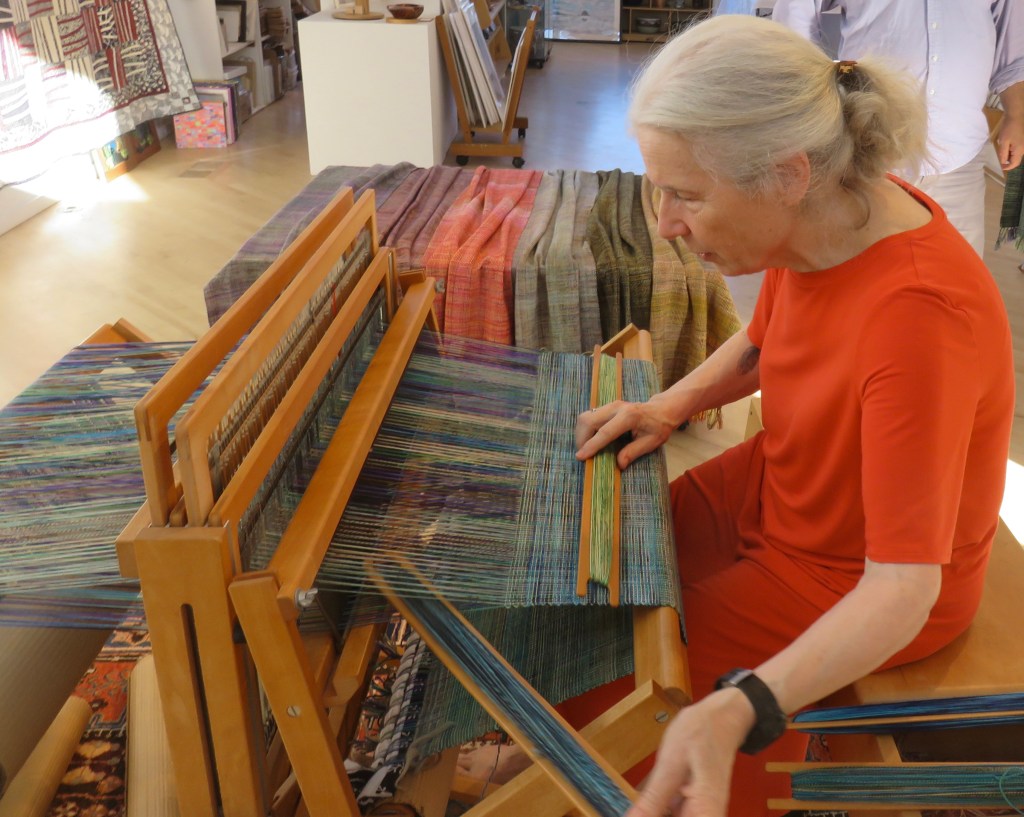
Weaving during the opening of the textile show last month at Cannon Beach Arts Association Gallery. A former student bought the one I am weaving in this photo, thank you, Josh. Gary wants credit for the photo. Thank you, Gary.Continue reading →
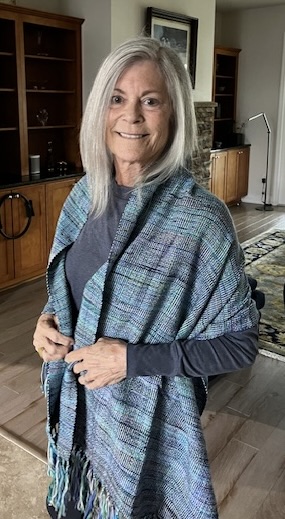
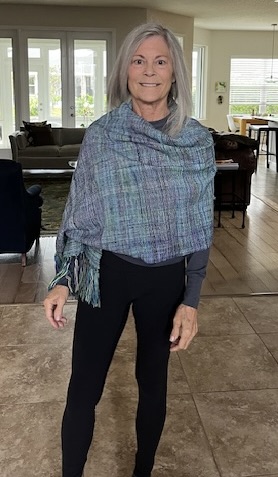
NOTE: I should be working on fiction just now, but one of my shawls found a home far away from here, I am reminded of thankfulness, and I’m sharing an assignment I enjoyed doing myself over and over again.
My husband Gary worked in and managed a farmers’ cooperative for over nineteen years. It was a United Grocers store, but as manager he brought in products from many vendors. It’s been twenty-five years since he left that job, but he still has an eye for the way stores are stocked. When I ask him to pick up a particular product, he looks for the UPC number [the barcode] to be certain he gets exactly hat I want. While we were waiting for servicing on our car, I walked into a Hispanic grocery in Hillsboro. Even I knew he would admire the produce. It took some coaxing to convince him “you have to see this” because he wanted to get back to the car. He declared it wonderful. The whole store made him smile.
Kathy in Florida was visiting in Cannon Beach last month and bought this shawl on faith—I had barely begun weaving it in the gallery, but she liked the colors and trusted.Continue reading →
Locals mostly hate the Fourth of July. Too many people, loose dogs, and illegal fireworks going off at all hours. During my run this morning, a dog charged me, barking deeply, and the owner didn’t even apologize. But also a great many brown pelicans, sand all the way around Hug Point, and Gary built a fort. Some bad news, but good food. Education.
There were dozens of brown pelicans onshore in front of our home when we went out about 6:30. We did not approach but took zoomed-in photos. By the time we got home there were people and loose dogs scattered across the beach, and the pelicans had gone off for the day.Continue reading →
On my run this morning I thought about how, as a teenager, I used to plan my life. Alone or partnered? With or without children? Horses? Goats? I was still dreaming of five acres and independence in college when I completed a sustainable living plan for a Botany class using a book by that title as a reference. [Five Acres and Independence by Maurice Grenville Kains, 1935]
I was younger than the young woman pictured below, but she must also have dreams of where her life might take her. Life will probably surprise her.
While we were waiting for a friend, I asked for a photo of one of the two girls celebrating her quinceañera in the Portland Rose Garden this weekend. It does not show in this photo, but she sparkled extravagantly! Behind and to the left you can see two of her quinceaños wearing black shirts with white embroidery, one holding his hat over his face. The other quinceañera wore peacock colors.
I’d hoped to meet up with a friend from my MFA program in the garden. I walked with Gary to the park, but she drove. She’d forgotten it was Memorial Day weekend, and I had never visited the roses after 8am. The crowds were astonishing and Felicity could not find a place to park. We walked back down the hill and sat outside Starbucks after she parked in the Zupan parking lot.Continue reading →
Three months ago a nine year old girl, a Fourth Grader wearing pink glasses and named Bobbie Wilson was collecting Spotted Lanternflies. She’d learned about the dangerous-to-trees invasive species and how important it was to stomp them out. That’s what she was doing on the sidewalk where she’d lived since she was a baby: stomping on huge flies. The man who lived across the street watched her out his window and became frightened. He called the police to report her.
“There’s a little Black woman walking, spraying stuff on the sidewalks and trees on Elizabeth and Florence,” Lawshe told the dispatcher, according to a call obtained by CNN.
“I don’t know what the hell she’s doing. Scares me, though,” Lawshe added.
NPR, 3 February 2023
I feel certain that there is more brownish beer bottle glass on the beach than any other color, but we don’t often find it. Beer bottles are thin and their color is harder to spot, easily mistaken for rock, wood, or other debris. Old glass is thick. That big green piece is exceptional and probably from the base of a bottle.
Want to guess the race of the two people in this news story?
Gary has heard this story too many times: It’s from years ago at one of our holiday Open House events to which we invited neighbors and co-workers and hosted forty or so. I was teaching, so for a few weeks before, I came home from school and made small savory pastries and baked cakes and cookies and stashed them in the freezer. We cleaned the house, me down on my hands and knees to scrub the floors. The party began at 2pm and ended two hours later. It was a great deal of work, but cleanup after the party took only minutes, not hours, no messes, no fights. We served only sparkling non-alcoholic apple juice. That might be why people only chatted, ate, and then went home without hard feelings.
One year, a co-worker went off on me about people who claimed everything was a matter of opinion. “You English teachers want everything to be a matter of opinion. Some things are not opinion. There are such things as facts!” He raised his voice, not quite yelling, went on for a bit, the closest to an argument we ever experienced at our parties. He was also talking at me.
For the record, I have never claimed that everything was subject to opinion. Nevertheless, I heard what he said. That uncomfortable moment impacted me and my teaching. I was careful to make that distinction with my students: fact and opinion are not the same thing. Some accepted truths are subject to interpretation and opinion. Some facts are indisputable. Know the difference.
The rewards of listening closely to someone who is not you.
—Scott Korb in his craft talk at the Pacific University MFA residency in Seaside, Oregon on 7 January 2023
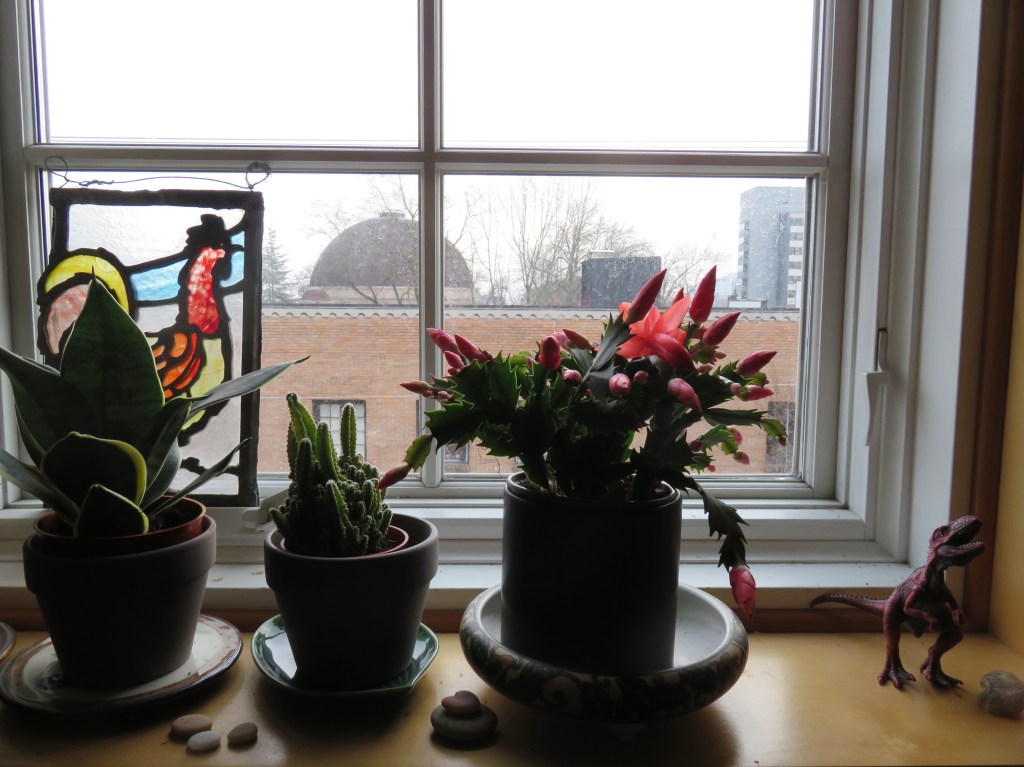
Our window in Portland with Gary’s dinosaur. We have suffered power outages and internet outages at the coast, avoided ice storms in Portland, and walked in the rain and terrific winds. The beach house shook from 75mph wind gusts, and I have learned to make better use of my cell phone. The cell phone itself is an accomplishment I failed to note in my review of 2022. Ian helped get us started.Continue reading →






 IMPERFECT PATIENCE