An imperturbable demeanor comes from perfect patience. Quiet minds cannot be perplexed or frightened, but go on in fortune and misfortune at their own private pace like a clock during a thunderstorm.—Robert Louis Stevenson
It feels very much like bragging to say I’ve so far had lunch with Claire Davis, dinner with Molly Gloss, and lunch with Omar El Akkad. But there, I’ve done it. Saturday, Claire and I talked about what book covers can do to reveal a book or damage its sales. Molly and I talked about the program and our writing. Sunday at lunch, Omar and one of his students and I talked about Portland, fire and how wealth insulates some people even from disaster while leaving others homeless, and that the best Indian food he ever had was while appearing at an event in Iceland. We talked about food. He asked about my novel, would I tell about it? Well. You know the answer.
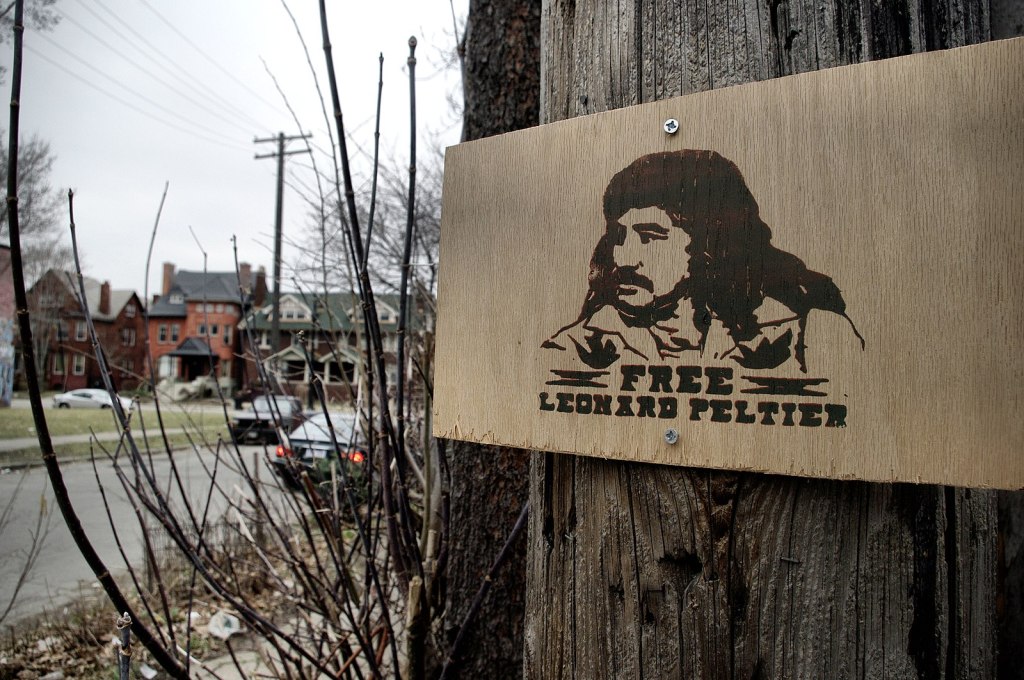
Peltier was imprisoned nearly five decades ago for murdering an FBI agent. There was and remains serious doubt about his guilt. His release is supported not only by Native peoples but by the prosecutor in charge of trying him in the 1970s.
‘free LEONARD PELTIER’ / Trumbullplex (Anarchist housing collective) / Detroit, Michigan / March 2009Continue reading →
Most days Gary and I go out early, but this morning I slept in—going on six when I woke, which is sleeping in for me. We went out for our walk just before seven, which is late for us. We like to get out early to avoid visiting dogs. Really, we go out early because we love having the beach to ourselves. Often, ours are the only human footprints on the sand. We often see wild tracks of coyote, deer, elk, raccoon, and birds.
Wildlife doesn’t scare us. Dogs do sometimes.
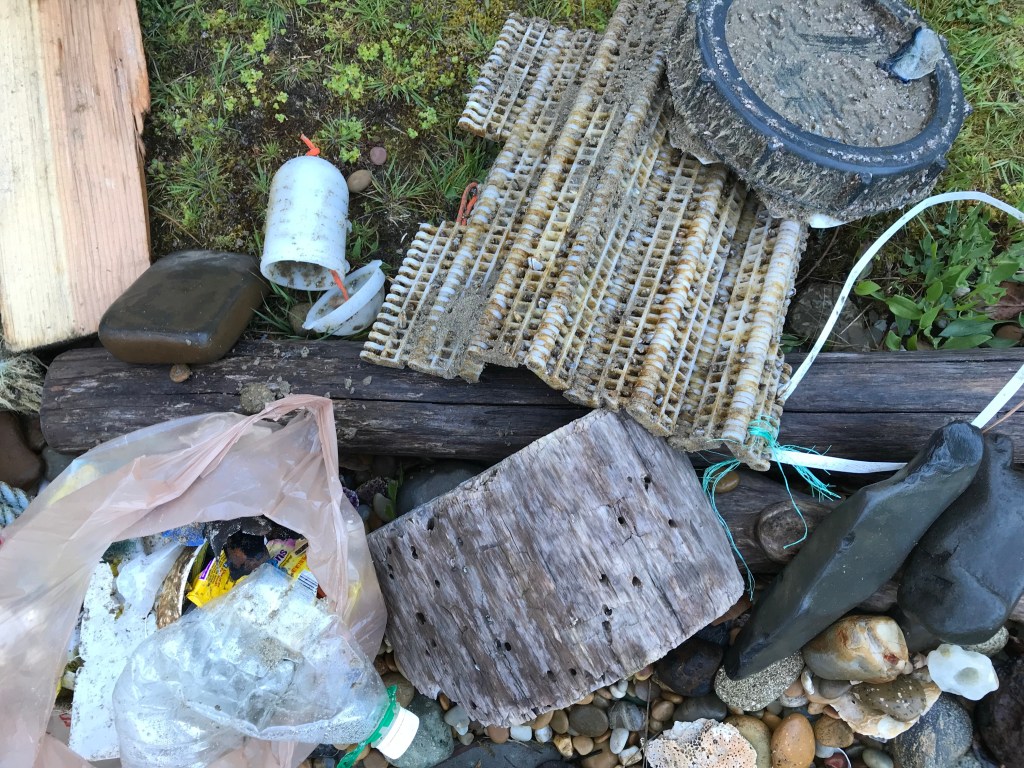
Beach finds. The local bald eagles passed overhead on our walk home this morning, which is the best find of all!
[Gary says he’s afraid of “bats” as carriers of rabies. But bats generally avoid people and so will other wildlife. Or, in the case of elk and raccoons, we have enough sense to avoid them. Only a dog will come right up to a person, bump or charge or bite them for no good reason at all.]
The latest research claims that “learning styles” are a myth but that reading aloud to one another is a good thing. I have to wonder sometimes if educational researchers ever consider their own biases?
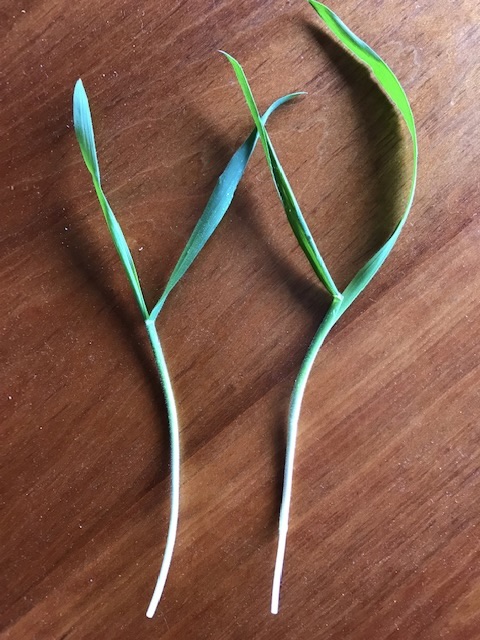
Gary worried, when he brought me these stems, that they were bamboo from our neighbors’ ugly bamboo hedge. I think: No. At least, I hope not. Anyone?
Running on the highway, I once found a perfectly serviceable machete. The beach is our more common source of junk.
Yesterday was easier. Gary found a commercial grade 3/4 size garbage can kicking around in the creek a little over a half mile north. We almost filled it with plastic trash, including the rubber boot, but we didn’t find the oversize shoe this morning. The thick black lid in the upper right corner [above] was about ten inches across, and half under it, what is that flexible grill-like nylon object? It weighed a ton.
We’ve always gathered litter, but mostly stopped in March 2020. Even then, Gary would pick up dangerous stuff that could hurt someone: syringes and fluorescent light tubes. But we’re back at work.
I took guitar lessons in my teens, and that was a long time ago. The late 60s. I still have the guitar, an unusually sweet Aria nylon-string that I haven’t played in fifty years. Gary cares for it. My lessons from Cathy Mack at Shoreline Music focussed on Childe ballads that Joan Baez was singing. I could finger-pick along with singing “The Trees They Do Grow High” and “The Cherry Tree Carole.” Anyone could play “the House of the Rising Sun” and pretty much every garage band of the day covered that one, though it really only made sense with a woman singing it.
Somehow, that brings me to “Jolene.”
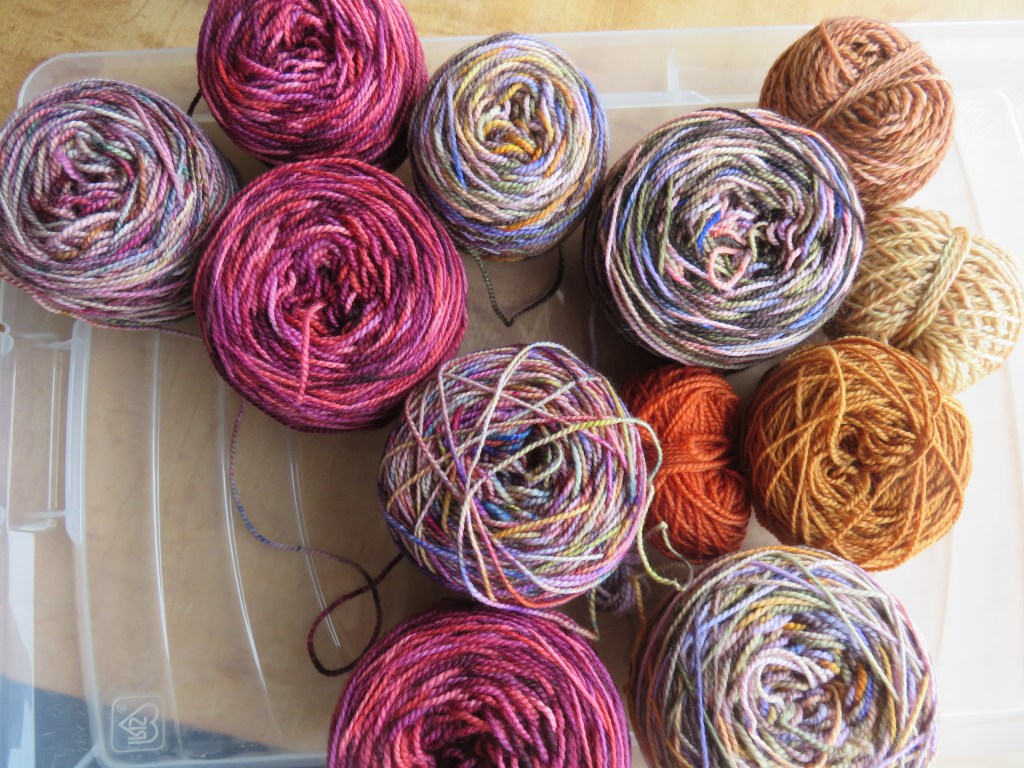
Here are the skeins for the next warp I’m winding. The “Rose Petal” warp is Koigu, which, despite my efforts to find something else, works best as warp and fringe. I’m not sure where that leftover bit of bittersweet orange will land. The weft will be almost entirely handspun. My goal over the last couple of years has been to weave down my stash. I had eight medium bins and a large one. I now have just two medium bins left plus handspun, and I am highly skilled craftsperson in my weaving, not an artist.Continue reading →
We’ve been sorting and clearing for a few years. It’s gone well so far. The attics are empty. Most of my books are prioritized and the most precious of mine have moved East. We’ve talked a lot about the art and furniture that is important to us both. Gary even completely cleared his corner of the living room!
Gary emptied his desk—everything! The desk remains empty, the contents shown here are sorted and stashed invisibly in Portland. Other of his things are set in prominent locations but they do not show in this photo. It all matters to him, and so do the 29 boxes he constructed from my roll cardboard I using on my loom. Each has a shelf of CDs. They will fit under the bed, and Gary wants them kept though he’s not sure he will ever open those carefully constructed and labeled boxes.Continue reading →
Yesterday I shared a meme on my newly revived Facebook page. My friends “liked” or “loved” or “cared” that post. The meme contains a great story. I loved the story and appreciated the “truth” of it at first. But then I thought. The problem is that while the story may or may not be fiction, it certainly contains a lie.
This is a 2016 post from my old college class blog:
I said [That is, me, Jan Priddy] the first few paragraphs of this op-ed twenty-seven times to you, one at a time. It took me four days of conferences to explain to each of you that the papers you are currently writing are not about proving how right you are, but about reviewing several reasonable and sincere concerns and finding a solution that is about doing the right thing, not finding a hero or taking sides.
We live in a big, diverse society. There are essentially two ways to maintain order and get things done in such a society — politics or some form of dictatorship. Either through compromise or brute force. Our founding fathers chose politics.
Politics is an activity in which you recognize the simultaneous existence of different groups, interests and opinions. You try to find some way to balance or reconcile or compromise those interests, or at least a majority of them. You follow a set of rules, enshrined in a constitution or in custom, to help you reach these compromises in a way everybody considers legitimate.
The downside of politics is that people never really get everything they want. It’s messy, limited and no issue is ever really settled. Politics is a muddled activity in which people have to recognize restraints and settle for less than they want. Disappointment is normal.
But that’s sort of the beauty of politics, too. It involves an endless conversation in which we learn about other people and see things from their vantage point and try to balance their needs against our own. Plus, it’s better than the alternative: rule by some authoritarian tyrant who tries to govern by clobbering everyone in his way.
As Bernard Crick wrote in his book, “In Defence of Politics,” “Politics is a way of ruling divided societies without undue violence.”
Over the past generation we have seen the rise of a group of people who are against politics. These groups — best exemplified by the Tea Party but not exclusive to the right — want to elect people who have no political experience. They want “outsiders.” They delegitimize compromise and deal-making. They’re willing to trample the customs and rules that give legitimacy to legislative decision-making if it helps them gain power.
Ultimately, they don’t recognize other people. They suffer from a form of political narcissism, in which they don’t accept the legitimacy of other interests and opinions. They don’t recognize restraints. They want total victories for themselves and their doctrine.
This antipolitics tendency has had a wretched effect on our democracy. It has led to a series of overlapping downward spirals:
The antipolitics people elect legislators who have no political skills or experience. That incompetence leads to dysfunctional government, which leads to more disgust with government, which leads to a demand for even more outsiders.
The antipolitics people don’t accept that politics is a limited activity. They make soaring promises and raise ridiculous expectations. When those expectations are not met, voters grow cynical and, disgusted, turn even further in the direction of antipolitics.
The antipolitics people refuse compromise and so block the legislative process. The absence of accomplishment destroys public trust. The decline in trust makes deal-making harder.
We’re now at a point where the Senate says it won’t even hold hearings on a presidential Supreme Court nominee, in clear defiance of custom and the Constitution. We’re now at a point in which politicians live in fear if they try to compromise and legislate. We’re now at a point in which normal political conversation has broken down. People feel unheard, which makes them shout even louder, which further destroys conversation…
—“The Governing Cancer of Our Time” by David Brooks, FEB. 26, 2016 in The New York Times
Nearly eight years ago. And, mind you, David Brooks is a Republican. (This is why Obama was not able to put a centrist on the Supreme Court and why we got that sniveling whiner instead nominated by Trump. Brooks doesn’t mention McConnell who really ramped up the crazy. Even McConnell must be sorry about this by now.) Brooks was scared even before the election. Is this a little scary, given what is happening in Congress today? It should be making us all worried.




 &PRIDE Press