unSATISFIED CUSTOMER

95a8e252eca89dbaa7458a3c2b379aa0.jpg

The order.

“Years and years and years ago” when Mom was still alive, I did what my mother had done and decided on solid black, spindleback wood chairs for her old dining table she’d given me. I wanted four chairs, and bought cheap, unfinished chairs and stained and lacquered them matt black. They are currently serving duty in my son’s dining room.

Our garage sale library chairs have been good, but they are too heavy to slide easily in and out at table. It was time, I decided, to get what I really wanted.

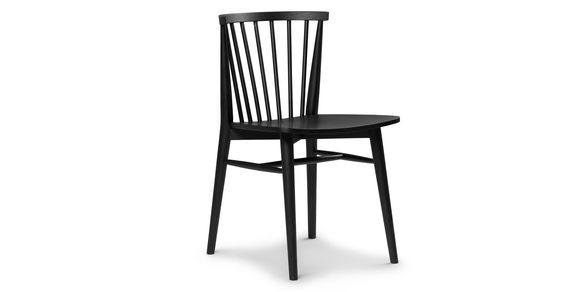
Anthropologie (see above) had chairs that looked right. Black. Spindles. Oak. I had a discount coupon. The coupon did not work, but I ordered the chairs anyway. I had not sat in them so I worried they might not be as comfortable as they looked.

They were beautiful and comfortable, apparently sturdy. We received only three, each with serious flaw—a cracked leg, a botched paint job, seat not fitting to the back legs. After a dozen emails and many phones calls, each with conflicting information and advice, the chairs are all returned, the lost one given up, the money refunded, and I have the option of ordering chairs “at any time in the future” with a 20% discount from Anthropologie. Probably not.

Then a desk I had saved for and ordered months ago arrived Tuesday and is stripy walnut like milk chocolate-colored teak. I wanted dark bittersweet black walnut swirls. Honestly, even the salesman recognized it was not what I wanted, and I think both of us hoped I would love it anyway. I don’t. I am a generation past and a generation too late for the Danish-teak-now-called-Midcentury-Modern aesthetic. I mostly did not like the style the first time around and have not warmed to its resurgence.

The desk will go back as well, and that is going to be an expensive return.

The disorder.

These are the concerns of affluence, I think, fussing over chairs and custom desks, as if they mattered. Money. I have tried to figure this out. I do love all this stuff, but lately we have been selling and giving things away, emptying closets and attic, and even my jewelry box. Most of my life I have accepted what came—furniture, people, jobs. Maybe that is a flaw in my character? A failure of common sense? Bad and good luck?

We have been shoveling out what came unbidden into our lives in order to trade up for things deliberately selected. Affluence again to have that choice. Entitlement.

What matters is that my husband and I go for our long beach walk each day, even when it’s raining. We sit at the table and share breakfast.

Spiders can hear human conversation, I am told. They know when we spot them working their way across the ceiling. They hear our alarm. They huddle down and accept our coming for them, or run for a crack in the ceiling.

Maybe I need to run away too?

We listen to and read the news and would rather worry about furniture.

Run away! Run away! Doctor Who shouts.

Yes, maybe that.

There is terrible news every day and no place to escape to. But we would like to escape from cruelty and willed ignorance and obsession over money, even our own.

Who needs a vacation?

I can count the days we have slept away from home during the past twenty years on my ten fingers. In 2003, Gary and I began calling a few hours in a daytrip to Portland our “vacation.” Since then we have had two nights in Orcas and one in Canada, two trips to Seattle and two nights at Nye Beach, a few nights with family in Portland (does that count if I have to cook?). Fifteen years and, okay, maybe we had a dozen nights away from home. More than ten nights in fifteen years. We talk about travel to Iceland and Ireland and Portugal. (I have always wanted to see Hagia Sophia and Crete.) Mostly we stay home and stare too much at our computers. Have we been investing in furniture in place of vacation?

We should try it the other way around. Or something.

Next week we will go for two nights without technology. When we come home, there will still be just two ancient chairs at the dining table, and that will be plenty for us. Perhaps the desk will have gone back to Portland by then, and I will continue to sit up in bed when I write.

In the mean time, vacations too are the concern of affluence. Give me time to think about that.

I’ll keep you posted.
 

PASSING

IMG_3471

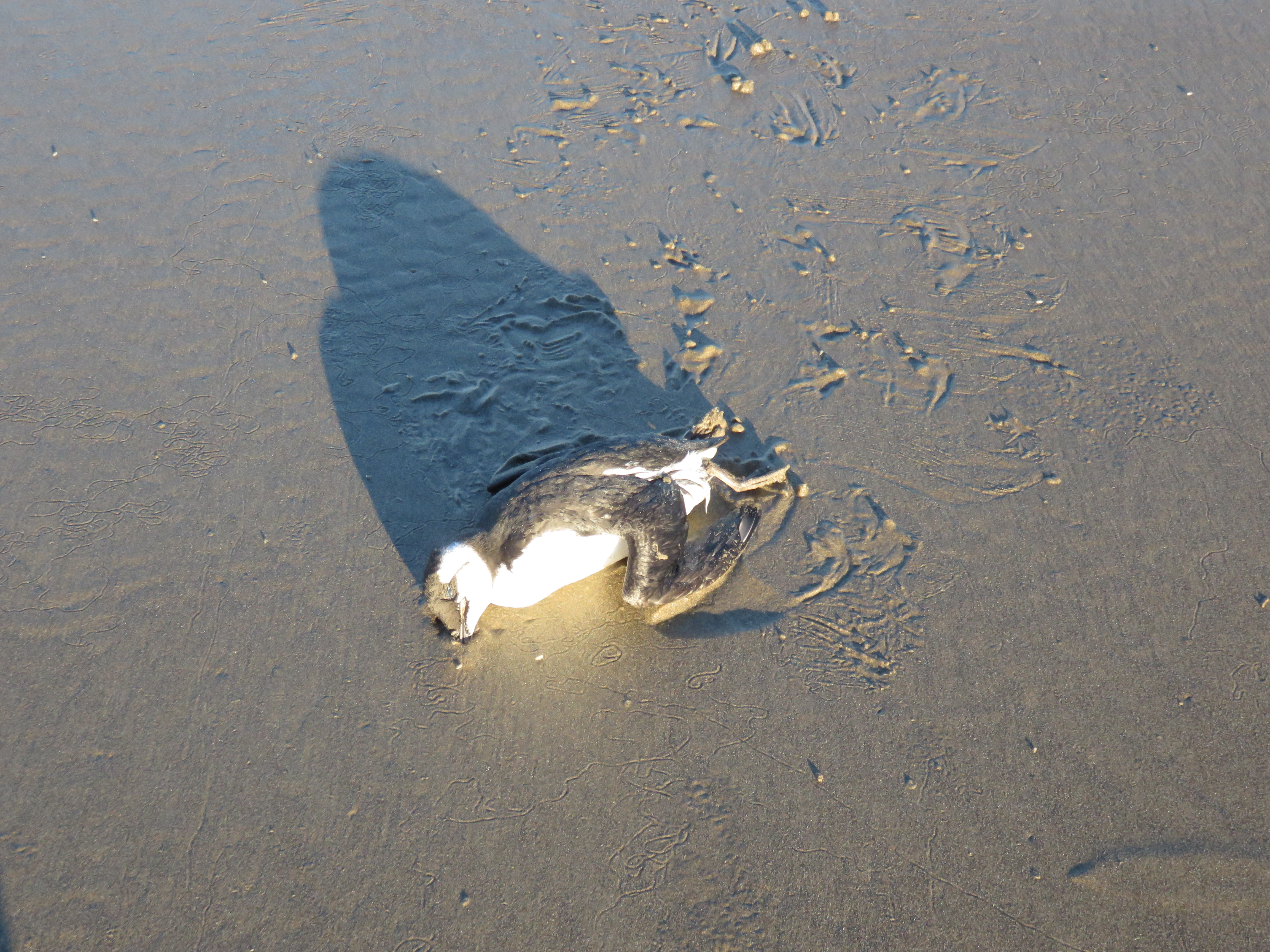
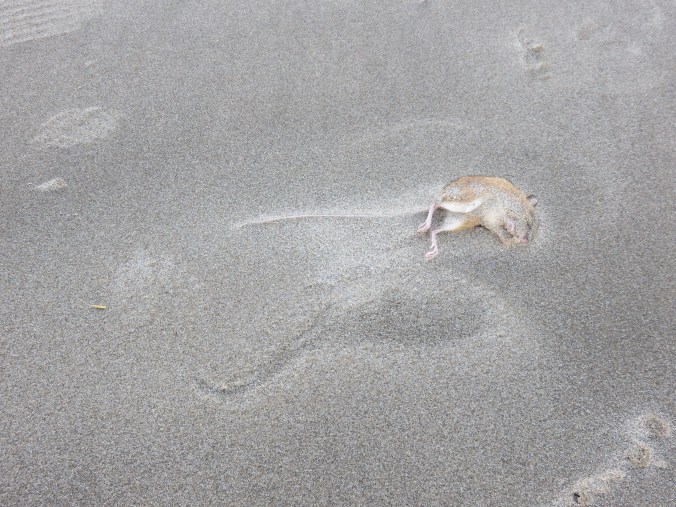
I passed this mouse on the beach—mouse?— half-covered by blown sand.

There is a novel by Nella Larson called Passing, which includes racial passing by a character. There are other sorts of passing. Passing by, passing judgement, passing the mashed potatoes. A running dog passing another is called a go-by and it’s a good thing. Passing over, we die.

Years pass too, time passes. But not really. We are only here from instant to instant, only really here. Life is not a train headed in a particular direction and we are not riding a carrousel in circles. We are here, looking ahead at what we hope or fear might be coming, basing our predictions on what we remember has already happened.

Today is my birthday. I am 66. We have already established that I am not any number of “years young.” But back in May, I decided to track my daily activities. Looking forward, I thought I should plan more decisively for writing and reading and walking and eating, taking the medication for my thinning bone, and drinking enough water, limiting alcohol—all the things my mother would tell me to do if she were alive, even while she failed to follow her own good advice.

A new post on the Brevity blog urges us to consider how easily we are distracted, not just by the distractions of phone calls and tweets, but by the time required to process and recover from them. Set priorities, set goals.

Most of the project goals I established in January and June are coming along. I lost fifteen pounds and I am walking an hour a day. I have seen my writing published eight times this year, which is fortune as much as effort. The only control I have over publication is submitting my work. Mostly I submit—terrible term—to journals that publish a tiny fraction of the work they receive. They might print a dozen stories in a year and reject ten thousand. Just yesterday I earned my 100th rejection for my writing, and it was, in fact, a writing goal for the year, one I could control by submitting my work many times. Score one for me! I passed my 52-book reading goal for the year too. I have a story that might become a novel next month during NaNoWriMo (National Novel Writing Month). In that story nearly all visible life on earth other than plants and insects dies. One woman is left alone wondering how she deserved to survive and was it punishment for something she doesn’t know she did? Too much time passes for her.

The Washington Post warns about an massive drop in insect life and the birds and reptiles that eat them on pristine tropical islands. Is it the result of climate change which impacts insects much more dramatically than I supposed? Or is this the result of the use of pesticides and defoliants? Some Devil’s Triangle of threats? Researchers can’t explain it, but they’re worried. So maybe I have my prophetic story backwards?

Or perhaps what I was told about Australian people is true, that they see humanity as forever facing the past, walking backwards into whatever unknown comes next.

I am merely passing by.


GROWING UP

IMG_3417

Yesterday, though it is October and cooling, the sun was bright overhead and we got in our two beach walks. A huge broken V of birds flew south so fast we were not able to identify the species. Not Canada geese, who fly slower and in a tidier skein and honk. Gary suggested cormorants.

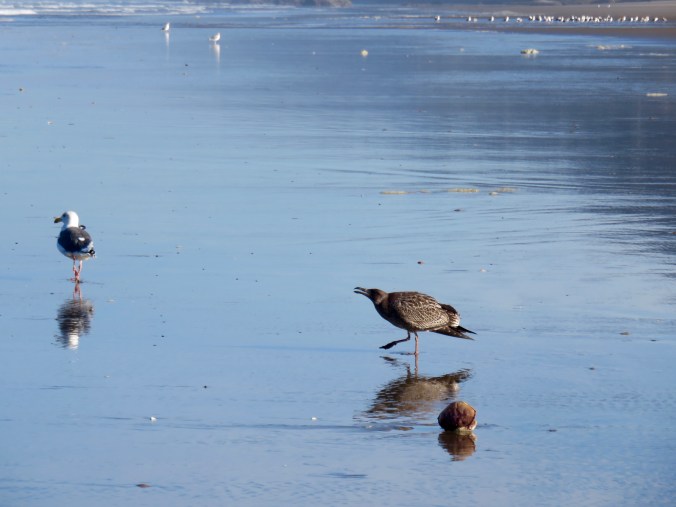
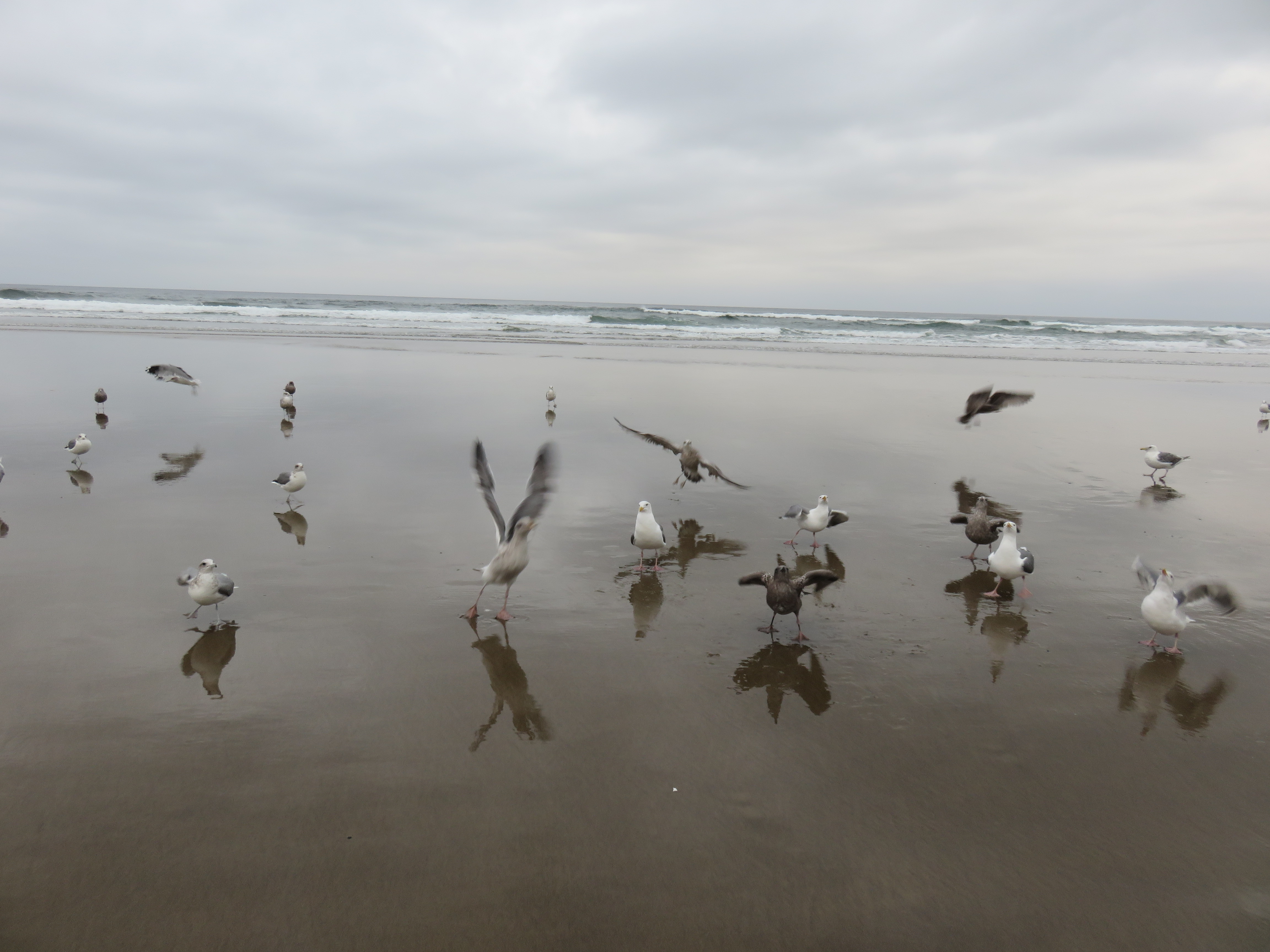
The juvenile gulls have mostly begun foraging for themselves, but we still see the occasional young bird begging its mother for food. The young gulls are fully fledged and as big as their parent, but still in dull gray child’s clothing. They duck their heads into their bodies, circle their parent and peep: “Feed me! Feed me!”

IMG_3424

The pelicans, too, seem to have fully grown children still in baby plumage, though these larger birds have more dignity, stately in size.

Hild by Nicola Griffith of Seattle is a novel about Saint Hilda, an ancient woman, who begins in this telling as a three year old. Her life is at risk, and she has been warned: Quiet mouth, bright mind. She is to listen and connect all she observes and throughout her precarious early life, she attends those around her with power: to the words of powerful people, to the scent of boggy land and new-turned earth and blossoms. She hears how the winds rattles leaves and the rustle and tuck of creatures in the wild.

Hild flies with eagles. This is not so much magic—this is medieval history, not fantasy—as wisdom. Hild connect dots in the air that no one else pays the slightest attention to. She misses things, but her seeing is not represented as a magical gift, but as the result of her openness to everything around her. She is smart and strong and very tall at a time when these qualities were often confused with the right to power. Hild seeks the pattern, sees it build and twist and turn, looks for ways to use it to advantage, both her own for the sake of weaker folk.

Times have not changed so much. We still confuse size with virtue. And even now there are people seeking a pattern to how the world changes.

There was a royal wedding, my husband tells me, and people were complaining about the cost. In Crazy Rich Asians there is an insanely expensive wedding too, but at least in the latter fictional case, the parents were supposed to have done something to earn the price. I always cry at weddings, and I even cried during that fictional one. I cried at my own wedding, which cost only a couple of hundred dollars including my dress and the gold I bought to make our rings.

I was young when I married, but Gary and I paid for the ceremony. We were already past begging our parents to feed us.

These days I think it would have been nice to have a friend who threw me a bridal shower, a father-in-law who paid for a pre-wedding banquet, a mother who insisted on all the trimmings and paying for them. But these are things I did without quite happily at the time. And they would be distant memories now, less valuable that the dress still wearable though folded away. There is no genuine regret. It was a lovely weeding in my parents’ back yard under the pagoda tree.

Seasons pass and time gathers itself in lumps of memory. How I laughed from excitement during the ceremony. How my new husband wrapped me in his arms. How our grins made our teeth click ever so gently at that first married kiss.

IMG_3418

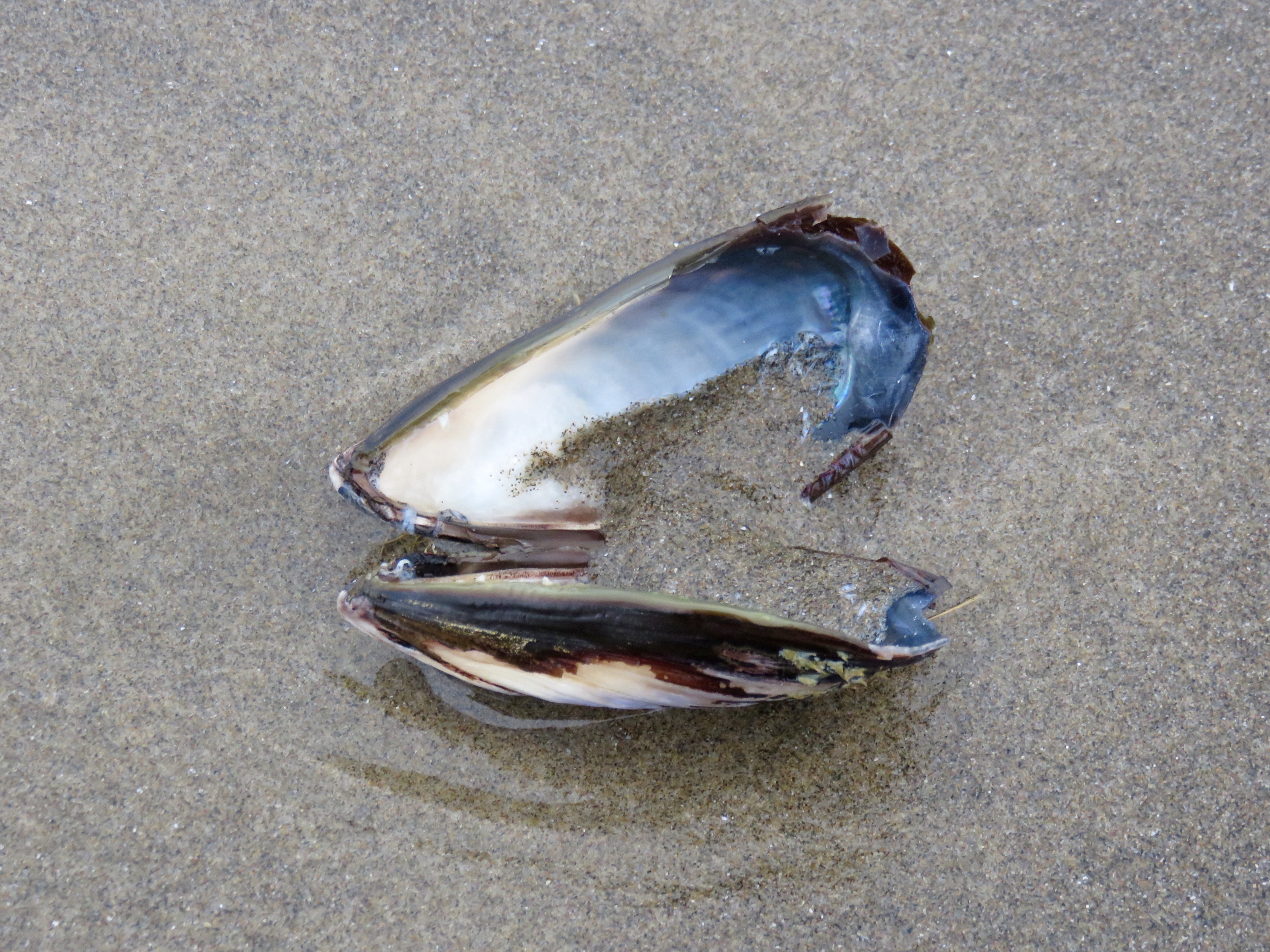
The parent has already provided a crab meal—stripped clean here—and walks away. However it strives to appear small and dependent, it’s time for this gull to grow up.

EMBRACING THE CRONE

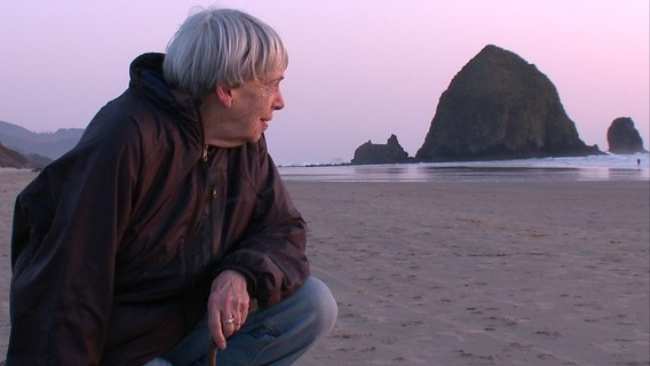
Ursula K. Le Guin once talked about embracing that word, “crone” as an honorific. For most, it is pejorative, inherently agist and sexist, but Ursula argued for a different take. The crone has experience and perspective, intelligence and awareness. The crone is old because she has lived long and prospered. She has earned respect, even though she rarely gets it.

“In her essay, ‘The Space Crone,’ Ursula Le Guin wrote that old women would make the best space explorers. Free from the daily tasks of rearing helpless children, free to see and comprehend without vanity, loving life because we know we may have to leave it soon, we would embark on our journey to the stars not for ego or planting flags but only for information to transmit back to our grandchildren for their future explorations. We know by then that we are part of the flow of life.”

I heard her talk about crones in the 1990s when she was about what my age is now. She wrote this essay twenty years earlier in 1976, when she was in her late 40s and I was in my 20s. It’s the first essay in Dancing at the Edge of the World, which includes her speech “Hunger” that I teach each year. Half that volume is made up of collected book reviews about writers such as C.S. Lewis, Doris Lessing, and Molly Gloss.

Kate Atkinson objects to book reviews written by authors, and particularly to a reviewer declaring her a “matron” in The New Yorker. I understand she considers the term disrespectful. I get it. She’s right. It wants to connect to “society” as in society matron, some woman with grown children who works on charitable committees without ever dirtying her hands. Matron, according to common use and the dictionary is a married woman, especially a dignified and sober middle-aged one. Like “bitch” maybe it’s time we took back the label of matron, the way Dick Gregory took back “Nigger” when he used it to title his memoir, so his mama would know that when she heard that loaded word, it was someone talking about her son’s book. Except that never quite worked and the n-word is still a bad’un.

Like racism and sexism, agism is something we’d like to pretend does not exist. In our youth-obsessed, age- and death-denying society, everyone past high school feels pressure to be young. How many times have people declared: It’s only natural to want to be young? Maybe. But in most past cultures, even the feeble old were regarded as having earned respect. They are the holders of what we now call institutional knowledge.

A woman I worked with on the local arts council assured me decades ago that “the great thing about being 70 years old is that no one expects you to look young anymore.” She made me laugh. We both laughed. I admired her home, her view, the wooden blackbird hovering over her dining table. I admired her ability to be who she was. I was 30-something at the time, no longer “young” but still uncomfortable with “middle aged.” I clung to Gloria Steinem’s incredible birthday riff about turning forty. “This is what forty looks like. We’ve been lying for so long, who would know?” Except, she was always beautiful, still is, and she’s 84 now. Gloria Steinem is old. She is even that worse thing, elderly.

I will be 66 next week, and I am old. (In medical terms, I am also elderly, but I resist that term. It belongs to my next decade and the one or ones after, should I be so lucky.) I am old, not middle-aged, not young. And I am not “66 years young” which is a pathetic claim to my mind. I am not living backwards. I am not trying to look 35 or 45. I am what I am. I am tired of guilt about youth. I am weary of being told I should yearn for youth, that I should strive for it, that I must always be forever young. I am not young.

from On Golden Pond:

Ethel: “Hey, I just met the nicest couple…. In the woods.”

Norman: “Couple of people?”

Ethel: “No, a couple of antelope. Of course a couple of people. Their name is Migliori, I believe…. They’re a nice middle-aged couple, just like us.”

Norman: “If they’re just like us, they’re not middle-aged. Middle-aged means middle, Ethel. Middle of life. People don’t live to be 150!”

Ethel: “Well, we’re at the far edge of middle age,” she says: “That’s all.”

Norman: “We’re not, you know. We’re not middle-aged. You’re old, and I’m ancient.”

Ethel: “Oh, pooh! You’re in your seventies, and I’m in my sixties.”

Norman: “Just barely on both counts”

[In fact, Hepburn was 74 when she said those lines. Henry Fonda was 76. Both were genuinely old, but not ancient. Hepburn was 94 when she died in 2003, but this was Fonda’s last theatrical film—he also made a TV movie that year. He passed early the next year, in 1982.]

There is nothing I want back from youth but the ability to run distance. I could still do that when I was 58. I would like that back. Yes, I truly would. But it won’t happen. I can walk for 2 hours and run short distances, but I will never run 6 or 16 miles again.* I mourn for the loss of that running freedom, but I honor what living, reading, and thinking have given me at my age.

I have experienced much, read many books, and thought deeply. I have never stopped reading and thinking and observing the world. There is still learning in my life. I am subject to change. That last should be another posting.

In the mean time, I have lived long and prospered. I have earned my age. Give me the credit I am due.

______________________________

*UPDATE: In October of 2022, the week before my 70th birthday, I ran a 10k in 71 minutes, 9 seconds. That’s 6.2 miles and I was 8th of two-hundred-something in the 65-69 age group. Whoo-hoo for me!

further UPDATE: I completed the same run the next year, a little slower but came in 2nd in my age group of over 200 runners because at a week before my 71st birthday, I was 70-74. Yeah, elderly now.


WAITING FOR THE SUN TO RISE

IMG_2210

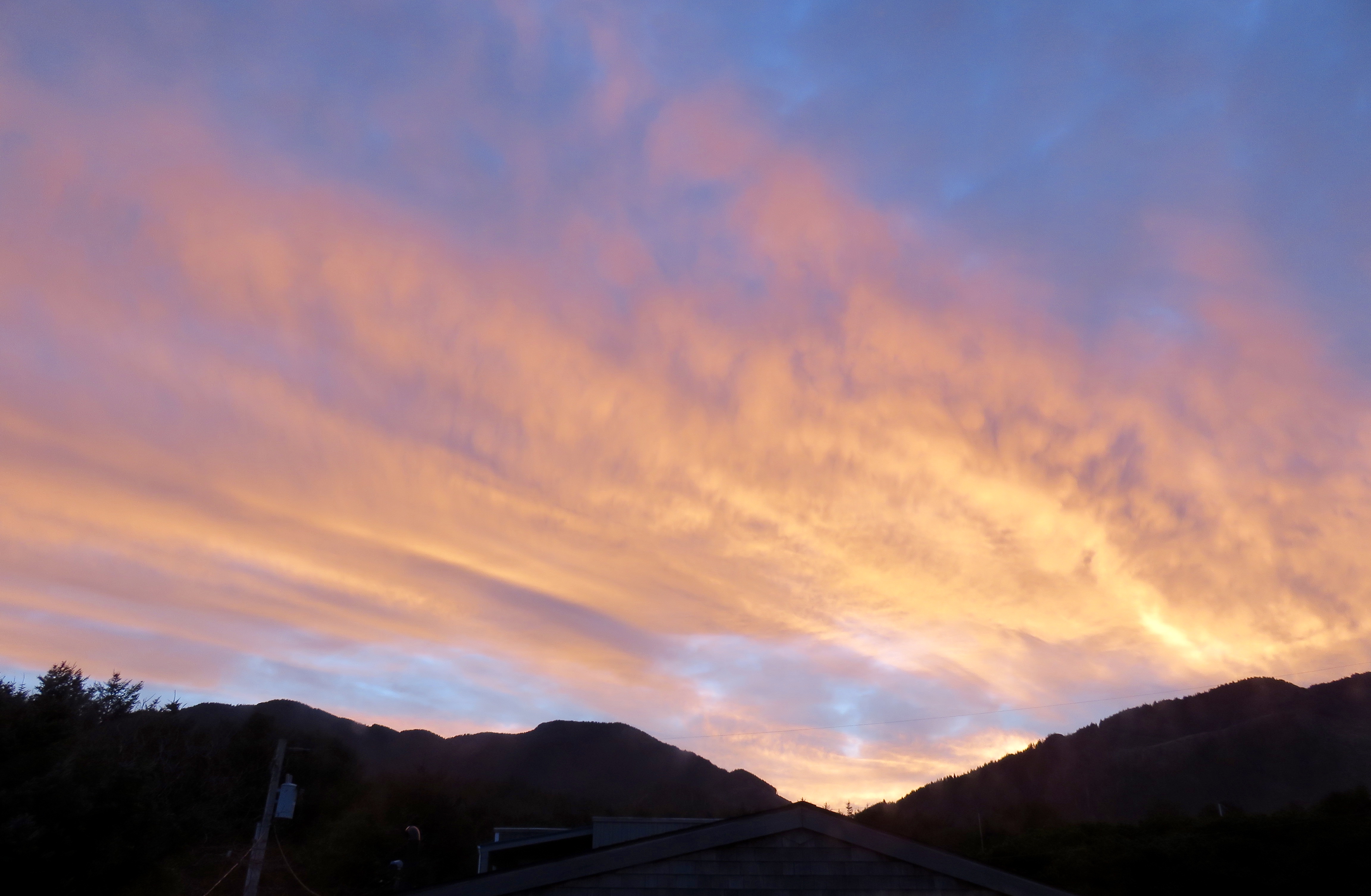
I am reading historical fiction just now. The E key on my keyboard has worn down to a splotch—it’s happened before. I had trouble getting to sleep from dwelling on memories of attack. I am waiting for the light so that I can have my walk. I am trying not to make things worse on social media. I would like to have my say, to talk. But silence is safer. Most women have been taught to keep their heads down, to smile, to keep silent, and avoid stirring the pot.

Years ago, the mother of two students asked me whether I was a pot stirrer or oil on troubled waters. I admitted I was a stirrer. I laughed. She did too. “I thought so.” She handed me a packet. She had commissioned a pendant from an Alaska Native carver, carved wood with abalone eyes. It is a frog. I hold it often.

By Northwest Coast reckoning, it is the large animals—Bear, Wolf, Eagle—who quiet things down. They are the “peacemakers” and maintainers of the status quo.

But it is the small trouble-makers, like Raven, who created the world.

The smaller animals, often that black bird, who appear in stories to stir the pot. A Haida story explains how humanity came into being because of Raven’s mischief. It is Frog, not someone larger and stronger, who has the capacity to make change, merely by finding what is there hidden underneath the calm surface.

Maybe this is because the strongest ones want to keep things as they are? They are strong, after all, powerful and influential and capable of protecting their rank. Keep still, they warn, don’t make trouble. Let this go quietly and perhaps we will not eat you.

It is the small among us who stir the pot, looking to see what we might find underneath. There are people and place, ideas and movements, all begun by the little-small among us who will not rest, but must speak out.

When has silence ever kept us safe forever?

UNSUBSCRIBE

IMG_3358

When I throw an email away, it goes in Trash, but my system also selects what it understands I do not want to see and puts it in another folder as Junk. Junk never appears in my Inbox. Periodically, I review the emails in that Junk folder, just in case something is misdirected. What I find includes distressingly numerous sex ads, invitations to enlarge my penis, queries about whether I am my email address (“Is this xxxx.xxx?), and links to places I do not want to go. Rarely, I find an email from a website that I have recently been tossing without reading. I think my favorite Junk emails are the ones that allow me to “unsubscribe by clicking the link below.”

Uh-huh. That would be dim of me.

A reminder of one of the key warnings everyone receives upon accessing the internet: Do not click on links unless you are certain, absolutely certain, where it will take you.

Even the legitimate “unsubscribe” links at the bottoms of emails you once thought you wanted to receive and no longer want to receive, sometimes refuse to do what you have asked. After I unsubscribed from Subaru USA, I continued to receive emails from that national site, and also the regional site, the local dealership, and the Tump-supporter who sold me the car. I unsubscribed from each of them, several times each, and they still went on for weeks. I finally wrote snarky notes to two sources. They did not stop. Then I wrote to the dealership and said I would give them a lousy rating if they did not stop. They did.

Immediately after the last presidential election I began receiving emails from that man in the White House. Eventually, after I repeatedly asked, they stopped. Isn’t it enough that he appears more often at the top of my news feed from The Washington Post AND The New York Times?

The other day, when I was supposed to be getting a test National Alert message, I received an email from the woman currently married to man in the White House. Trust me, I never asked for this. I am hoping that will be a one-off.

In the event of a national emergency (aren’t we already having one?), my phone is not smart enough to receive it.

Just as well.

And now to go watch the new Dr. Who.

“Run!”


NOW AND THEN

IMG_3363

I apologize to people who will see no point in reading this post. There is no point in reading this post.

I have been trying to think of other things, to focus on the good I know is everywhere around, and to remember that I am a fortunate person. I am the oldest in my family and a woman, and the men in my life are almost entirely good people, kind and decent and loving people. I am trying to remember that times have changed.

When I was a freshman in college, a man in the house behind me was molesting his daughter (“Please Daddy, no.”). The police advised me to call the public health nurse in downtown. It was late at night. The police would not come. They said there was nothing they could do. Maybe they did come but could do nothing to the man. It’s hard to remember. They did not accuse me of making up my story for political reasons.

It was 1970. It was probably October, forty-eight years ago. I can only pin down the date that far because I have thought it through so many times over the years. It was while I lived in the View Ridge house before I was laid off from work in the record store at Northgate and caught the flu and moved back home with my parents even before my first college term ended. So I might still have been 17 years old. Or maybe it was right after my October birthday.

In a fit of desperation and fear, one night, listening to that child cry, I ran around the block on the wet sidewalks and confronted the man. I was barefoot. I could describe the house, the front door, how naked my knuckles felt knocking on his door, what the man was wearing when he answered it, the expression on his face when he said, “Who are you?” He looked around behind me to see who else was there. Just me. I was terrified. I felt like a fool. I feared he would follow me home and hurt me. Cowardice. Impotence.

For many years, this terrible mix of self-blame and fear did not connect to carrying keys splayed between my fingers when I walked across campus or to hiding from people who crossed my path in the dark. Or to my own experience on the playground when I was a little girl (I never told) or to an explosive overreaction when a boy trapped me against a counter in my junior year of high school (was that overreaction?), the men who exposed themselves to me, the physical therapist who made lewd suggestions (that was recent), or my embarrassment trying to report a man who chose to masturbate beside me in an otherwise empty college lecture hall when I was 18 (“Well, if you’re scared,” he’d jeered as I ran away).

I was young then. And now I am old. I did not even have words to describe what I experienced then. I still prefer not to think about it now.

Nobel Peace Prize for anti-rape activists Nadia Murad and Denis Mukwege

RANDOM FACTS

IMG_3392

Years ago, long before non-GMO became a common label on foods, before Safeway even had an “Organics” section, and before “gluten-free” became a thing, a junior came to class with an idea for her research paper. “It sounds interesting. They are altering the genes of food,” she said about the NPR broadcast she’d listened to on her way to school. ”

“What do you think about it?” I asked.

“I don’t know,” she said. “I want to find out.”

Her eventual essay included the word “Frankenfoods” in the title, so we can see where that led.

Over the years, students rarely choose to write about topics they begin by knowing little about, but those papers are most often the best. Writing a research paper should be as much about finding out truth as proving it.

Changing our mind is probably one of the greatest struggles any of us have. We get an idea in our head and simply cannot move. For a teenager to research a topic with an idea already clear in their head about what they want to say is pretty typical. For a reversal to occur is rare indeed.

Recently, a junior was writing about forcing sports teams to change what some perceived were racist logos. She argued this would be unnecessarily costly and inconvenient, would destroy honored traditions and history, and anyway, “racism” was not the intent and probably not even effect of these logos. She got through two drafts, and then the day before the next draft was due, the one that was supposed to be done other than minor word-smithing, she came to see me after class.

“I have a problem,” she said. “My thesis is wrong, or anyway I disagree with my thesis. I made a mistake and now I don’t know what to do.” She had, the night before, read an opinion piece about the damage racist stereotypes, including the images used as sports logos, do to young people living on reservations. Such images preserve and inflate prejudices and contribute to a sense of exclusion and hopelessness for children already living in poverty and on the margins of society. “I’ve seen that,” she said. “It’s true.” She had worked as a volunteer on a reservation.

“Change your thesis,” I said.

“But I don’t have time to start over.” She sounded surprisingly reasonable, given her sense of her dilemma. This had to feel like a disaster in her world and she was struggling to maintain her calm. She began to rattle off all the arguments that supported her original thesis.

“But one article convinced you that you were wrong.”

She nodded.

“So use everything you already have, and then show me how you were convinced. Concede everything—inconvenience, costs, fan outrage—and show me how there is something more important at stake. It convinced you; convince me as a reader.”

She did it too. Changed her hook, reversed her thesis, fiddled her body paragraphs, and concluded with a bang. Her argument was logical and emotional, reasonable and persuasive.

It can be done. We can change our minds.

Long ago, another junior showed up before class, the day before a draft of the same assignment was due. She was in tears. “They have to shoot them,” she wailed. “They have to do it as a symbol, and the sea lions aren’t even the real problem.” She had been writing a paper to argue against killing the sea lions that were eating salmon at the base of a dam spillway. She could prove that the sea lions were not the cause of dwindling wild salmon populations, but she also came to understand that the issue was not as simple as she’d hoped.

Another student, in his senior research paper (SRP) was struggling to prove his thesis, that welfare recipients should be drug tested as a condition of receiving public assistance. Why should people on public assistance be allowed to abused those funds? The trouble was that drug-testing had been tried and had proven that few people do abuse drugs and it cost a great deal more to test for drug abuse than was gained by cutting such people off from public services. Ten or twenty times more. There were also issues related to privacy and other forms of public assistance and contracts that he did not even want to address. He had not changed his world view, but he did change his point of view on this particular policy.

Students have proposed legislation that was eventually adopted (hat off to you, Russell for advocating pleasure boat pilot licenses), as well as the use of artificial turf, graphite bats, and golf carts during tournaments. I read about forty essays on allowing or banning abortion, most of them on both sides rather hysterical and unconvincing, before I banned the topic altogether. One senior cried so hard every time she tried to work on her pit bull essay that I chose to put that topic, too, on the banned list.

Religious arguments? Mostly banned. When a student used Thomas Jefferson’s faith as part of his proof that we are a Christian nation, I suggested he had better read the work of our third President. When his mother argued that no Christian ever owned slaves, I gave up trying to reason with her. In order to use a faith-based argument, you would first have to convert your audience. I was teaching in a public school.

I readily confessed the obvious. I have opinions. I am opinionated, but I am more interested in the writing. I have been convinced by students, and even when I am not convinced, my purpose is to evaluate their skill, not to make them agree with me. One of my all-time favorite essays, one I still recall vividly and with respect, was written to support preserving “under God” in the Pledge of Allegiance. It was a hot topic one year because of a California lawsuit. Three students wrote supporting restoration of the original form of the Pledge. Two wrote supporting the current form. One of those last was brilliant. I still don’t say “under God” because my mother taught me not to, but I respect and honor that student’s essay. Her exploration of the history and implications of the Pledge were more complete than anyone else. She won me over.

It is one of the side gifts of teaching researched persuasive essays: I learn a lot. Sometimes I find I know random facts I cannot even explain. I have no reason for knowing about water rights and road-building, statistics about rape and fishing, the costs of medical insurance and how many student athletes are injured by sport. Part of scoring their papers involves reviewing their research, verifying their claims, checking for additional overlooked aspects of a problem. I read a great deal.

And as determined as students are to avoid interviews, talking to the right person will yield solid facts and details available no other way. Even so, the right questions of the right person are critical. A student asked an engineer working with nuclear power via email what health risks were associated with nuclear power? The man emailed back that he was “unaware of any health risks.” The student quoted this as proof that nuclear power was non-polluting and harmless. I had to break it to the student that “he may be joking.” An engineer would not be the right person to ask about health issues, and he needed to research nuclear accidents. Plus, you know, the long term effects of The Manhattan Project . . . “Look it up.”

I am a good researcher, and with the internet and experience evaluating sources, it is surprising even to me what I can find out if I look hard enough. The key is a willingness to look beyond what supports my prejudice.

Skepticism is a good thing, I have found. Finding multiple sources to confirm the same information is important. Avoiding the crazies. Doing the math. Recognizing that a minority opinion is not necessarily wrong. But it isn’t necessarily right either. What’s worth arguing is never simple.

In the face of personal experience, we might alter our perspective. In the face of evidence and logic, we must be willing to consider other perspectives.


READING OUT OF THE SHELL

IMG_3388

The student working on the research paper was well and truly stuck. He walked from the back table to where I sat at the front and asked me for help. “I am really far behind,” he said as if this were a permanent condition. He had the research. He had an idea of what he would say. He told me about what he knew and showed me the research. When I asked him questions about supporting information and about complications, about the opposition to him claims, he was able to answer.He had nothing written down. I helped him create a simple graphic of pros and cons. Then I gave him chocolate and 20 minutes and when I came back his page was completely blank. Time had passed and his fear stared him down.

Last year, when I suggested to a friend that reading for 10-15 minutes a day would result in reading a complete book every 3-4 weeks, she commented wryly, “You could say that about a lot of things.”

Well, yes, I could.

Let me put this another way. If you stayed off Facebook and your cell phone for 10-15 minutes a day, you would have time to exercise, write an actual letter, do some yoga, meditate, cook oatmeal for breakfast, make a salad . . . or read.

Making time is not so hard. It is impossible. Time is not created, it merely passes. How we pass with that time is choice. Recently I binged an Australian television series, walked the beach, played Scrabble with a friend, and laid awake worrying about family in the middle of the night. I wrote blog posts and helped a student with Geometry while volunteering in the local high school library and yesterday I helped a student with his Senior Research Paper. I made bread of bananas just in time, and each morning I read the news. I read novels and nonfiction. Just now there are two books on the shelf behind me.

I never begin a book I do not hope to love. Sometimes I am disappointed. More often I am amazed. Reading transports, instructs, teaches—if I am willing to allow that to happen, if I am willing to stretch and learn, to participate in a process. I am willing to invest the time to read.

A new post on the Brevity blog discusses time for change. The author and her husband have sold their house and are moving to a much smaller house in another state. It is a thoughtful essay about movement, both exterior movement and interior movement, about simplification and change, about making those choices to be somewhere and perhaps even someone new.

My sense is that significant change is almost entirely interior, that large or small house, New Mexico or Florida, and perhaps even near family or far away, we carry ourselves along as the primary baggage. Our capacity for becoming, for changing our lives, breaks down to our willingness to use time in new ways. That is less about external than internal geography.

No matter where we go, there we are.

In the mean time, I have avoided knitting and weaving and a story because I fear I will do projects badly. I have a plan but things are not looking promising. Last night while giving good advice and deadlines to a student, time passed. I experimented with point of view (tried third person thanks to Ursula) in fiction. He eventually had a list of paragraphs to be written and a start. That student had an introductory paragraph, I had 500 new words of a story. Like the student in the library, I had stared too long at my blank page, certain I was doomed.

I was not doomed, I was trying to wait out time. Time merely passes.

As he was leaving, the student said, “I have a month to finish it.” But he doesn’t have a month. He had that evening for an hour, and he needs to use an hour each day until he’s done. If he thinks of the month, he will wait to begin. He will slide along without progressing because there is a month, then three weeks, then less and less time left as he allows it to pass. Thinking like that will land him in the same spot he started yesterday evening, a blank page before him—the way we all end up staring at the same spot because we have an hour to start the work or a lifetime to begin a new life.

It is always there for the start.


FLYING ON

IMG_3370

When I prepared my application to the MFA (Masters of Fine Arts in fiction) at Pacific University, I needed a short story, a very brief literary analysis essay, and a personal statement. This was 2004. My mother had been dying for over two years, and my brother had declared me “the most disfunctional person” he knew.

I had recently unshouldered the yearbook and left the high school cross country team, but I was teaching high school English full time, and visiting my mother at least three times a day since her collapse in 2002. My husband, too, carried this burden, stopping on his way to work to get Mom up and make her coffee, at lunch, and again on his way home. I have my annotated calendars from those years. They do not list these and other daily tasks or fun events as they would have during my working-my-way-through-college years. They note my mother’s hospital visits.

There was a four day period that included my high school Open House and three visits to the ER. I never missed school. I trudged on.

It’s true that I felt disfunctional. I was overworked, but I did not have the leisure to alter my obligations. I loved my mother and she was too stubborn to change. I was only halfway through the most stressful and painful and emotionally destructive period of my life, but I was doing the job. All the jobs of teacher, wife, mother, and daughter.

In the midst of this chaos, halfway through what would be the five years of Mom’s dying, I began to carve out a new life for myself. Our older son had completed his first college degree and our younger son, despite taking time out for commercial and regional theater and a leading role in a film, was completing his degree. I was, I see now, adjusting to my life chaos, struggling to regain space for myself as an individual.

My application to an MFA program, then, was essentially a survival strategy. I have absolutely no memory of what I wrote in my personal statement. I wrote my literary analysis about how Edward P. Jones details events without reflection in The Known World. And then, because I had never written a story longer than ten pages, I set out to write a story of close to twenty.

“The Promised Hour” was based on a pair of a true events, one of personal experience in college when I believed a child was being molested and I confronted the man after the Seattle Police said they could do nothing. The other, more recent event, concerned a local doctor, a man I knew whose daughters had gone to my sons’ grade school before moving out of the area. After his wife left him, the doctor deliberately bankrupted his practice and then seized and murdered his children and killed himself.

These deaths were reported in the newspaper and had a devastating impact on my community, on the people who knew the girls, teachers who had cared for them in the classroom, neighbors and school friends. I kept trying to understand how that mother could ever recover.

That was the story I told, the story of a woman carving out existence after devastating loss. I told it badly, I was later told, but well enough that someone thought I might have potential as a writer of fiction.

The story itself went through endless revisions. I mostly stopped keeping track after the first forty or so rewrites. I moved events into and out of chronological order, added and deleted scenes and details. Removed characters and created them. The story has since been submitted to literary journals a few dozen times. Sometimes it is summarily dismissed. A few journals kept it for months past their normal review time. Some wrote back with admiration and perhaps even sincere regret, but always rejection.

Then, in 2016, I turned it into a novel, which allowed me room to explore this woman’s life after death, the years of clawing her way back to life. Only fourteen drafts of the novel, and I am done rewriting. That novel has done no better than the story in submission. Mostly, it does not get past the query letter.

Everybody’s Mother Dies, a literary novel of about 78k words, follows a woman’s odyssey through grief. 

Thena Justice was building a new life near Seattle after the death of her mother and breakup of a terrible marriage when her former husband murders the neighbor-babysitter and their daughter before committing suicide. Lost in grief, Thena first hides in a friend’s converted garage, then in a tiny cottage on the Pacific coast, thrashing her way through apathy, anger, and routine. Instead of returning to Puget Sound, she moves to the city where she was born, takes the bus to a retail job each day, and keeps her head down until a child crying in the night wakens whatever it is that gives existence meaning. 

One agent wrote:

“But no, I’m sorry.  . . . I read this query letter, it’s thoughtful and well-written. I don’t, however, have the mental energy to read a novel of this description, the world has become such a violent and angry place, I find myself unwilling to read fiction which deepens that impression. I’m sure there are others who will disagree with me and toward that end, best of luck.”

Though I rewrote the query, too, others do not disagree with her. Even the reader who read the entire work and liked it ultimately said no,

“I would love to take your manuscript on and work with you in placing it, but I’m afraid my current workload simply wouldn’t do it justice. This project requires care and attention – because it is no doubt a beautifully quiet yet impactful story – that I don’t feel I can give. I say this with a heavy heart.” 

Whatever care and attention it requires is beyond me. Though the bulk of my story is about recovery, not the devastating loss that demands it, I cannot help but respect these views. The world has become too angry and violent. And I have written my story badly.

Two agents and seven* small presses have sample pages, and then I will regretfully put this work aside permanently.

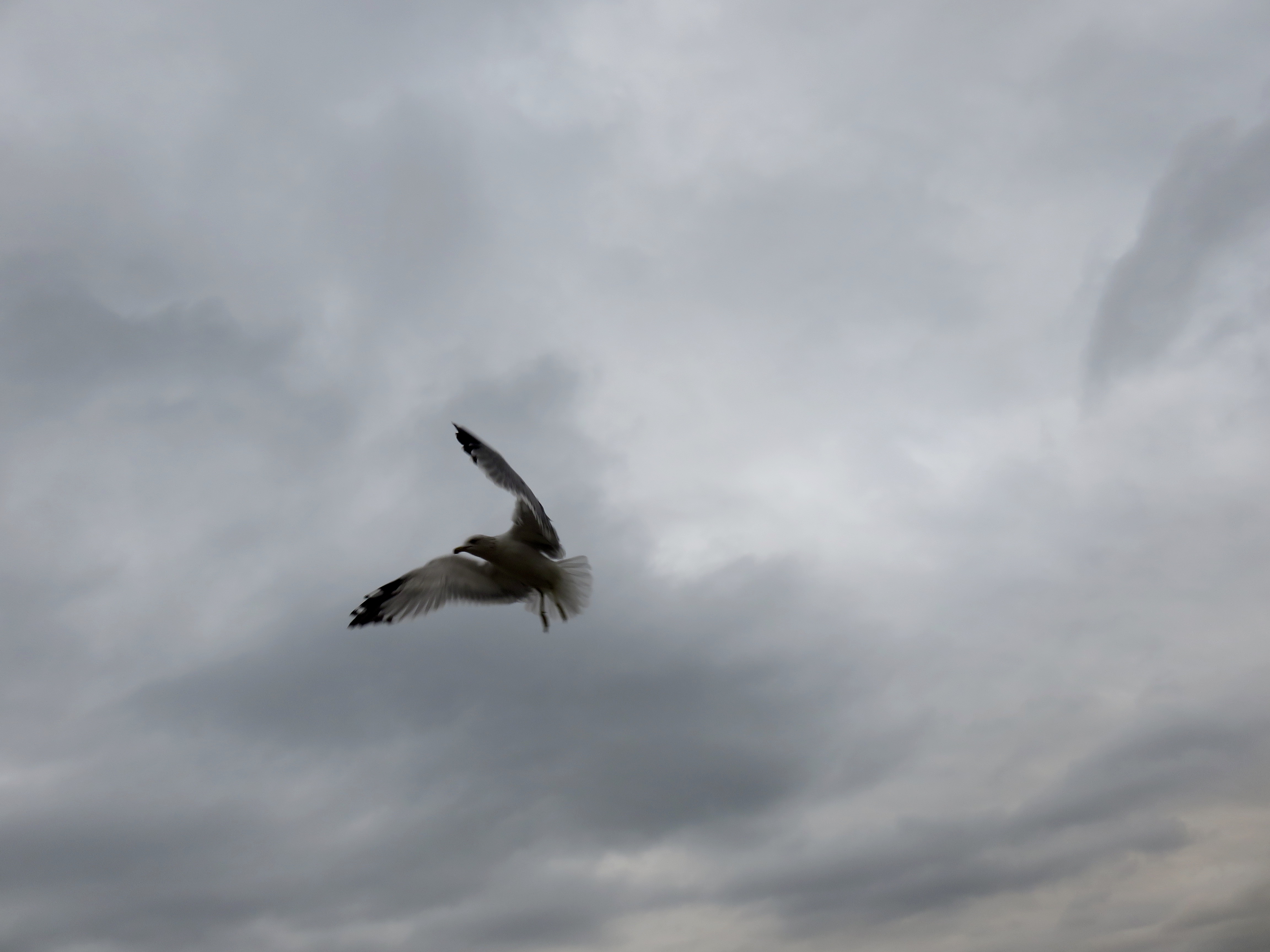
Sometimes the only way to survive is just to fly on.

IMG_3390

*I had to go look this up. Not four, seven.