Camp NaNo day 5: SHAPE

Camp NaNoWriMo word count: 6,833 as of 5am, mostly journaling, but also progress on “The Elk Pact” that might be next week’s flash fiction. I have four others that need a look. I have updated my word count and then I will stop writing for a while. For me, this means for a few hours perhaps. I would stop working for the day, but I am meeting a friend to discuss our writing. I will bring “And Another Thing” about the man in the bar. I will whine about the novel. 

Revised novel EMD word count: 74,883 The entire novel is roughed back in. I worked from several old drafts, though I have not returned to the story that started it all. 

I started work a little after 4am yesterday. I finally put my computer away close to 8pm. My eyes are sore, but the entire novel is pasted into the new document. That’s not what I intended to do but the result of unwise impatience, I fear. I just wanted it all there. I wanted to arrive at what is to me the most powerful moment in Thena’s story, which is now the last line of the next-to-last chapter. 

I worked from several drafts written over the past three years and cut more than 15k words out of the final third—I hope this is the part that dragged—not to mention moving passages revealed earlier to later and putting a couple of flashbacks into more-or-less chronological order and, perhaps sadly, cutting back on the romance that has always felt a bit forced. A couple of times I tried to set the novel down, tried not to move ahead beyond what was carefully edited (another reason the last third dragged?), and tried to work on something else. Every time I went back to this story. 

Part 2 has a new and necessary chapter focused on the relationship between Thena and her daughter. Part 1 is mostly done and concerns regret and digging back out of it. Part 2 is triumph and obliteration and might be half complete. I returned to my initial choice of withholding specifics until later while revealing the general loss. I will save the details for Part 3, which is more or less forgiveness. I am building a new story arc.

I wanted 75-80k when I am done. There is still work to do in the middle, but further butchery toward the end, including entire unnecessary chapters already cut near the back. I need to go faster right at the end, not in the revision, which will continue for the rest of the month and go slowly indeed. My fear is repeating myself. I have already caught myself having done that. I have copied and pasted the same passage. 


We did not take our walk yesterday morning. Gary insisted he was not up for it, but then worked on the front yard where the deck is gone. The ocean rolled in mostly one breaker at a time, what I always think of as her “tame animal” behavior. This is our payment for stiff wind and rain the morning before when we did get a walk. But we went out late in the afternoon and visited with a couple on vacation from Tokyo.

After receiving six (6!) emails in the last week from Consumer Union about stopping robocalls, I unsubscribed. 

I will stop writing for the day. My eyes are tired and I need a break, and probably I will not be able to resist opening my novel and looking and writing more, but I am reading from book 9 of the Patrick O’Brian novels and feel the need to focus on the adventures of Jack Aubrey and Stephen Maturin. Maybe I will wash the glass in the front door—a manageable and measurable task sounds just the ticket. When I told Gary I thought I would take the rest of the day off, he said, “You mean I get my wife back?” Maybe, for a few hours. He has nearly finished reading Part One of Don Quixote. I am still reading Mother Is a Verb (I would love it for the cover alone).We are well caught up with our books. 

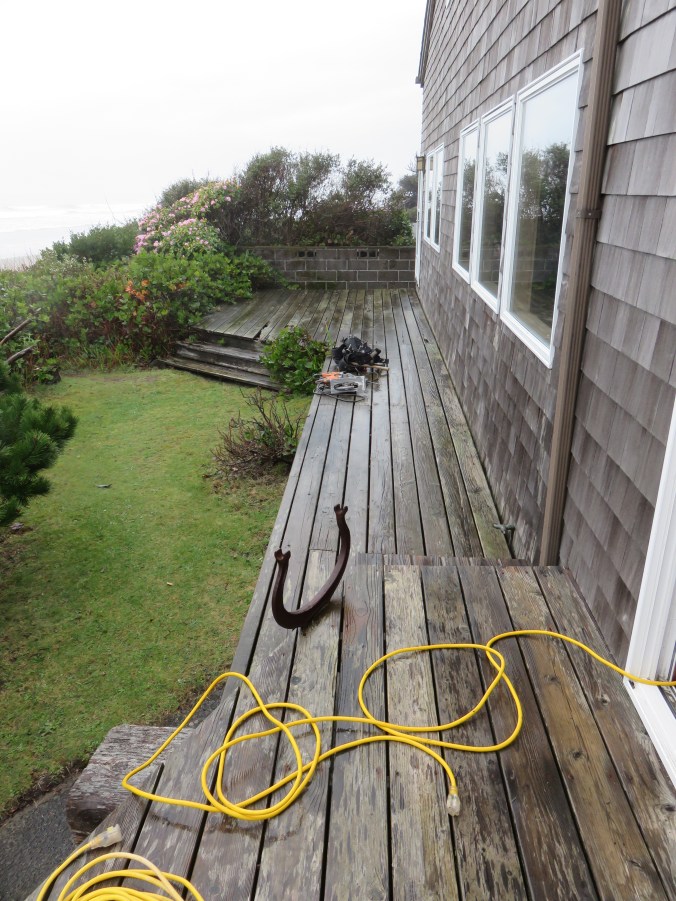
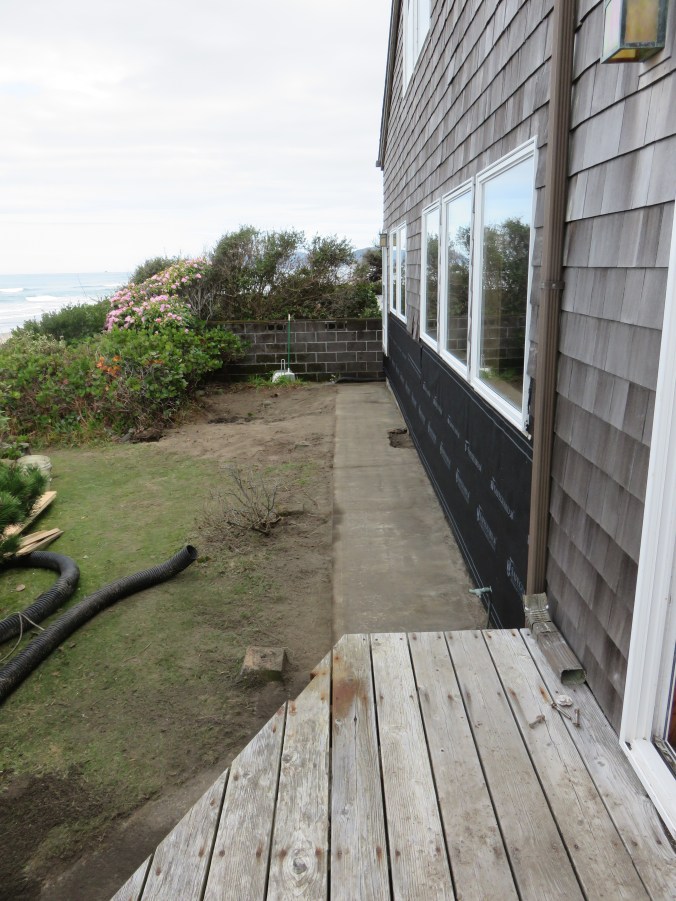
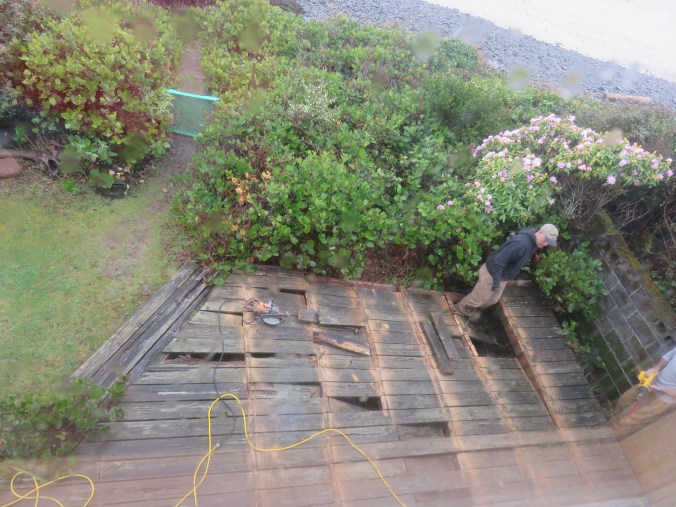
Below are photos of our missing deck. Gary does not want it returned. If you find a wild deck wandering about your neighborhood, you are free to lead it home and keep it. 

IMG_3997

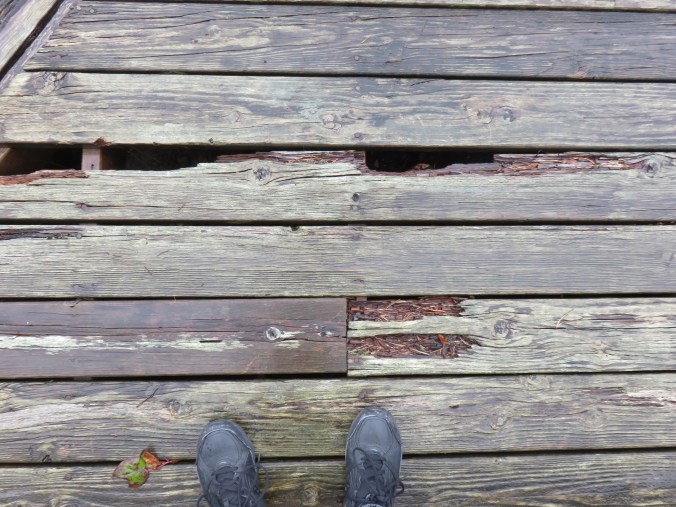
It won’t look too bad from a distance, but this photo shows why we tore off our deck.

IMG_3999

Here the deck is cut up. Jeremy has a place that will take the lumber and find a use for it.

IMG_3996

Here’s the deck from the south just before the work began. The boards in the foreground are staying.

IMG_4003

AFTER—the old concrete walkway is exposed after Gary did the tidying up yesterday morning. Jeremy is preparing to reside the sandblasted west face of our house, so he’s taken off the lower courses. The pink rhododendron is blooming.

Camp NaNo, day 4: ORDER

Camp NaNoWriMo word count: 5,576 as of 6:30am this morning, mostly journaling, but I have started a new story, a single page so far. That will be the fifth flash, I think.

Revised novel EMD word count: 20,027 Chapter 1 “Lying to My Mother” (4448 words) + Chapter 2 “Surrender” (about 5791 words) + Chapter 3 “Lying to Myself” (5476 words) + Chapter 4 “Finding the Will” (4170 words so far) is still in progress. I hope to complete the first four chapters and begin work on Chapter 5 “Painting House” this morning. That chapter will complete Part 1. It is deeply satisfying to me to restore my original structure. It might even work. I created a Table of Contents for EMD, chose titles for the fifteen chapters, and resisted—hard—the impulse to paste in additional chapters from earlier drafts. I want to work front to back on this revision. I am trying to stay on task.

We managed a walk yesterday. I emptied the linen closet. Gary worked on the front yard, clearing trash and sand off the concrete walkway and is paying for that this morning.

We were crazy-busy the rest of the day. Maybe tomorrow I will post photos of our missing deck.

Camp NaNo, day 3: DOUBT

Camp NaNoWriMo word count: 4840 as of 6am this morning, mostly journaling. One completed flash fiction (920 words) for this first week.

revised novel word count: 9817 Chapter 1 “Lying to My Mother” (4448 words) + Chapter 2 “Surrender” (about 5297 words) needs reworking. I know I am making a mess for later on, but there, at least I am writing. This afternoon I will rough-in Chapter 3 “Finding the Will” and hope to accomplish another 5k words. Not new but reworked/reframed.

As of yesterday afternoon, my plan is to write, just write anything, for NaNo and count those words each morning. For the rest of the day I will work on the novel. Fifteen chapters? The NaNo word count, therefore, is what I have accumulated as of this morning. My word count for the novel is what I did as of yesterday.

My first flash fiction looks “done” and I am journaling to gain words for CampNaNo. Separately, I am revising the novel EMD, chapter by chapter—messier than it sounds since the chapters are reordered and recombined—reintegrating old material, writing new, editing as I go along. If I “complete” a chapter every other day I might be done with this new structure by the end of the month, and if I complete an essay or flash fiction each week, I will meet my CampNaNo goal. That much looks good.

This morning I am much less confident about what I am doing with the novel. The three parts I had in mind yesterday—Denial, Regret, Afterward—feel wrong today. Today I think: Regret, Grief, Hope. But how to cram the entire recovery/denouement into a quick swipe at the end? How to sustain tension, shift the dramatic high nearer the end? I would like to push the end of “The Promised Hour” close to the end and then the last chapter kept as is? Do I want less focus on Thena’s relationship with Larry, or do I want to reframe that or do I want some fantastical what-if that is all in her head? (Well, you know I want to do that.) Can I actually delay telling the story of the murder? I told it last in the original short-story version and I was totally smacked down for that. I never learned how to build tension. I can build and sustain tension, of course, I have done it, but that doesn’t mean I know how to do it here. I suspect that is something I must learn over and over again. (Karen Joy Fowler said that she struggled with her current project and her husband was there to remind her that she’d struggled each time.) 

I fear I will spend a good deal of time whining during my meeting with Ann on Friday. But at least I have the flash story to share. I plan to bring one to each of our meetings. That will allow me to meet at least my original goal for the month.


Yesterday, Jeremy and his helper had the entire rotting deck cut apart and gone before noon. We may not rebuild most of the deck. No Scrabble this week because of work on house.

I made Pad Thai for lunch yesterday and finished the federal taxes in the evening. I made a first run at the state taxes (even more pages and also a new set-up). I know most people either use the online tax computing system or an accountant. I thought about that a lot while I was fighting with forms. But I am the person who prefers to understand how to create an APA reference rather than using an online source. I want to understand how it works.

Today, we woke early and hope to get a beach walk (we missed four days—our longest stretch in two years), clear out the linen closet, and finish the taxes. And there is more cleaning and painting in the apartment before our new tenant moves in . . . I have promised Gary we will never have to paint again as long as we live, but that also means I will have to paint the walls in the hallway pretty quick!

Will there be time for reading?


NaNo, day 2: MY WORDS TODAY

My posts for this month are likely to be entirely uninteresting. I am writing, seriously writing, and also journaling about writing. These are some of my words today:

I am reading about subtitles. The examples mostly came from nonfiction, memoirs, essay collections, but then I thought: Why not?

Everybody’s Mother Dies: A Novel About Living Past Regret

I think I might divide the novel into Denial, Regret, Afterward. I am not happy leaving work unfinished, and that novel is unfinished.

NaNo word count: 3726 as of 8am

revised novel word count: 0

I have revised a flash fiction from working hard yesterday, a funny piece called “And Another Thing.” It’s been a long time since I wrote funny. It’s about a drunk man in a local bar who manages not to get into a fight, this time. I read it aloud to Gary and he liked it, asked me where it came from—I have no idea. I will still plan on accomplishing my original goal for the month: 4 polished pieces prepared for publication, with all that alteration entirely by accident. Now I will also try to rewrite the novel.

STICKER PRICE

I did not have my camera with me so I cannot post a photo of the orange-juice orange Mustang we saw this morning at Costco. The sticker price is a tad over $44k, but I could save $4k buying it from Costco. I laugh about this because the color is one of my husband’s favorite (bright) car colors, and because somehow we managed to raise a son who likes muscle cars. Yes, it’s true. He bikes or busses or walks to work and doesn’t own a car, but if he had one it would be a Mustang GT. Or something like it.

April I have committed this year to CampNaNo again, a daily writing tracker. National Novel Writing Month (NaNoWriMo) in November involves a commitment to 50k words in 30 days. I’ve done it three times. The “Camp” in April works differently and allows writers to determine how many pages or words or hours or minutes of time they want to commit to.

I dithered and pledged something easy. I pledged to write 10,000 words. I expect to exceed that, and so far have 2900 words. But here’s the thing: What do I really want to work on? So far I have taken fragments of story ideas and worked on those. Do I work on one of the novels? fantasy and SF? flash nonfiction? poetry for National Poetry Month?

Good questions.

So far, as I said, flash fiction:

“And Another Thing” realist fiction about a drunk in his bar confronting another drunk, and it’s funny. It’s been a long time since I wrote funny.

“Final Words from the Master” is a first contact fantasy about the end of a seriously unfortunate landing on what might be Earth by kinder and more intuitive people than ourselves.

“The Way They Disappeared” about a young girl who causes an attacking hand to, well, disappear.

“Rapunzel” is realist fiction about a girl scooping ice cream in a tourist-town, and it makes her ears cold—actually no idea where this will go. Also funny.

What I think I most want to work on is a novel that no one wants. My goal was to show the hard work of recovery from overwhelming grief, but that grief-inducing scene remains the highlight and I kept pushing it earlier and earlier into the novel in order to focus more on what happens afterward. Every time I tried to reveal that event late in the narrative, I got chewed, even when I left foreshadowing hints big as pink elephants. And with that scene near the beginning, the rest of the story apparently feels like a letdown. There must be a way to fix this, but I do not seem to be a good enough writer to figure out how. Still. I might try again.

Maybe create a short story to try out a different structure? What if the grieving mother imagines other ways her life might have gone? What if grief is her best option? That’s cheery.

Or I could work on another manuscript entirely. I have a novel that won publication and prizes for the first chapter. Maybe that one?

Or flash.

Stay tuned for daily updates and maybe a shared story along the way.

post-AWP


IMG_3994

So we went, I saw, and we came home again. Fourteen thousand people. I saw Marvin Bell entering the building as we drove past. I am mostly the invisible woman, too old to matter, but there were amazing people all around.

My choices of what to bring home were determined by money ($15) and covers. I am a genuinely shallow person who chooses books for their covers. Then I read the first page. Believer is stunning. Witness (a journal I have long admired) gave me a free issue because I rolled 9 three times in a row. Ruth Gundle (bless her!) handed me Judith Barrington’s newest. I could not resist buying Karen Joy Fowler’s new collection of short stories (charged it!) and then three volumes of poetry (Dan Kaplan’s cover was not great imo, but a peak inside revealed his write is). I could have spent a couple of days trolling literary journals. I had less than an hour.

I went to only one presentation (seriously, just one) and it was a perfect choice, even though I am not teaching anymore:

S157. The Most Versatile Essay: Flash Nonfiction in Any/Every Classroom. (Brian Benson, Allison K. Williams, Sayantani Dasgupta, Anna Vodicka, Celeste Chan) Even the most reluctant-to-write students take to flash essays. Drawn to their economy, they’re won over by the urgency and potency of the form. From the academy to the incarcerated, beginners to advanced, flash nonfiction is a boon to writers of all stripes, and a vital part of teaching in the technological age. Panelists will discuss the versatility of the form, successful teaching strategies, prompts, exercises, and go-to resources from a range of educational settings and pedagogical perspectives.

Panelists represented programs from all over the U.S. and the world. Hugo House in Seattle, The Attic in Portland, as well as academic and commercial backgrounds. Pages of notes! I received a wealth of excellent advice from five people who write nonfiction, are active members of writing communities, and shared years of specific, hands-on experience working with young adults and adults. Though I have taught for 40 years, I learned from each member of this panel and left feeling energized and excited by approaches that were entirely knew to me.

I hugged Allison, shook Dinty Moore’s hand, bought Karen Joy Fowler’s new book, two poetry books from Burnside Books, plus another book written by the person working that booth—gorgeous all! I rushed through the Book Fair. Presses I have submitted to, presses holding work, some who have sent me kind rejections, and others who sent me form rejections. It was pretty overwhelming.

And then I sat and talked to Molly Gloss and Bette Husted and when Karen Joy Fowler showed up, we all talked.

I had arranged to meet Gary outside at 2:30, and as I went down the stairs I could see him through the window. There he was on the sidewalk talking to Ruth Gundle while she waited for Judith Barrington to pick her up. Brilliance everywhere I looked.

Five hours of literary illuminaries.


Gary felt I should mention the $4.25 for a Pepsi. He’d waited in line for 10 minutes and felt disheartened by the price. He left his change as a tip, and it wasn’t cold, though the young man who handed it to him was touched to receive a tip.

I had told him I would not be buying lunch. That much I know about conventions. He is still ranting about that Pepsi, “my AWP experience.” He was a grocer for much of his adult life and knew what was paid for that Pepsi.

Bette or Molly told me I’d missed Nisi Shawl. I missed Debra Magpie Earling. There were many people I would have enjoyed shaking hands with. I took no photos, though I had my camera with me. I knit a couple of rows on a baby blanket. I limped.

AWP

fullsizeoutput_edf

There are beautiful and interesting places all over the world. This is mine.

So yes, I am going. I am going to the national conference today, just for a few hours. Originally, because it is in Portland and has not been here in ages and because I know many people who will be attending and serving on panels (though specifics were hard to come by unless an individual posted them) and because, you know, I realize I should go, I was going for three days. Then I thought we would dive in twice, over the Coast Range and through the woods, but no.

The truth is that conferences overwhelm me. I am always glad once there, but . . .

It was two of our grandchildren who drove over the river and through the woods to grandmother’s house. They arrived in time to keep me home for all but one day. (And I will not post photos I did not take, but it was a really wonderful visit. We played Uno and made jewelry out of shells found on the beach, and I made waffles.)

The Burnside Bridge is down for repairs and Gary had planned to drive that way. We disagreed about how far the Oregon Convention Center is from Powell’s City of Books (no one should miss that). Gary thought it was miles, I thought it was closer. Google Maps suggests a 26-minute walk, 1.2 miles. I will wear my walking shoes just to get around the convention center. I used to take students to Powell’s on unofficial field trips.

So today. I hope to finally meet Allison Williams in person, and to visit with Bette Husted and Molly Gloss, and why didn’t I email Felicity? Jeannette will be busy and I have not heard from others. This is the disadvantage of leaving Facebook last month.


HORSES and FOSAMAX

fullsizeoutput_ede

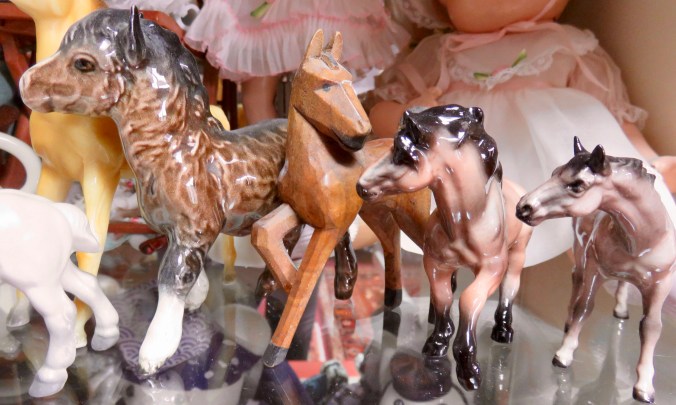
A few of my horses in the foreground. My mother’s and aunt’s dolls in the background.

There’s a connection. Wait for it.

I was crazy for horses as a child. I begged for horse figurines for my birthday, read every horse book in the juvenile section of our local library before I hit adolescence and loved the smell of horse manure. “Can’t I have a pony?” Not in suburbia. I read a British book on stable management intended for adults. I correctly predicted the winner of the Kentucky Derby five years in a row.

In high school, my mother finally granted my dearest childhood wish and gave me weekly riding lessons for a few months. I was terrible. I’ve been bit, kicked, and thrown twice. The worst was the bite’s deep bruise. My last time on a horse my dismount was an embarrassment.

Even all that is not enough to ruin my passion. I still love horses, but I could never afford to keep them.

Instead, for a few decades I showed sighthounds (Afghan Hounds) and ran them in field trials through the American Sighthound Field Association (ASFA) and as one of the original people involved in founding the Canadian Sighthound Field Association (CSFA). I served on Boards. I chaired events, I designed logos, I edited newsletters.

At shows, I sometimes saw medication in tack boxes and overheard conversations about the use of various what-now-would-be-called “performance enhancing” drugs. One Afghan breeder willingly told me she had to medicate her foundation stud because otherwise he was too fearful to show. I witnessed a dog from California bite the judge who went on to give him Best of Breed—that dog is now described in almost worshipful tones by people who never actually saw him in person. In addition to problems with temperament, I knew the dirty laundry about rare eye and hip and thyroid diseases. I ran eye clinics. I read the research. I was careful breeding, and mostly didn’t.

The American Kennel Club has never been quick to address breed problems, trusting the breeders who register puppies to police themselves. (No surprise that judges were always Mrs. or Miss, no Ms. allowed when I was active.) Using drugs on show dogs was absolutely forbidden, but no one was checking. So I began to wonder about how drug abuse in show dogs might be better managed?

I cold-called the Secretary of the Oregon Racing Commission, which at that time regulated dog racing in my state as well as horse racing. This would have been in the 1980s. I had rehearsed my line: “Hello, my name is Jan Priddy, and I am writing an article about drug use in show dogs and would like to know how the state Racing Commission handles drug use in track Greyhounds.” It was a good thing I knew that line because I would repeat it several times.

The Secretary’s secretary was the first to ask, “Who are you? And who are you writing for?”

I repeated my lines, “My name is Jan Priddy, and I am writing an article about drug use in show dogs and would like to know how the state Racing Commission handles drug use in track Greyhounds” and added: “I am free-lancing.”

Almost instantly I was put on to the Secretary, who naturally asked me who I was and who I was writing for?

“My name is Jan Priddy, and I am writing an article about drug use in show dogs and would like to know how the state Racing Commission handles drug use in track Greyhounds.”

“I don’t have time to talk to you,” he said in an irritated tone. He asked me to tell him again who I was. So I did. Again.

And then curiosity got the better of him. “What are they using on show dogs?”

I named what drugs I had seen, including the one I still remember: “bute” (a steroid).

“I don’t have time to talk to you,” he said again, and then: “Why would they do that? Is there any money in showing dogs?”

“Not really. Not at all. It’s an expensive hobby, but there’s ego at stake.”

“I don’t have time to talk to you.” He said it four times, and I said my line four times, and then we talked for almost an hour while he told me how the Racing Commission monitored drug use on racing Greyhounds. He told me the drugs they could test for and the ones they hoped to be able to test for by the following racing season. He told me the drug they tolerated, even though they could test for it, because if they outlawed that drug, trainers would use another drug they could not test for. “And that one is really bad, harder on the dogs. But we once we can test for that, we’ll outlaw both.” He was optimistic about getting ahead of the curve and outlawing medication entirely in racing Greyhounds.

Win and place were tested in every single race. About once a day and without warning, every single dog in a race was tested. Once a month, on an unannounced day, all of the dogs on site—retired dogs, non-Greyhound pets, and Greyhound puppies as well as dogs currently racing, every single dog at the track—were tested. If there was any drug detected, the owner and trainer and all their dogs were banned. The wrath of god came down upon them, and I was talking to god.

By the end of our conversation, god was quite pleasant, I had learned more than I knew there was to know, including the name of the lab that did State blood testing. He offered, at any time, the use of that lab at his cost to test show dogs. I knew that was never going to happen, but I shared his optimism about a drug-free future for racing Greyhounds.


Step forward 35 or so years. I never completed writing my article, I no longer show Afghan Hounds, there is no Greyhound racing in Oregon, and 22 Thoroughbred racehorses died in the last few months in California at the track. No one wants to admit that drugging racehorses is a major contributing factor. (My friendly god was wrong to be optimistic.)

A French racehorse trainer has been arguing for a reasonable approach to drugging racehorses for a long time. Here’s a statement from over a decade ago:

“Anyone who has read any of my comments to posts or my articles will know that I believe eliminating all race-day medication and the use of steroids would be the biggest, most effective first step. Steroids bulk up a young horse’s muscles to a level that the skeleton cannot support. In France, the trainer of a horse that tests positive for steroids will lose his or her license — permanently. A ban on race-day medication of any type seems painfully obvious. If a horse needs medication, it is not fit to run. That principle governs the rules of racing in all of Europe, most of Asia and Dubai. The United States, Canada, Saudi Arabia and some South American countries allow a panoply of race-day medications from anti-inflammatory drugs, which mask pain, to lasix, the diuretic drug that some believe controls bleeding in the lungs of a racehorse.”—Gina Rarick, 2008

More recently she blames the recent racehorse deaths on a number of factors including track surface but there is still the way Americans drug our horses. Yesterday she mentioned steroids, including bute, but also this:

“Breeders need to get the highest price possible for a yearling, so in addition to corrective surgery to fix defective legs, they use steroids to add bulk and sheen, and bisphosphonates to stabilize the bone structure. But these bisphosphonates also limit new bone growth, impairing the young horse’s ability to adapt to the stresses of training and racing.”

“Once the horse has fetched that high price, there is huge pressure on American trainers to get it racing as soon as possible to cover the costs of the purchase and training fees. That means the young racehorse is treated with endless rounds of so-called therapeutic medications: phenylbutazone, known as bute, to help with the aches and pain; clenbuterol to keep the lungs clear (plus there’s that added steroidlike side effect, which keeps them eating and keeps the weight on); and the diuretic Lasix every time before fast workouts and races, ostensibly to prevent bleeding in the lungs. There is little science that says Lasix actually does that job, but quite a lot of science identifying Lasix as a performance-enhancing drug.”—2019

The danger of bisphosphonates is what caught my eye. I wondered how long horse people have been aware that the drug may suppress healing. The result is that micro-fractures or cracks in a bone don’t heal, and if too much minor damage piles up, even a minor bump can result in a disastrous fracture for an animal weighing well over a thousand pounds traveling over 55 mph. The horse breaks a leg and is put down on the spot.

[I remember when the great filly Ruffian bumped into the starting gate and after she took a misstep on the backstretch, broke a leg and was put down the same day. According to Wikipedia: “Medications such as corticosteroids for inflammation and pain management came into common use. However, while helping the horses in the short term, the increased use of medications at the track had a downside, as many more horses were raced while injured. The average number of starts per year steadily declined, though this may also be attributable to economic factors.” I was watching that race when it happened, and mostly stopped watching horseraces after Ruffian was killed.]

Here’s the leap: bisphosphonates are used to treat osteoporosis in human beings, hundreds of millions of human beings have taken this drug. It does increase bone density and studies show that reduces hip fractures. But maybe bisphosphonates are not without drawbacks. A Harvard study in 2006-2008 found that the use of bisphosphonates such as Fosamax used to build bone, might result in fracture from even a slight bump. “The researchers concluded that long-term Fosamax use is a significant risk factor for low-energy fractures of the femur.” Studies conclude, as the French horse-trainer mentions, that bisphosphonates build bone quickly but are not without their down side.

My mother was on Fosamax for a very long time, far longer than the 7 years in the Harvard study. During the years she was on that medication she broke several bones including her arm and both hips, each hip requiring replacement. She did not recover from the second hip fracture. The surgeon shattered her pelvis while trying to repair it. (I shamelessly eavesdropped on the surgeon’s conversation with Mom’s GP. He said he could not understand why her bones were so brittle.)

I have always been a milk-drinker, but I stopped cold after my second bone scan showed terrible score, and then my scores actually improved a year later after I lowered calcium in my diet? They improved again after a year on Fosamax with calcium and D, but none of this means much of anything because each scan showing deterioration or improvement was done on a different machine and bone scan machines are not normalized one against another. Each one does its own readings and has its own standards. Any decent medical advice website will warn you to be sure you are always scanned on the same machine. Even my “second opinion” emphasized that. My local hospital keeps replacing its machines and scores from one machine cannot be compared to scores from another.

And, yeah, how dumb is that? If the scans were reliable, wouldn’t they each find the same reading? But, no, they do not.

So after my most recent scan, I checked back to see what machine had been used each time. When the letter came from my GP expressing optimism that the therapy was improving my bone since my scan numbers had shown improvement, I posted her right back that the new numbers were pretty much meaningless since they came from yet another new machine.

I went off Fosamax in January after a little more than 2 years on the medication. I feel better, maybe. But maybe that’s because I am more careful about water and calcium and vitamin D? Maybe in a year or so, I will go back on the drug? I can’t be sure it’s helped me. Maybe it has, but my bone scans have each time been conducted by a different technician on a different machine, and then, each time reviewed by a different radiologist, I have little confidence and no trust. I tried at the beginning to get a second opinion about my bones before starting treatment, but all I got was a second opinion telling me Fosamax is great, not a second opinion willing to even glance at my medical records or family history. Seriously, he joked about inter-hospital rivalry, refused to look at my records, and mostly got his notes wrong.

If the doctor is making medical decisions about my health based purely on averages and not considering me as a person? I would rather have that new computerized diagnostician. And the physical literal hand-holding (which I experienced only once at another hospital)? Some local doctors all went to a seminar to learn how to pretend to care. It doesn’t mean that are better at their job. It doesn’t mean much at all, though it feels sincere.

Some doctors really do care. There is still at least one local who has not retired, but he is not in family practice anymore. None of the good ones are, it seems.

Once they find a treatment and procedure that insurance will pay for, it’s hard to let go. Statistics suggest Fosamax helps, so it must be okay. And “talk to your doctor” isn’t always an option. (My doctor prefers to lecture rather than listen to anything I might say.) Fosamax is cheap but there are far more expensive substitutes doctors keep urging me to try, just as there were for the drug my husband was on after his one blood clot. I have even less faith in options that have not been in use for decades.

I walk 45 minutes each day. I watch my diet and drink my water and rest and get my sleep and do what I can to stay healthy. I am not as prone to falling as my mother, but I have fallen without breaking a bone, and I am not having another bone scan or taking Fosamax the rest of this year. If the French trainer is correct, there will be another rash of deaths of racehorses on an American racecourse all too soon. I hope to learn from their bad experience.
Harriet Tubman

2017_30_47_001detail.jpg

The Emily Howland photo album containing the portrait of Tubman, (above: detail, ca. 1868) was unveiled this week at the Smithsonian’s National Museum of African American History and Culture. (NMAAHC, Library of Congress)

800px-Harriet_Tubman_by_Squyer,_NPG,_c1885I have added the photo above to the post from this morning: UNDERGROUND RAILROAD. Harriet Tubman would have been about 36 years old.

The photo at left is the more familiar one from when she was in her sixties, long after the Civil War.

According to Wikipedia: “Harriet Tubman (born Araminta Ross, c.  January 29, 1822 – March 10, 1913) was an American abolitionist and political activist. Born into slavery, Tubman escaped and subsequently made some thirteen missions to rescue approximately seventy enslaved people, family and friends, using the network of antislavery activists and safe houses known as the Underground Railroad. She later helped abolitionist John Brown recruit men for his raid on Harpers Ferry. During the American Civil War, she served as an armed scout and spy for the United States Army. In her later years, Tubman was an activist in the struggle for women’s suffrage.” Also known as “Minty” and “Moses” for obvious reasons, Harriet Tubman died at the age of 90 or 91.

She served her country and its people in every possible way, with honor, courage, and dignity.

UNDERGROUND RAILROAD

I was reading The Underground Railroad by Colson Whitehead. In a blurb on the back cover, Oprah Whinfrey urges people to buy a second copy for a friend “because you are definitely going to want to talk about it.” Someone asked me to be that friend.

This fantasy fiction details real atrocities committed against African Americans over the past two hundred years in the fictional life of a woman named Cora, born a slave. There is no fiction in these burnings, beatings, and other bald unwarrantable usurpations Whitehead describes, though they are unlikely to have all been experienced by one person, and did not occur as described since some events are expanded in scale or compressed in time, and some happened in the following century. (Those alterations and inventions do not make the suffering any more disturbing, but considerably less so. I kept wondering why it was necessary to exaggerate an already abominable history? My friend tells me she can set history aside, but I never can. She’s right about that.)

And then there is the literal manifestation of railroad tracks and engines underground. Sometimes they went the wrong way. I liked that a lot. Such is real life. Sometimes.

Cora jumps on the underground railroad without knowing its destination, just desperate to escape. There was no telling. From Georgia, her first ride takes her to South Carolina.

Late in the novel, Cora begins working on a side branch of the underground railroad—no engines here, only a hand-driven cart through a narrow tunnel headed north from Indiana. There’s more. But step aside for a moment.


There was a real woman in Indiana working for the Underground Railroad during the first half of the nineteenth century. She was born a free person in the slave state of Delaware in 1823. She traveled all over, and she would eventually marry and raise two children. Her husband died four years after their marriage, and like many woman in my family, she supported herself and her family. Her home in the last years of her life in Washington DC has been designated a National Historic Landmark. She is easy to research.

“Mary Ann Shadd Cary (October 9, 1823 – June 5, 1893) was an American-Canadian anti-slavery activist, journalist, publisher, teacher, and lawyer. She was the first Black woman publisher in North America and the first woman publisher in Canada.

“Shadd Cary was an abolitionist who became the first female African-American newspaper editor in North America when she edited The Provincial Freeman in 1853.

“During the Civil War, at the behest of the abolitionist Martin Delany, she served as a recruiting officer to enlist black volunteers for the Union Army in the state of Indiana. After the Civil War, she taught in black schools in Wilmington, before moving to Washington, D.C., where she taught in public schools and attended Howard University School of Law. She graduated as a lawyer at the age of 60 in 1883, becoming only the second black woman in the United States to earn a law degree. She wrote for the newspapers National Era and The People’s Advocate and in 1880, organized the Colored Women’s Progressive Franchise.

“Shadd Cary joined the National Woman Suffrage Association, working alongside Susan B. Anthony and Elizabeth Cady Stanton for women’s suffrage, testifying before the Judiciary Committee of the House of Representatives, and becoming the first African-American woman to vote in a national election.”—Wikipedia

Undergroundrailroadsmall2.jpg

A nineteenth century map of the Underground Railroad.


I felt held at a slight distance from Cora. This impression was underscored as I read accounts of real women living in slavery in Mother Is a Verb by Sarah Knott. This well-documented nonfiction about mothering, speaks from the author’s personal experience as a new mother and from first-person accounts of real women from hundreds of years past. Two pages about slave labor in the fields created a greater intimacy than I found in The Underground Railroad. I felt at once that I was reading truth, and I never quite felt that in the novel. (Perhaps arguing with his mucking about with history.)

Nevertheless . . . Whitehead is a wonderful writer, and I waited to fall under his spell; he certainly casts one.

“Before the book the only thing to read was what came written on a bag of rice. The name of the firm that manufactured their chains, imprinted in the metal like the promise of pain” (235).

Their chains do not belong to them.

2017_30_47_001detail.jpg

The Emily Howland photo album containing the previously unknown portrait of Harriet Tubman, (above: detail, ca. 1868) was unveiled at the Smithsonian’s National Museum of African American History and Culture. (NMAAHC, Library of Congress)