HOPELINGS

header+logo+2Bracken, the online journal from Washington, believes in hope to get us all by through with “love of the woods and its shadows.”

It is a beautiful magazine I’ve already recommended. Begin with Bracken’s main page because just now you do not want to miss another look at Amanda Greive’s art, and then click on “Coronavirus Hopelings” for a series of lovely offerings. I sincerely recommend the short piece from yesterday, called “Yellowing.” I’m there too.

P.S. I am a little embarrassed to ask, but I would be grateful if you “liked” my photo essay at Hopelings.

FATHER OF MINE

IMG_3723

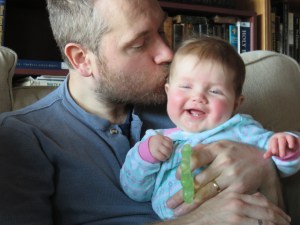
Gary “being silly” a couple years ago when he still had four hats.

My own father, Arthur Henry Priddy, kept “salmon” (orange) three by five cards in the breast pocket of his shirts and he wrote with a striped green fountain pen in blue-black ink. When I asked him questions as a child he always knew the answers. When I wanted to know about trade in the Minoan empire, he pulled out one of the cards and his pen and described their form with a few graceful sweeps of that coveted pen. He told me that Columbus did not discover America and that, in fact, he had not even been the first European to reach its shores. On separate cards he drew the vessels used by Chinese, Portuguese, and Viking explorers and fisherfolk. He always answered my questions. Sometimes he took a very long time answering and I was almost sorry I asked, but the answers always came.

•••

IMG_1797

Our older son with his daughter.

My father had been a small, slender boy in a time of Clark Gable shoulders. He was an only child and when his parents divorced, he was raised in a household of three women—mother, aunt, and grandmother. Throughout his life he honored women, but aspired to the masculine pursuits available to his frame. He learned to target shoot and play chess, fly fish and take photographs. He set a record swimming the butterfly, played water polo, and raced bicycles in Los Angeles. He joined the Army in 1942, earned a purple cross and liberated a German concentration camp. He worked for the Bureau of Commercial Fisheries until arthritis stopped him. Over the years he lost his childhood faith and many of his prejudices as he placed his life into the hands of people he’d been raised to distrust.

•••

IMG_2915

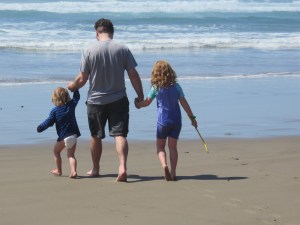
Our younger son with his two.

When the arthritis began, my father hiked the Olympics alone or with his son. He slowed but kept moving, determined to find a way out of the pain. The jogs on the beach ended and the quick flip from prone to standing that made his children squeal with delight. He paced himself and dealt with the setbacks as they occurred. He might spend four days backpacking the High Divide and then pay for it with crippling pain. He might hike for a week, rest, and find he could not walk at all.

Most often, as the rheumatoid arthritis consumed him, he awakened resentfully, late, each stir in his narrow bed a difficulty. He felt the grind of bones on edge and he did not move without purpose, no wild thrashing in his sleep or cat stretches in the morning. He wore familiar clothing and slippers that knew the twists of his body. He sat on the edge of his bed and smoked Camels cigarettes and listened to the radio. He had surgeries to remove spurs of calcium but over the years illness robbed him blind, literally. But it was cigarettes and cancer that took him. 

After two radiation treatments he refused to have tubes or a hospital gown, but only a sheet. The oncology nurse took my arm outside his door and told me he was dying. “If he’s trying to leave us, we don’t want to call him back.” She stopped another nurse from turning him and the blood cart from taking tests, until she could find a doctor to cancel them. She darkened the room, drew the curtain halfway to shelter him from the hall, and held my hand for moment. 

•••

IMG_6149

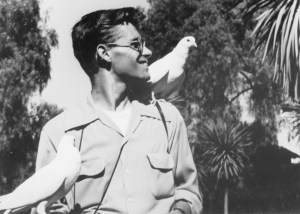
Daddy while at UC Berkeley in the 40s.

My father’s ashes were mailed to me in a little cardboard box and I placed them behind a door in my desk until the other members of my family were ready to deal with them. But one day I opened the door and took out the box, looked at the postmark and realized years had passed. My father had asked that his ashes be scattered on a rock in the ocean in front of my Oregon home, but I would wait no longer for my family to hire a plane and so one morning my husband and young sons and I walked down the beach and let the water take his ashes to the rock in the sea. 

I did not cry that day. I had not cried on the day he died, or even on the day, some time before his heart stopped, when I knew he was already gone. But sometimes, even so many years later, I want to ask him a question, and I imagine his fingers holding a green fountain pen, drawing sailing ships on three by five cards, and the tears come. 

Thank you to good fathers everywhere today and tomorrow and the days after that.


.

Why We Write: On Pandemics, Heat Waves, Police Brutality, and Resiliency

Melissa HartHer mother’s “writing represented both financial and emotional survival. For money, she edited a small newspaper and freelanced articles. For solace, she wrote stories at dawn. Some were published, and some weren’t. Publishing wasn’t the point.”

Melissa Hart is the author of Better with Books: 500 Diverse Books to Ignite Empathy and Encourage Self-Acceptance in Tweens and Teens (Sasquatch, 2019).

Go here to read the whole of it: Why We Write: On Pandemics, Heat Waves, Police Brutality, and Resiliency  


FIRST

Museum of Latin American ArtThe 1st Amendment to the United States Constitution: “Congress shall make no law respecting an establishment of religion, or prohibiting the free exercise thereof; or abridging the freedom of speech, or of the press; or the right of the people peaceably to assemble, and to petition the Government for a redress of grievances.”

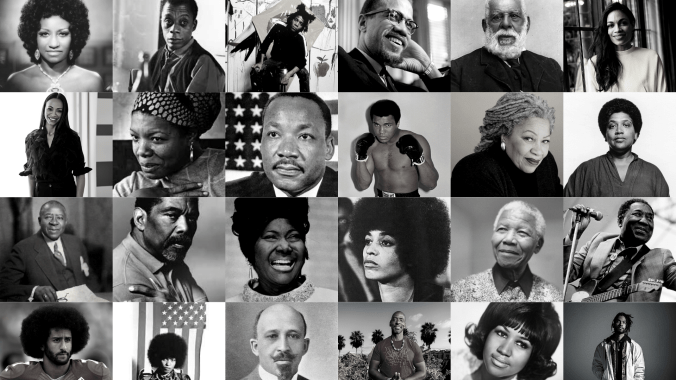
Religion, speech, press, assembly, and petition. Protecting our thoughts, our expression, our access to the news, our right to disagree. These came first.

You might appreciate reading Solnit’s take on what looks to some like an overnight change: “The death of George Floyd was a match that lit a bonfire, and how the fuel for the bonfire piled up is worth studying. That is, for a national and international uprising against anti-Black racism and police violence to achieve such scale and power, many must have been ready for it, whether they knew it or not. Not in the sense of planning it or expecting these events, but by having changed their minds and committed their hearts beforehand. . . . You can point to specifics about this moment . . . But none of these would have signified if the smallest thing hadn’t happened millions of times over: people changed their minds.”

I used to say to my students every time I introduced the persuasive essay, that the most impressive thing they could accomplish while researching and arguing their thesis was if they changed their minds about an issue.

It rarely happened, even in the face of overwhelming evidence, but it was a beautiful thing when it did.

•

•

GENTLE RAIN


fullsizeoutput_125c

The rain has come and gone and come again—sending torrents, sprinkles, showers, mists, and what my grandmother called “pitchforks and hammer handles.”

My feet are still up instead of walking for a couple more days, Jeanie Tomalek’s painting has been lost by the UPS since 19 May, the Russian doll and the CD from Estonia are still somewhere between there and here even though the Atlantic is not so big as the Pacific Ocean, Butterfly Fontanelle has been submitted for the third time (did I already mention that?), the left side of my jaw remains tender (I may never chew on that side or anything crunchy ever again), my son helped me download software that removed the (thirty-eight!) malware things on my computer, I have been revising work for a collection of slightly-to-seriously non-realist stories in order to submit (to someplace), and I am laying out yarn for a “Strawberry” warp. I might not have all the colors I want for the weaving, but I tell myself that sometimes forging ahead with what I have works out best. In between writing paragraphs, I move skeins around. Continue reading →

RISK

fullsizeoutput_1255

A friend traveled to her vacation house, another marched for justice, and our younger son and his children are here for the weekend.

Most of my yarn order arrived in the post office, but we will not visit before Monday or Tuesday. The website promoting my fifty-year high school reunion has not been updated for months. The painting I bought early in May is still lost by UPS. So is Gary’s CD from Estonia and the doll from Russia. I discovered that UPS does not acknowledge or search for lost packages until and unless you absolutely insist. Who knew? Continue reading →

continued SHIPPING ADVENTURES

IMG_6070

The rabbit ate every single leaf off this rose last summer. Gary put her in a cage and she’s blooming. So is pretty much everything!

Some good news and some other news. Mostly funny stuff. Mail, stories, running, television.

The TV remote fell over the back of the couch last night and we could only turn the television on and off, but we could not use the up/down/side-to-side button that would allow us to access anything online. Continue reading →

POLICE, a verb

fullsizeoutput_1248

It depends on what you mean by police. Officers of the peace uses “police” as a noun. Police as a verb is action. To police the grounds means to pick up what does not belong and put it where is does belong, to collect waste and protect order. Policing also means to serve and protect, to serve as a warning and a promise of justice, to provide oversight and balance against incursions by individuals and organizations threatening peace.

police, verb

1:  to control, regulate, or keep in order by use of police
2:  to perform the functions of a police force in or over
3a:  to supervise the operation, execution, or administration of to prevent or detect and prosecute violations of rules and regulations
b:  to exercise such supervision over the policies and activities of
4:  to make clean and put in order
5:  archaic, GOVERN

According to “Defund the police? Here’s what that really means,” an Op-Ed  in The Washington Post this morning:

“To fix policing, we must first recognize how much we have come to over-rely on law enforcement. We turn to the police in situations where years of experience and common sense tell us that their involvement is unnecessary, and can make things worse. We ask police to take accident reports, respond to people who have overdosed and arrest, rather than cite, people who might have intentionally or not passed a counterfeit $20 bill. We call police to roust homeless people from corners and doorsteps, resolve verbal squabbles between family members and strangers alike, and arrest children for behavior that once would have been handled as a school disciplinary issue.”

The author, Christy E. Lopez, is a professor at Georgetown Law School and a co-director of the school’s Innovative Policing Program. “For activists,” she writes, “this conversation is long overdue. But for casual observers, this new direction may seem a bit disorienting — or even alarming.” The goal is not to remove protections, but to shift strategies and redefine responsibilities for public safety.

I thought over my own interactions with police officers and others charged with protecting property  and people. There were great experiences and terrible ones.

There was the police officer who looked down my shirt and declared: “One more button and I could take you in for public indecency.” There was the line of armored National Guardsman several blocks from a peace march who shoved me off a sidewalk and into traffic, despite my noninvolvement. There was the time I waited for a bus in front of Andy Shiga’s import store in the University District and officers got out of their patrol car and accused me of prostitution. (Let it be noted that I was wearing sport shoes, jeans, and a blue workshirt from Penny’s during each of these incidents, and it was buttoned to the top after that first incident.)

But it was kind policemen who coaxed the young woman out of a shared bathroom in the apartment building Gary and I managed in the University District all those years ago. They were calming and gentle and took her to Harbor View where she was held and treated until her father arrived to take her home. The hospital diagnosed a complete psychotic break triggered by a drug overdose. Those officers came by to tell us what happened to her, and came by later to ask if we knew how she was doing. By then Debbie was in a California mental hospital. There have been a lot of times like that when I witnessed police officers taking care of the public.

When a series of local burglaries resulted in lost food and small items from several homes and a broken window, the community assumed it was the work of a local teenager. Nevertheless, neighbors held a meeting at “Sitty Hall” and invited the county sheriff to weigh in. “What should we do?” The sheriff suggested we all buy guns. “That’s a terrible idea,” I said. And seriously, that is a terrible suggestion. 

Everyone seems to know someone who knows someone else who had an uncle who protected their home against Violent Drug Addicts or Known Felons. That was not what we were looking at. We were looking at kids breaking into holiday homes and raiding the refrigerator. The truth is we needed to de-escalate, not turn petty crime into a gang war.

You start something, I get a gun to protect myself, you pull out a gun to protect yourself. Someone goes to the hospital for four ounces of cheese and a transistor radio that hasn’t worked for years.

I don’t think most officers enter policing so that they can bully or beat citizens.

But some are trained to do just that.

Police on television seem most often to be soldiers fighting a war against the public. Oh, yes, career criminals and gangs and so forth, but too often this orientation of police and policing as a sort of domestic warfare does our society more harm than good. Lopez goes on to explain: “Defunding the police means shrinking the scope of police responsibilities and shifting most of what government does to keep us safe to entities that are better equipped to meet that need. It means investing more in mental-health care and housing, and expanding the use of community mediation and violence interruption programs.

from today’s The New York Times:

“An encounter in Buffalo last Thursday — in which two police officers shoved a 75-year-old man to the ground and left lying him there while blood poured out of his ear — was troubling partly because of the original police account.

“The account claimed that the man ‘was injured when he tripped and fell.’ If a video hadn’t existed, the truth might never have come out.

“That’s a widespread problem:

“Philip Stinson, a criminologist at Bowling Green State University, who has analyzed thousands of police reports, told CNN that lies like these were fairly common.

“Activists in the current protest movement have begun to focus on how they can turn the rallies of the past 10 days into lasting change, to reduce both racism and police brutality. And reducing the frequency of false reports by the police is likely to be a key issue.”

Forget the cop shows and consider personal experience. Our faith that problems are best solved with the threat of violence or incarceration instead of reason and safer options might be at the heart of the problems they are supposed to address. Sometimes we do not need the knight in shining armor when a little old lady speaking slow and calm might have served to resolve the problem. Most policing situations are better served by an officer trained in de-escalation of an emotional situation than by an officer trained to fight a war. It sounds tough and purposeful to say a “war on drugs” or a “war on poverty” but there is no glamour in winning those fights and too often we abandon them even when we are winning.

I understand the appeal of a fight in an arena or on media, all that violence raising our blood pressure and exciting our lives. Action movies. Video Game. Football and ice hockey. So thrilling! At a safe distance.

In real life, we just want to go about . . . living. We want to do our jobs, get to the store, talk to the people we love. We want a hug. We don’t want a fight. In real life, most of us do not want war.

Ask someone who has been in one. Let officers of the peace do that.


STRANGE FISH

IMG_6022

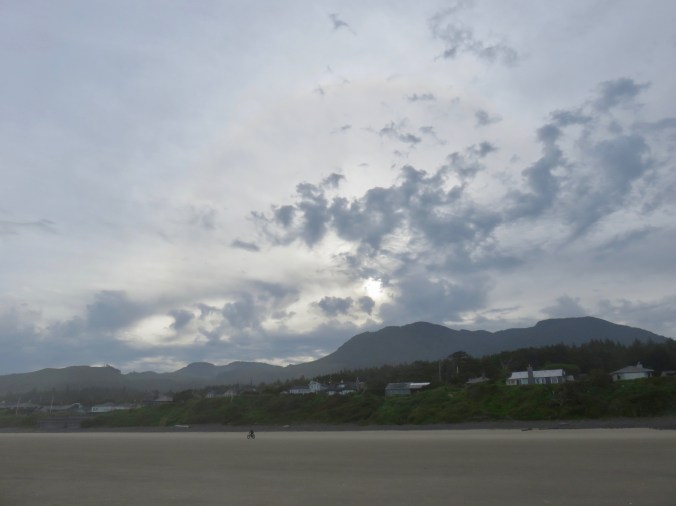
I am more than a little bit obsessed with the sky.

Gary went to the Post Office yesterday and we received a “limited edition” 2021 calendar from a nonprofit. He considers this an act of optimism, not merely because they hope we will give them money, but because they think we will need and use a calendar next year. That seems almost naive. In the mean time, I now have three packages temporarily missing if not actually lost in shipment. The painting is still lost (for two weeks) and now also a small yarn shipment I wanted for my next warp seems to be misplaced, both carried by UPS and last seen in Hodgkins, IL; the third shipment is from an artist-friend in Russia, so that would be Russian mail or a ship sank or a plane went down, or it burned in New York. And Gary has a CD that will get here eventually from Estonia. I wish I could explain why all this is so funny because we both think it is hilarious.

My novella was shortlisted by a very good magazine and rejected three days later. They would like to see more of my work, and I wish I had more to offer. I have sent the novella off again to another magazine. Assuming it is also rejected there, I will submit it at least twice more. If no one chooses to publish it by then, I will stop. These are carefully chosen markets with smart editors and if they do not find it publishable, I will accept their judgement. I was telling a friend that I have submitted one story at least 58 times and received some quick rejections and some very kind ones. I revised that story after each rejection, and many other times besides, starting it different ways, altering chronology and point of view—hundreds of hours—so you see how I have over-invested in it. However, whatever is wrong with that story, I still love it though evidently I am the only one. Enough already.

The lost packages will be found, or money refunded, or some combination, or not, and my novella will find a home or not. I am entirely resigned about publication. Instead, I will create my own little book with a spectacular cover illustration, print off ten or twelve copies, stitch the binding, and give them away. Sometimes I just need to see the process completed. Maybe I will write more of the story as Tula sees it, or Rosetha, or the Daughters. Or maybe I will just be done. It is good to finish things.

fullsizeoutput_1252

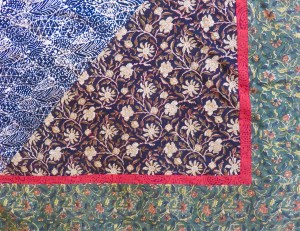
Just a bit of the pieced top in progress—you’ll have to trust me that this photo does not do the fabrics justice.

Since I do not have the yarn I need, I turned in another direction for the sake of sanity. Mid-March I ordered vintage Indonesian cotton from Cargo Inc. in Portland, hand block-printed and batik fabrics. I wanted to visit the store, but we were already self-isolating “in an abundance of caution” as people were starting to say then. The fabric came quickly by mail with a lovely string of little bells. I wanted to piece the front and back of a quilt. They had sold out of one fabric, and another was too blue so I thought for a while, sorted and arranged, pre-washed and ironed twelve yards of fabric, fiddled and rearranged. I had what I had and could not get more. I dug through my grandmother’s cotton threads and decided to sew with red. That was a happy choice. Piecing the black-and-cream backing took only a day and I was satisfied. Then there was the long period of staring at the rest of the fabrics, of accepting that the original vision would not fly and seeking an alternative. Eventually, pieces began to settle in my mind’s eyes. Yesterday morning I started working on the front, cutting and sewing. It is a center diamond pattern, a simple and classic America design. Two frames in red, an inner and outer border. When I ran out of red thread, I used pink. Strangely, no major glitches along the way. I work fast once I figure out what I am doing. The top and backing are finished already, the top in one day, and are pressed, folded, and ready for quilting. I began this task before eight and kept at the task unsteadily for the next eight hours. This morning I ache all over from my efforts and am grateful showers and downpours will likely keep us from a long walk. It is currently pouring rain, a great dark cloud moving in from over the ocean.

[Gary has stripped the bed so that there will be no question of going right back to bed after we eat our oatmeal. Tempting.]


Emails have carried many messages of solidarity from museums and news agencies, social activists, and yarns stores—from virtually everyone I know virtually! It is heartening.

“As always, we hope you’re well, and we hope you’re safe. We took a break from knitting this week, to speak from our hearts about the deep-seated problem of systemic racism and anti-blackness. We just haven’t had the heart for our normal chatter about knitting.”

And perhaps heartening of all, the NFL has finally reversed their stance on players taking a knee. A white player has apologized for his wrong-headed condemnation of protests over racial injustice: “Through my ongoing conversations with friends, teammates, and leaders in the black community, I realize this is not an issue about the American flag,” New Orleans Saints quarterback Drew Brees wrote. “It has never been. We can no longer use the flag to turn people away or distract them from the real issues that face our black communities. We did this back in 2017, and regretfully I brought it back with my comments this week. We must stop talking about the flag and shift our attention to the real issues of systematic racial injustice, economic oppression, police brutality, and judicial [and] prison reform.”

One of the greatest accomplishments is to change our mind.


IMG_6024

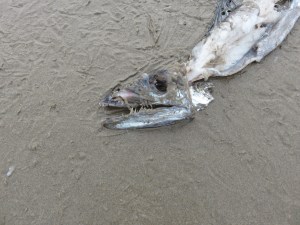
Eyes gone but the teeth . . .

Seriously, anyone recognize that mostly-eaten fish up top? Teeth! What looked like a dorsal fin. The eagle got most of it. I think our resident pair have eaglets they are feeding. We have seen a great deal of them. Seagulls had dragged the tail off to a safe distance.

The osprey has been fishing in front of our house.

The ravens do a fly-by just to be sure they aren’t missing anything.

IMG_6025

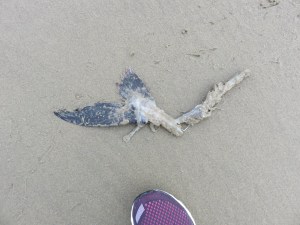
Most of the tail with the toe of my shoe for scale.