An imperturbable demeanor comes from perfect patience. Quiet minds cannot be perplexed or frightened, but go on in fortune and misfortune at their own private pace like a clock during a thunderstorm.—Robert Louis Stevenson
When he was teaching Physics at Seaside High School, my brother held a Rube Goldberg Machine competition for his students. They worked in teams and were given a specific goal to build a machine that did something simple like cut a fruit in half or open a box. That simple process was deliberately and pointedly complicated through over a dozen steps—pulleys, marbles rolling down tracks, things falling over, balloons popping. That’s what Rube Goldberg Machines are supposed to do. It is satire on modern life.
Teams wrote manuals explaining how their machine worked and why. Then they demonstrated their accomplishment for an audience. They were given a couple tries to get the entire string of operations to work properly and chop their fruit or squeeze a lemon. It was a big deal, students, parents, and community members came to watch in the evening, judges ruled, and a member of the Rube Goldberg family handed over the honors to the winners. I do not remember what the prize was, other than bragging rights.
“A Rube Goldberg machine, named after American cartoonist Rube Goldberg, is a machine intentionally designed to perform a simple task in an indirect and overly complicated way. Usually, these machines consist of a series of simple unrelated devices; the action of each triggers the initiation of the next, eventually resulting in achieving a stated goal.”
—Wikipedia
Rube Goldberg’s Professor Butts and the Self-Operating Napkin (1931). Soup spoon (A) is raised to mouth, pulling string (B) and thereby jerking ladle (C), which throws cracker (D) past toucan (E). Toucan jumps after cracker and perch (F) tilts, upsetting seeds (G) into pail (H). Extra weight in pail pulls cord (I), which opens and ignites lighter (J), setting off skyrocket (K), which causes sickle (L) to cut string (M), allowing pendulum with attached napkin to swing back and forth, thereby wiping chin.
This class project involving teams explains why, over the years, I have continued to look for and enjoy Rube Goldberg Machines. My brother was doing this at least thirty years ago. Today, if you search online, you’ll find lots of information about Rube Goldberg Machines and competitions as well as the same thing done under different names in other nations. We all enjoy a pointless effort just for fun.
In the machine below, the goals is to pour glasses of lemonade. At nine minutes, it is incredible, absurdly lengthy, often funny, and the work of a six-person team.
Truly, you do want to watch this. It is ridiculous fun.
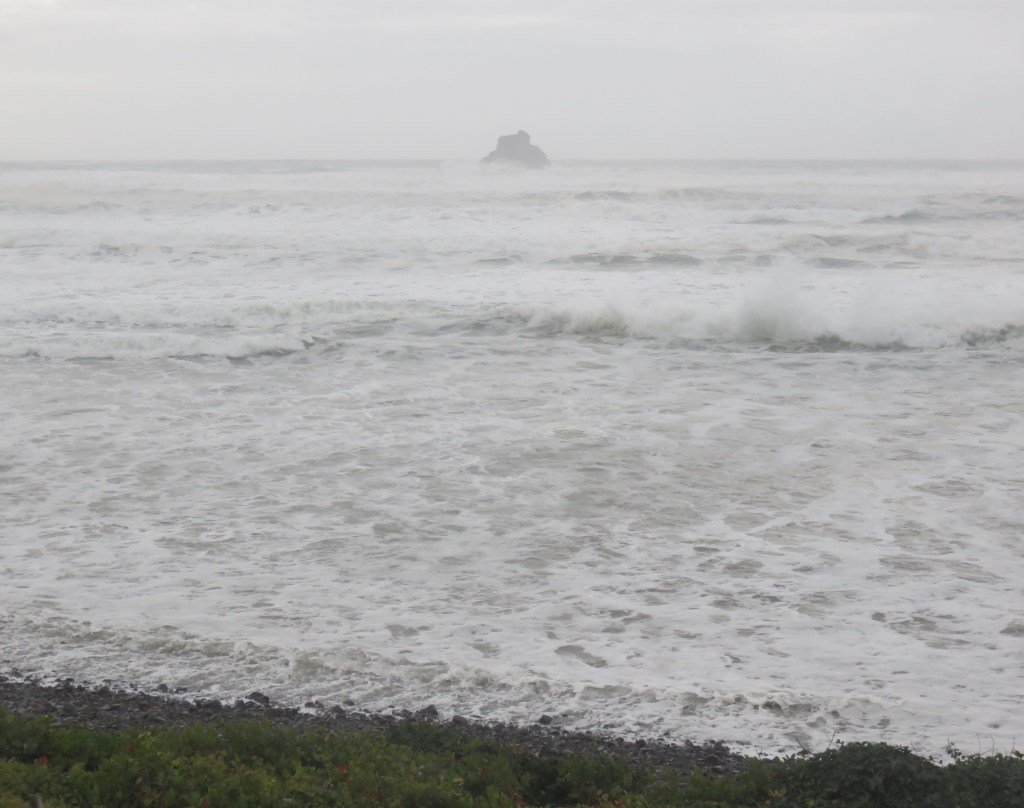
The cloud-occluded sky was dove gray and Oregon chalcedony blue. A fragmented break to open sky over the ocean glimmered platinum that swept a reflection across wet sand. I did not have my camera with me, so perhaps you will take my word. It was beautiful.
November, the middle of autumn, is like this. We are just home from a walk in a dry gale wind. It was easy walking out north, hard work coming back, our heads bowed into the blow. We had missed our morning walk because of the fierce winds and drenching rain. There was no sand at all, though it was only an hour past low tide. When the weather cleared this afternoon we took our chance. It is the great advantage to retirement, I think. We can go out whenever we like.
Yesterday, we were out early to see what the ten foot tide had left us. We have walked the shore daily for so many years, we recognize rocks, the places where sand shows through, where there is a flat stone, where the rocks are rounded and fine like river gravel.
All is changed. The path Gary built in March is entirely swept away, even the heaviest stones set as steps through the hedge were tossed. They have survived a dozen winters. Water flowed right into our neighbor’s yard, a reminder that house is built over a swamp and creek. The ocean remembers and takes back.
In the spring we pull aside basalt stones lining our shore to create a meandering path to the sand, a task requiring gloves and sometimes metal garden tools. This path is a depressed passage two feet wide through the margin between sand and land. It makes our morning walk down onto the beach easier. Walking over the stones is unsteady and bumptious on the bottoms of our feet. It takes hours or a few days to dig away stones. Sometimes the sand is a few inches under the stones. Sometimes we must dig deep and have to carry sand up to fill the resulting trench. The work is satisfying, traditional. Sometimes a high wave in April will sweep the rocks back into place and we must build the path again. Sometimes it happens again and again and we threaten not to bother rebuilding.
By summer, the sand has begun moving inshore from sandbars beyond the breakers. Most oceanfront homes have built paths through the stones to save their feet. The dry sand is untouched by most high tides, and low tide reveals a hundred yards of clean, hard wet sand. For three decades I ran on that smooth sand surface every other morning if the tide was out far enough to permit me. Now we walk our miles regardless. When I was a girl, sand swept all the way into the green by midsummer. That doesn’t happen any more.
Some of the sand is simply gone.
There has been less sand onshore for so many years, local newspapers don’t even mention it. Twenty years ago they offered several explanations. Most involve happenings far away up or down the coast. Barriers intended to protect harbors shifted the seasonal flow of sand, causing it to pile up. There are condominiums built on shore that did not exist so very long ago. A powerful wave in January of 1999 picked up not only sand, but the rocks themselves. Massive sandstones rolled amid the wet-blackened basalt. Strong waves push the basalt high. Some years there has been a ridge of rock five or even ten feet in the rocks up shore from us. We’d like to trust the seasonal shifts to level things out in summer. There is no counting. The tide is not dependable.
In autumn, sand begins to slide back into the sea. Tide and wind swipe the basalt clean, drive sand into the ocean. Waves seem to rise higher. Low tide gives a narrower strip of wet sand than we saw in August.
It is different all the time. Asbury turns hard right and flows a quarter mile south one day, and a week later it spreads straight west. Gulls rest there.
Everything changes, shifts from one tide to another, one month to the next, and year to year. It is a moveable feast. The people who bought the house north of us to use as a commercial rental asked us: “Where has our sand gone?” the first time they visited in the autumn. We could not help laughing.
Yesterday on our walk, a wave swept in across a hundred yards. We had climbed into the rocks. When an outgoing wave flows back into an oncoming wave there can be a great crash—the sound is starling and water sometimes flies straight up into the air. The so-called “sneaker” waves are silent, and it is the sudden quiet that causes us to run. An incoming wave overtakes a wave also moving in, picking up energy and speed from the one below. Then a third wave over the top of that one. There is no predicting, no pattern. It is a random event.
The main thing is that we are not sick, though we seem to know several people now who have been ill.
Biden and Harris won the election. Trump is sulking and raking in all the money he can. The pandemic has exploded due to small (careless) gatherings. There is a divorce coming in our family (not Gary and me). And last night was stormy. The power went out. Gary made coffee the instant it came back on in the middle of the night. Emailed a former student. Two people from my MFA program reached out. I have lost eleven pounds, gained back two—I expected that my weight would move up and down, but I still hope to reach my goal next June. We gave up seafood this year and that is going well but I am considering a sockeye fillet for our small Thanksgiving. Yesterday I began weaving the third of three shawls on an “Olive” warp.
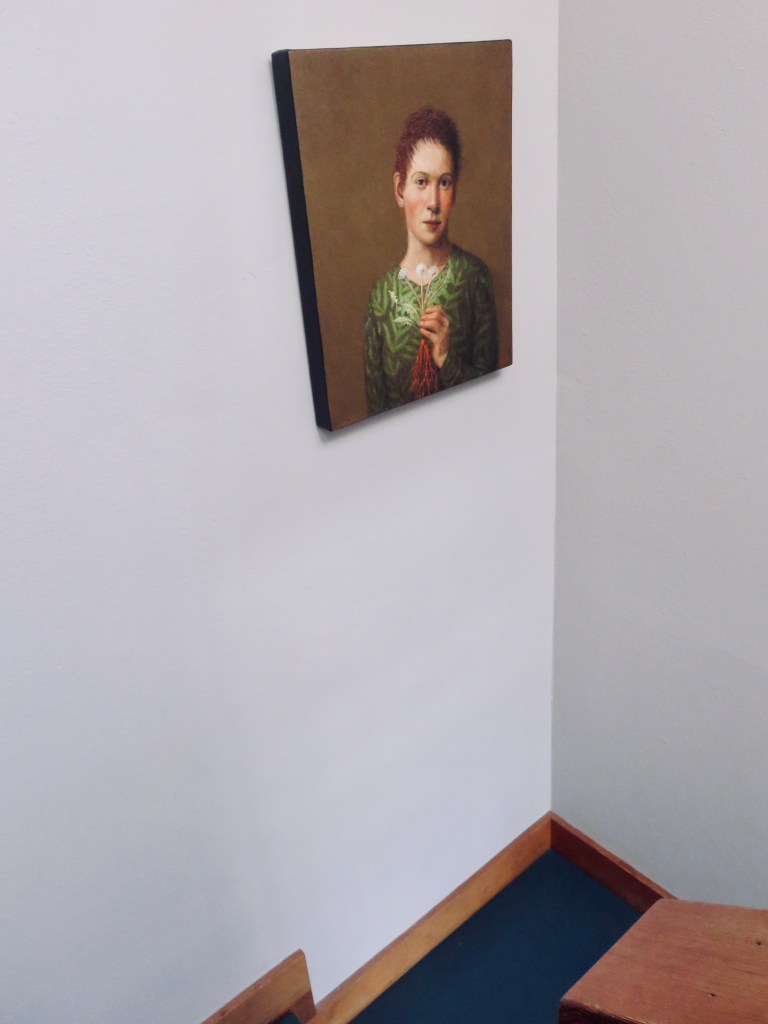
I am on track to read 70 books this year, which was how many I was reading before beginning my MFA in 2005. The Russian doll arrived after three or four months; the painting arrived from Georgia after five months; and I bought another painting because she kept looking at me. She hangs on the landing, visible from up and downstairs. “Weed Gardener” by Katherine Ace (2017).
I found this painting title “The Gardener” on Ace’s website, just “Gardener” on her local gallery’s website, but on the back of the painting it says “Weed Gardener,” so I’m going with that.
Pinterest allowed me to suspend magazine subscriptions. I visit that site to find images and to save images. Sometimes I revisit what I have saved. Mostly I never look at it again, but I preserve the illusion of ownership. Last month I became aware that a number of favorite paintings I had “collected” were all by the same person. These are mostly magical realist pictures, often with birds and women. Women with birds on their heads or a stack of stones. Illustrative paintings of folktale characters. I put “Feather” on my desktop, the only time I have used an image that I had not created myself. Once I went looking it took me only a short time to find the artist’s name and local representative gallery. I had missed a Portland show by a week. I cannot afford the paintings.
“Weed Gardener” looked to me like a self portrait from the Face to Face show. The artist often uses a similar face, but this one felt deliberate—not similar a real person but an actual portrait. I looked at her and looked again, the more I studied her face and the dandelion in her hand, the more I felt she was a cancer survivor with her plushy hair just coming back in. Imagine my lack of surprise to discover the artist lives in Portland and is indeed a cancer survivor. (So is one of my dearest friends.)
That’s why I called Visa to raise my credit limit and we drove to Portland to pick her up from the gallery. (That gallery visit, masked, is another absurd story. Suffice to say, I will not go there again.)
A neighbor has kindly shared her sourdough start, in her family since the 60s. I have sent over rhubarb and apricot jams. She is offering salal, which I did not manage to make this year. We have not actually seen one another in months.
“Yes, sister, sometimes we may be the only one that looks like us walking in that room,” she told a largely Black audience in Fort Worth. “But the thing we all know is we never walk in those rooms alone — we are all in that room together.”
— Senator Kamala Harris of California, who will become the first woman to serve as vice president
from The New York Times: “With her ascension to the vice presidency, Ms. Harris will become the first woman and first woman of color to hold that office, a milestone for a nation in upheaval, grappling with a damaging history of racial injustice exposed, yet again, in a divisive election. Ms. Harris, 56, embodies the future of a country that is growing more racially diverse, even if the person voters picked for the top of the ticket is a 77-year-old white man.”
She is also the hope for our nation, a smart person capable of finding a fair and just path for our collective future.
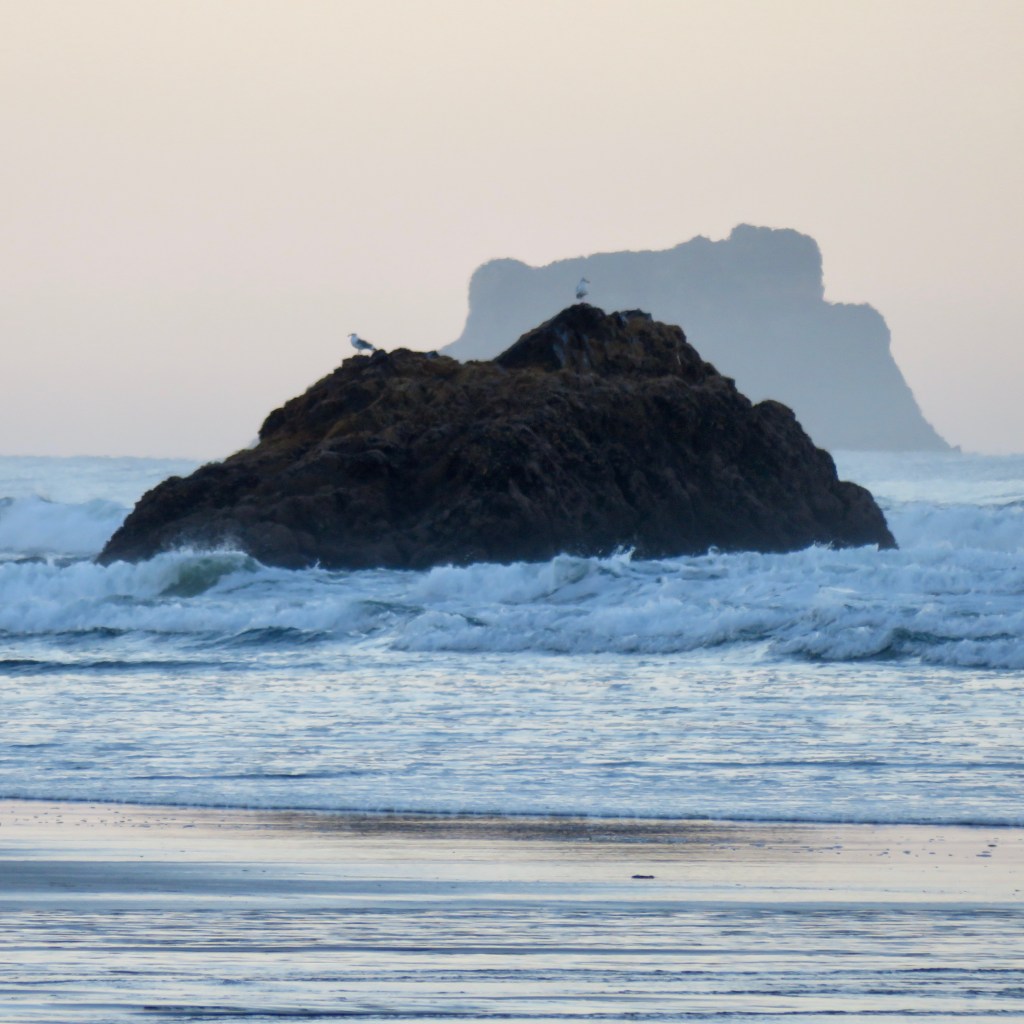
We see this bird perched at the top of a snag above the bluff north of us. She’s there most days on our walk, and sometimes a few others too.
It looks likely that Biden will win the presidency (50.5% of the popular vote), and I am glad for that even though I am mostly excited about him because his intentions are to care for the nation, to respect the People, to serve.
Am I the only one who finds it sad that this seems like such a massive shift? Shouldn’t service be something I should, as an American, take for granted? The President serves his country.
Gary brought home a fill-in-the-blank poster:
The America I believe in ________________
Perhaps this is why I am not feeling celebratory. Yet.
So don’t read the rest if you are trying to work up a head of cheerful steam.
Of the national news networks putting the presidential race at the top of their page (all of them) only one lists the popular vote. If you’ve been paying attention, Biden has been ahead since Tuesday. He has 4 million more votes now that his opponent. But that doesn’t matter, not really. It’s all about the Electoral College.
Yesterday, we went to Portland to deliver our granddaughter’s birthday cake. Downtown was a mass of homeless camps and boarded-up storefronts.
That senator from Kentucky was reelected.
Almost 70 million people have voted to keep the current resident of the White House.
One reason he’s losing (and I have to love the irony) is that a reactionary rightwing third party is sucking up over 1% of the vote nationwide.
The Senate is still in the hands of people who oppose healthcare for all, addressing climate change, and “one man, one vote.”
The two QAnon people who are going to Washington DC.
The so-called Proud Boys and other wack-job reactionaries.
There is so much damage to undo, so much work that has been neglected for four years, and a tired nation wanting all the bad stuff to just go away.
Biden will be blamed if he is unable to work a miracle. And it’s late in the day for miracles.
So there you are. We have a lot of work to do finding justice and fair play for every single one of our people and for the Earth. We have a lot of work before us.
I baked oatmeal bread and cinnamon rolls this morning (two for lunch) and made fried goat cheese medallions this afternoon (ate one), avoided the worst-case-scenario news stories, canceled my participation in NaNo, and in a few minutes I plan to watch the most mindless show I can find streaming. I have rewatched the opening of the pilot episode of The Mentalist, and while it did make me laugh for the hundredth time, I am still worried.
It might still be the sugar from this morning? I have become somewhat unused to sugar. I finished the first shawl on the new “Olive Grove” warp. Tomorrow I bake a cake for my granddaughter’s birthday. Thursday I pick up another painting from a Portland gallery just before delivering the cake. I am warmed by supporting women artists.
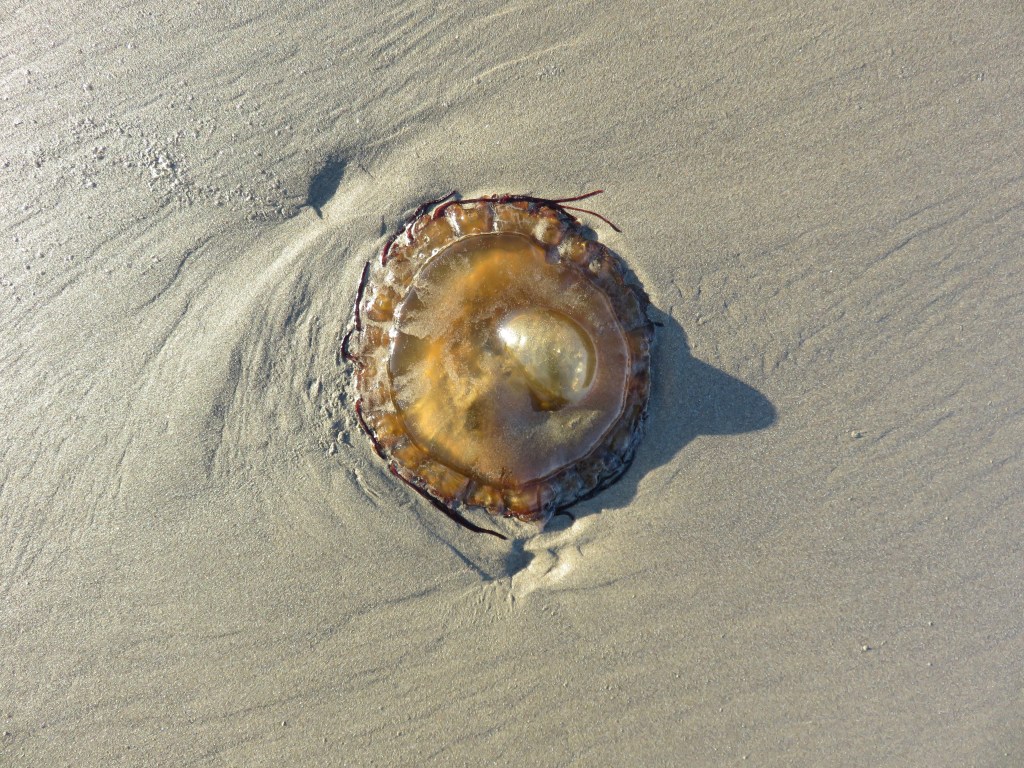
“Jellyfish” are neither jelly nor fish, but that’s okay. It’s just a common name. This one is specifically called a Pacific sea nettle (Chrysaora fuscescens), which suggests why my dad warned me as a child not to touch the orange ones.
The joke goes like this: What are the two saddest words in the English language?
I recognize that I have been complaining a lot lately. Mostly about shipping companies. So here is a good omen: “Soul Queen” arrived in near-perfect condition a couple of days ago, shipped more than five months ago, and presumed lost early in the summer. Gary wanted to calculate how many miles we’ve walked since then. He thought maybe we could have walked her here from Georgia.
I didn’t think so, and it’s not nice, and I am too lazy to go back and count up the total distance of our walks. (Do I really want to know?)
She’s here. That’s what matters. Our regular UPS driver was not even aware she’d been missing or anything. Insurance had paid. We’d all thought she was lost forever. And here she is. Good times.
It’s true that the space bar on my computer isn’t working so I have to stop and add spaces to my words and correct the Autocorrect (“to my” turned into Tony). And our property taxes . . . And one of our tenants is moving out in three weeks. And even the shipments from Finland and Estonia and Slovakia (music, music, and yarn) did not take this long. And I’d found two other paintings and paying again for “Soul Queen” was a painful pinch.
It’s also true that we both love her. Isn’t she marvelous!
So. Good omen? I am not superstitious, but I think: good omen!
Predictably made me cry in less than a minute in. Anger is not enough for me. I have to believe that we can do better and I have to want that enough to believe we can have it. So I cry in my grief and hope and love.
I read an article in The New York Times about 500+ people who gathered to discuss politics over a year ago. Before. Before covid and distancing and . . .
“Carole McGowan, a 74-year-old Democrat from Albuquerque, worries that Americans now seldom work together across different viewpoints, or prize a range of viewpoints at all.”
I hear you, Carole, and I have been hearing people ask for a multi-party system for several years. A multi-party system requires compromise and building alliances across parties, which we do not do in our country. Since before Mitch McConnell declared more than a decade ago that he would ensure NOTHING Obama wanted would get past him, most Republicans have refused to collaborate, compromise, or even discuss how to reach common ground. That so-called “Do-Nothing” Congress is now all on him. The Republican party has lost its soul.
By contrast, consider what the Democratic candidates managed to do in working through health care and global climate change and a dozen other issues, what Biden did in choosing Harris, what all those men and women did after arguing and talking talking talking and finally endorsing a man they trust. No one gets everything they want, but every single candidate got an American they could all stand behind.
Too many people have lost track of what conservatives used to be like, when even Republicans didn’t think people should die because they were too poor to afford a doctor, and Ted Kennedy fought for a national health care plan his entire public life, when we did not think that wealth and good fortune and good health and a family who could afford to support us meant we deserved every good thing while others got nothing but scorn. The time when we thought the right to life meant something beyond insisting the baby be born, but also that he got to eat and attend good schools and live in decent housing.
Gary found a poster that begins: “The America I believe in” and then leaves a blank for people to fill in.
Today on Brevity‘s blog, Lindsey DeLoach Jones illustrates “The Lost Art of Pretending: Imagining a Positive American Future” with her daughters’ play. Only by imagining what is possible, can we work toward a positive goal. Her idea of pretending focuses on our need for a “robust moral imagination.”
“We need a collective imagination like the one Martin Luther King shared at the Lincoln Memorial in 1963. King insisted, “Let us not wallow in the valley of despair… Even though we face the difficulties of today and tomorrow, I still have a dream.” At his core, Dr. King was a writer. His dream speech was wishful thinking, yes, but it was backed by action, protest, force of will. One man’s private imagination had untold constructive consequences in the real world. We seem to think we have outgrown this kind of thinking, that hope is for suckers. But to abandon the project of pretending is to abandon any hope for improvement.”