WAIT

IMG_1206

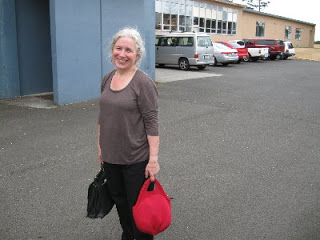
Immediately after my shower. I had run to school (15.3 miles) in August 2011. My husband trailed me & carried my briefcase and lunch. Don’t I look happy? I was.

I loved running. Loved it! I was never very fast, never did better than eight-something miles, never ran a marathon. But I ran the Hood to Coast several times, a bundle of 3ks, the Bridge Crossing, and a slow but official half-marathon in Portland nine years ago (2:17). Ten kilometers was my favorite distance and I aimed for 9-minute miles. I had measured runs of three and four and five and six miles on the beach and highway from my home. I ran at least every other day for years. I used to run the six miles on the beach to my mother’s house in Cannon Beach two or three times a week in summer.

And then I couldn’t do it anymore. I could barely walk for a year. I tried other exercise but biking is unsafe around here and involves a mechanical device, and the pool has too much chlorine. All I have is walking, and I am usually on the sand for over an hour a day without a problem. But I miss running.

That might change. I have decided I might try running again this next year, but to do that I need to weigh less. Wait for weight. When I quit teaching, I was about five pounds over my running weight. I meant to lose eight to fifteen pounds—is this starting to sound familiar?—but instead I have gained fifteen. Now you see it, don’t you?

Weight isn’t a huge issue for me. Well, that’s a lie. I grew up in the twentieth and live in the twenty-first century. I am female. Yeah, weight has been a huge deal all my life. In my teens the doctor was worried when I weighed 121 pounds. My mother tried to put me on a diet. Eventually I lost 7 pounds only because I had my tonsils out when I was fifteen, Ballard Hospital was remodeling, and I was in from Sunday until Friday. They brought me one meal on Tuesday, which I was still too sore to eat and neither the nurses nor I noticed that I was being starved. So I weighed 114 pounds by that Friday and throughout high school. By my senior year of college I weighed 118. Or maybe by then I weighed 121 again. I do not remember.

In my thirties, a friend called me plump when I weighed 130 after my second child. I dieted back to 114, but that did not last.

I began running, a few blocks in April and six miles by August. I am not built like a runner and had absolutely no history as an athlete. But running turned out to be wonderful. I felt strong and capable. I found runner’s high at three and a half miles in a rainstorm and laughed. Thus in my forties, I usually weighed 132 to 142 because of running muscle, lightest by the end of cross country season. (I tried dieting while running but that was pointless.)

During my fifties when I was caring for my mother and running time grew sparse, my weight pushed up. Then grief over my mother’s death took off 40 pounds. People complimented me on my weight loss, which I found ironic.

Like most people, weigh has gone on and then off and then on again with no deliberate effort on my part. I am always impressed by people who maintain a consistent weight throughout their lives. I am not fully in tune with my body. I know it does not want to weigh 114 pounds any more than it liked running more than eight 9-minute miles in a row. Lower weight and longer distance runs were each a struggle. I could do those distance runs, but it was against my body’s better judgement. In 2011 when I ran over 15 miles in bad shoes my body was not happy. My feet up and resigned their commission. I stopped running.

How’s it been without running? Like how a dog with no nose smells. Awful.

So, a new and more reasonable plan. Take a year to go back to my most typical running weight of between 132 and 142, mostly by eating only between 8am and 6pm. Three meals, no snacks, less sugar, more veggies. (Well, we all know that: “Eat food. Not too much. Mostly vegetables.”) And walking. For the duration, only walking. At sixty-seven years old, I can not afford to put too much weight on knees and feet. But I think, perhaps, if I can drop those recently gained pounds, I might manage three miles again. Slower miles perhaps and only on sand.

I’ll let you know.

2 FAVORITE NOVELS of 2019

43984883

Some books were entertaining but slid right off the dinner plate of my attention and a few I did not like. Here are two novels—though not the only two—I thought were wonderful.


Olive, Again by Elizabeth Strout

I loved Olive Kitteridge, but I loved this one more. Maybe that is because I am aging and Strout has tackled the challenge of writing about older people without sentimentality, but with realism, compassion, and wisdom.

An example: Out of the blue, Olive visits a much younger woman who is undergoing cancer treatment and fears death, but who also feels confused and guilty that she is becoming unkind to her husband, irritated and impatient. Olive shares about her own husband.

” ‘I don’t know,’ Olive said thoughtfully. ‘He may have been [sick before] and I just didn’t know it. He became very needy. And I wasn’t—I just wasn’t very nice to him. It’s something I think about a lot these days, and it bugs me like hell.’

. . . [and later in the same visit]

“You’re scared to die, even at your age?”

“Olive nodded. ‘Oh Godfrey, there were days I’d have liked to have been dead. But I’m still scared of dying.’ Then Olive said, ‘You know, Cindy, if you should be dying, if you do die, the truth is—we’re all just a few steps behind you. Twenty minutes behind you, and that’s the truth.’ 

“Cindy had not thought of that. She had thought that Tom, and her sons, and—people—that they would go on living forever and ever, without her. But Olive was right: They were all headed where she was going. If she was going.”

Of course it is Olive looking back sometimes, as well as forward, but that is Strout who recognizes how this tough, hard-edged “old bag” will continue her voyage. Again and again Olive’s choices and words felt personal to me. I laughed and cried and reread passages. There was one where someone confesses to Olive how weary she is at the idea of starting over and Olive basically says, “Oh, now, we never star over, we just go right on.”

As the first book, Olive is not always central to the narrative in these chapters which concern many people in the town. I read Olive Kitteridge when it was new and I feel fortunate to win an ARC of this follow-up. This in no way affects my review. I loved this novel. It’s one I want to read aloud to my husband, and that is a rare compliment.


Normal People by Sally Rooney
Normal People by Sally Rooney 

It was amazing.

I had it in hand for months, for a year even, sitting someplace in a stack of books to read, before I read it because I thought the cover was boring. Yeah, I know. Dumb, huh.

“Life offers up these moments of joy despite everything.”

My husband likes to share a Swedish saying: “There is no bad weather, only bad clothing.” That line is in this novel. No kidding. Most everything in this novel felt like that, like finding something I knew but mostly had not realized I knew.

For some, reading functions “as class performance, literature fetishized for its ability to take educated people on false emotional journeys, so that they might afterward feel superior to the uneducated people whose emotional journeys they liked to read about.” Bits about people who are more interested in sounding like they know than about actually knowing . . . oh, yeah. Been there.

Rooney offers personal wisdom about relationships, about power differentials between people, about seeking popularity, about wanting to be liked, about fearing being known. And broader truths about class and about self-acceptance, about forgiveness and making a difference in the world. There is wisdom about leaving home, about writers and writing and readings, about dependence and strength.

I did not read any reviews until I’d made up my mind. A lot of people adore this book (I do) and not a few hated it. Maybe it came to those who “hated” it at the wrong point in their lives, maybe their life experiences have not run parallel to this story, maybe they just do not get it. I am sorry for whatever reason they did not read the novel I read.

This reader got it. This reader loved it. I did not cry, but I really should have because this is a powerful book about young people figuring things out, about those fraught years between teenager and full adult, about people accepting others and themselves, supporting and honoring responsibility. This is the age to beg forgiveness and grow up.

The main characters Connell and Marianne want to feel normal, a normal they can be proud of, a normal that is good, and a normal they are unsure even exists. They want to believe of themselves that they are good people. They fail along the way sometimes.

A couple of unfavorable reviewers said it was depressing and so I worried throughout the second half about what would happen at the end, about how it might devolve into apathy or cynicism. I rushed through too much too fast, and loved it even so. Two days and done and now I am so sad it’s over. NOT depressing, enlightening. What I read illuminates. It gives light.

There’s nothing more I could ask for.

FOR FREE

botticelli31500x900.jpg

[There’s a great link at the bottom—don’t miss it.]

“Art never responds to the wish to make it democratic; it is not for everybody; it is only for those who are willing to undergo the effort needed to understand it.”—Flannery O’Connor, Mystery and Manners: Occasional Prose

vs.

For some, reading functions “as class performance, literature fetishized for its ability to take educated people on false emotional journeys, so that they might afterward feel superior to the uneducated people whose emotional journeys they liked to read about.”—Sally Rooney, Normal People

“Art for Art’s Sake” was a popular slogan when I was in art school in the 1970s. There was a general attitude that artists were some sort of elite beings, that their work spoke to an exclusive club, and also that the only real art was paintings, sculpture, and architecture. The rest was mere craft.

Thanks to my future husband, I was taking not just the required studio and Art History series, but a lot of Anthropology classes. This meant that I understood that art was never reserved only for the precious few. What we regard as “art” served the wealthy aristocracy in Europe after the Renaissance. Before that, and even after, and at every time and everywhere around the world, art serves to satisfy the aesthetic needs of all people, expressing ideas, power, yearning, hopes, dreams, fears, and distinct perceptions of beauty. Art reflects appreciation and even affection for the objects and environments we touch and use and admire every day.

That is to say, that while I like Flannery O’Connor’s fiction and I get what she is driving at, and every advisor I had in my MFA program pushed her books onto my reading list (and I read Mystery and Manners: Occasional Prose), I think that quote from her above is elitist crap.

There is no great effort required to appreciate or understand most art. And it shouldn’t be all that hard or reserved only for the special few.

Art does not choose only certain individuals nor is it handed out as a gift via a Muse. Creativity is not reserved for some sort of intellectual or preordained elect. Appreciating art is not a gift from the Almighty who only allows understanding by those chosen few. Art is human creation. No, it’s simpler: Art is human.

I won’t argue that there are not great artists and that creating art does not require enormous effort and even talent. Spare me Hallmark cards and bad art—and there is bad art—but I refuse to accept the narrow view that art is accessible only to special people. I will argue that if only a few people can “read” the art, its message does not speak effectively to the human condition.

There is room for art that offends or challenges our notions of art. Certainly art must not merely sooth but provoke and wound. That too is the proper place of art, to wake and stir our souls. To break us open and heal us too.

“I think we ought to read only the kind of books that wound or stab us. If the book we’re reading doesn’t wake us up with a blow to the head, what are we reading for? So that it will make us happy, as you write? Good Lord, we would be happy precisely if we had no books, and the kind of books that make us happy are the kind we could write ourselves if we had to. But we need books that affect us like a disaster, that grieve us deeply, like the death of someone we loved more than ourselves, like being banished into forests far from everyone, like a suicide. A book must be the axe for the frozen sea within us. That is my belief.”—Franz Kafka

Maybe even Kafka was full of it. Everyone wants to argue that what they make or like or pay for is the only true art.

“What we have here is a failure to communicate.”  Yes, art is communication and if it only speaks to a tiny fraction of the population, that might only be because it is a small and narrow effort.

The painting above sat in a storeroom for decades. The woman who gifted it to her local museum thought it was a Botticelli, but the experts declared it merely the work of some unknown apprentice. They had studied for years and had been “willing to undergo the effort needed to understand [art].” They knew so much they put it away and didn’t look at it again for fifty years.

Perhaps someone might have noticed it is beautiful? Someone finally did. The collector, Gwendoline Davies was right. “National Museum Cardiff has put on display a painting of a Madonna and child that had for decades been dismissed as a crude copy of Botticelli’s style.” But it was the real deal. Not appreciating the art without the name? Major fail.

There’s a Joni Mitchell song about this, “For Free” on Ladies of the Canyon. It has been recorded by over sixty artists who know great art when they hear it. So have their audiences. No great effort required.

For Free

I slept last night in a good hotel
I went shopping today for jewels
The wind rushed around in the dirty town
And the children let out from the schools
I was standing on a noisy corner
Waiting for the walking green
Across the street he stood
And he played real good
On his clarinet for free

Now me I play for fortunes
And those velvet curtain calls
I’ve got a black limousine
And two gentlemen
Escorting me to the halls
And I play if you have the money
Or if you’re a friend to me
But the one man band
By the quick lunch stand
He was playing real good for free

Nobody stopped to hear him
Though he played so sweet and high
They knew he had never
Been on their T.V.
So they passed his music by
I meant to go over and ask for a song
Maybe put on a harmony
I heard his refrain
As the signal changed
He was playing real good for free

[Joni added these lyrics to the song during the 1983 tour]

Playing like a fallen angel
Playing like a rising star
Playing for a hat full of nothing
to the honking of the cars


In case you have read this far, allow me to recommend two older (than me) bloggers, “Margaret and Helen: Best Friends for Sixty Years and Counting… “. Helen Philpot has a lot to say this morning and says it better than I could. She generally does. Here’s a snip:

“Suggesting that 13 year old Barron Trump isn’t a Baron is unforgivable but mocking 16 year old Greta Thunberg for wanting to save the world will get you several hundred thousand likes in MAGA Twitter World.”

SHORE BIRDS

fullsizeoutput_1135

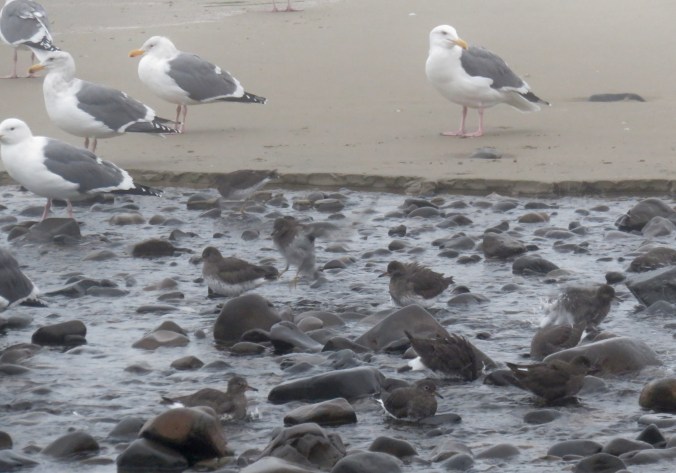
We saw dozens of  small shorebirds bathing in Asbury Creek this morning. They looked like smallish (largish robin-sized) but very fat pigeons. I stood and watched them while Gary moved quietly up to my side and gestured to his pocket where he carried the camera. A neighbor joined us. None of us knew what they were, and I took photos to be sure I could accurately recall what they looked like.  Continue reading →

DEFINE TERMS

IMG_0018

Early in the school year, I used to do vocabulary activities in my junior English classes. They required the use of hardcover dictionaries and most often teamwork. In each case the terms and their definitions were written into classroom journals which could be accessed during quizzes and exams. No need to write any of this down, I’d say, but if you find you need the information during a test, you can look it up in your own journals. Sometimes I did this twice.

The short version had four words: “sympathy,” “pity,” “empathy,” and “compassion,” and illustrates the classic case of dictionary definitions that reference one another. Continue reading →

PASTRY

fullsizeoutput_1131

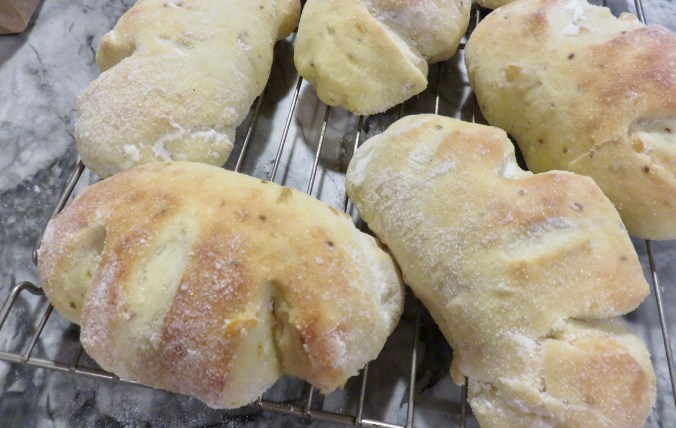
I made gibassier last evening. Fourteen brioche-rich rolls with both butter and olive oil and scented with orange flower water, anise seed, and candied orange peel that I made last winter. The previous night I made the preferment, and I completed the dough in the late morning, then two rises, and they baked in time for us to have gibassier for dinner.

After several experimental slashes, I figured out how to replicate the cutting and slashing we are used to from Pearl Bakery. (But then I created my own method.) The pastry looks different from each maker, though there are not many makers on this side of the world.

I had to do this bake because Pearl Bakery, one of our Portland destinations, has abruptly closed. Ten years ago I looked online for the Pearl’s distinctive pale sweet rolls, but I couldn’t find a reliable recipe. The day before yesterday I found a half dozen. The pastry traces to southern France. M.F.K. Fisher was given gibassier after Midnight Mass, but I do not have her recipe or the one pretending to be her recipe. I used the one from The New York Times that is measured entirely in grams—even the water and other liquid ingredients. That one might actually be PB’s recipe scaled back for a home oven.

Ten minutes of measuring and mixing Tuesday evening, and seven hours of mixing, rising, cutting, resting, forming, rising, and baking. (None of this was difficult, mostly waiting, but it did require attention over nearly 24 hours start-to-finish.) Then, hot from the oven, one last step: brush one at a time with melted unsalted butter and shake in a bag with fine sugar. Cool on a rack for as long as you can stand to wait.

They are light and not too sweet even with their dusting of sugar. Several recipes included a recommendation that they may be frozen and then thawed and warmed for 3-4 minutes at 375°. I froze eight of them once they fully cooled.

FALLING

iu-1.jpeg

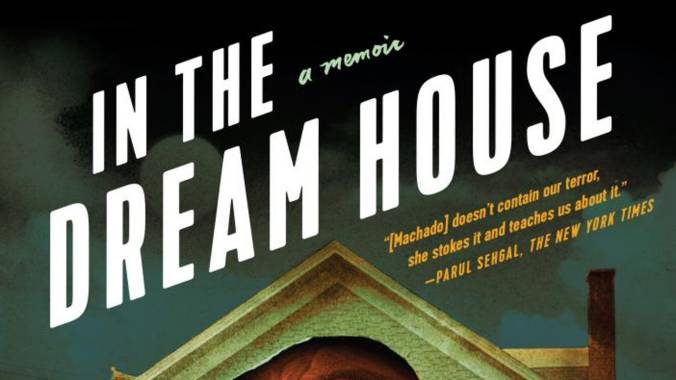
I just finished In the Dream House by Carmen Maria Machado. I usually read a book in a few days, but this memoir took longer. Where was the wisdom I was seeking? I was afraid for a long time that it would not come. I was doing NaNo during those weeks too, so I was writing my own angry story and struggled to know how to rate Machado’s until the last entries raised it up for me. “Dream House as Memory.”

Machado is brilliant and her writing is important. There is an element of revenge here but also of documentation. I believe her. She did not have to work so hard to prove her experiences to me. 

“It’s not radical to point out that people on the fringe have to be better than people in the mainstream, that they have twice as much to prove. In trying to get people to see your humanity, you reveal just that: your humanity.”

She did not need to prove that abuse is also possible between women lovers, I understand that. I have seen abuse. The seduction and gaslighting she so deliberately documents through her own experience and popular culture with an episode of Star Trek and Alice’s adventures. Readers must be forgiven for thinking again and agin: Why is she still there? Why does she come back? Again? Though Machado fails to fully explore the why, the answer is common enough. We believe the abuse is what we deserve. 

The last entries saved this book for me. I was impatient throughout the second hundred pages, but she writes so well—I make this judgement as a writer. She is brilliant. I nearly did not finish because I disagree that queer abuse is different. From inside all abusive relationships are the same. It is only details that differ. It is strong relationships, constructive and kind relationships that [should] matter, and this is merely a sketch here. I wish she had the perspective and distance to tell me more of that story. 

Perhaps in time she will.

SENSE OF DIRECTION

IMG_5167

Tracking shows my package shipped via UPS from Wisconsin and has since traveled to Georgia, Illinois, and Massachusetts. In that order. I live in Oregon. A former student who delivered for UPS once tried to explain to me why such routes are efficient.

I remain unconvinced.

Continue reading →

TREE SKIRTS

fullsizeoutput_112e

Over the years three boys in my Junior English classes argued in their research papers that nuclear power was the cheap, non-polluting, and safe alternative to fossil fuels. They were blissfully unaware that radiation is deadly. They did not want to hear about it. When one boy asked an engineer via email whether there were any health dangers associated with nuclear power, he was oblivious to the sarcasm dripping from the nuclear expert’s response: None. I pointed out that a nuclear engineer was certainly an expert but not on health. No matter. He found an industry website that gave him the quote he needed to prove his thesis.

1 million years

That’s how long Germany has to keep the radioactive waste from all of its nuclear power plants buried for it to be safe. The country recently closed all of its nuclear power plants and is looking for a way — and a place — to make the million-year commitment.

Nuclear fuel is only cheap if you do not count the waste left behind. It is absolutely polluting in itself as well in the vast amount of water heated while cooling the reactors, and safe? Seriously? Why did I have to keep bringing this up. Radiation is dangerous. At least acknowledge that and work from there. But these young writers were determined to ignore any information that countered their thesis.

We want to believe what we want to believe sometimes. Climate change is not happening. The hearings are unfair. I do not have to testify. I am safe to drive. I do not have to tell you. My situation is different. 

Yes, it is. They are fair. You do and you should. No, you’re not. Yes, you do. It’s the same for everyone else.

It is inconvenient to face facts.

There is no magic in pretending. What we believe is not the same as what we know. Faith in what we want does not have the permanence of truth in the real world.

Year after year, the majority of my students chose to write their persuasive essays about something they already believed and many of them left cavernous gaps in their argument because they could not be objective in their research. And year after year a few students chose to write about something they did not already believe and generally wrote better papers as a result. Once in a great while students changed their minds, and that was most impressive of all.


Yesterday I addressed holiday cards. They say “Happy New Year!” so there really is no hurry sending them out. It’s just one of those things on our list like ordering candles (done) and finding a tree (also done) and wrapping gifts (whoops). My approach to the holidays is to spread the labor throughout the year so that I can better enjoy the season. This must be a habit left over from having two toddlers and six dogs (with weekly grooming I did myself), and later a job that overwhelmed my time. I even held a holiday Open House for years when the kids were small. (Baking done each night after I got home from school for a month in advance.) Get it done early so that I am “not rushing about at the last minute,” as my mother used to warn me.

By the time the big Black Friday sales begin, my shopping is already done because I started a year ago. I am free to enjoy the season. Yes?

Does that really work for me anymore?

I’m not certain. The truth is that I enjoy making and buying presents. The truth is that I am one of those people who overdo the holidays. The truth is that my mother never entertained so I had no model for how to do that. The truth is my husband had a genuinely impoverished childhood and this was a dreaded season for him before we met, but now he loves it all. So that mission is accomplished.

Is that the goal? I check my list and mark off the tasks and something always remains undone.

There is a tree in our living room and NaNo is done and I still have to seal and stamp cards and one bed is crowded with gifts waiting to be wrapped. I am still knitting. This year I have several projects I hope to complete sooner rather than later. I thought I might actually sew patchwork tree skirts for family members. That project has been on my list literally for years. It generally haunts me till New Years. I plan each year to start on them earlier . . . and then I don’t.

I have already decided that to cross out tree skirts. It is good to let go of some obligations. It is best to face truth that everything cannot and need not be done. I am not sewing tree skirts.

There’s always something.