I know the world is bruised and bleeding, and though it is important not to ignore its pain, it is also critical to refuse to succumb to its malevolence. Like failure, chaos contains information that can lead to knowledge—even wisdom. Like art.—Toni Morrison, in a 2015 essay for The Nation
&
Word-work is sublime … because it is generative; it makes meaning that secures our difference, our human difference – the way in which we are like no other life. We die. That may be the meaning of life. But we do language. That may be the measure of our lives.—Toni Morrison, in her Nobel lecture in 1993
Month: August 2019
TONI MORRISON too

Toni Morrison died yesterday at the age of 88. “Rest in power.”
When I began teaching English, I was already a great fan of Toni Morrison. I photocopied her entire first novel, The Bluest Eye, to use for one class and later was able to order classroom sets. A student came up to me after class and asked where he could find her poems. She doesn’t write poetry, I said. I mean that poem you read in class. He was talking about this:
Nuns go by as quiet as lust, and drunken men and sober eyes sing in the lobby of the Greek hotel. Rosemary Villanucci, our next-door friend who lives above her father’s cafe, sits in a 1939 Buick eating bread and butter. She rolls down the window to tell my sister Frieda and me that we can’t come in. We stare at her, wanting her bread, but more than that wanting to poke the arrogance out of her eyes and smash the pride of ownership that curls her chewing mouth.
The story is of Pecola Breedlove who will be raped by her father and utterly ruined. This is no spoiler. Morrison tells readers this on the very first page. Her concern is not what happens but how. She writes that why is difficult, but this is a novel about love and it is the how of love that she reveals in The Bluest Eye. Pecola’s brutal father destroys her. The narrator Claudia’s loving father protects her. Parents all seem harsh: “Adults do not talk to us—they give us directions. They issue orders without providing information. When we trip and fall down they glance at us; if we cut or bruise ourselves, they ask us are we crazy. When we catch colds, they shake their heads in disgust at our lack of consideration. How, they ask us, do you expect anybody to get anything done if you all are sick? We cannot answer them.”
The scene begins in iambic pentameter and ends a couple of pages later—
But was it really like that? As painful as I remember? Only mildly. Or rather, it was a productive and fructifying pain. Love, thick and dark as Alaga syrup, eased up into that cracked window. I could smell it—taste it—sweet, musty, with an edge of wintergreen in its base—everywhere in that house. It stuck, along with my tongue, to the frosted windowpanes. It coated my chest, along with the salve, and when the flannel came undone in my sleep, the clear, sharp curves of air outlined its presence on my throat. And in the night, when my coughing was dry and tough, feet padded into the room, hands repinned the flannel, readjusted the quilt, and rested a moment on my forehead. So when I think of autumn, I think of somebody with hands who does not want me to die.
There is enormous wisdom in these pages. It is not the most popular Morrison novel but one of the shortest. It shows up in standardized test questions and college courses. Many students have written essays about the novel in order to get into college. More have emailed me from college to thank me for introducing them to her work.
I taught Toni Morrison’s first novel for most of twenty-five years and assigned that opening passage every year I taught. It was one of the few disappointments of my MFA program that not a single person recommended her novels or referenced her work in a craft talk. Seriously. Not one.
Perhaps it was judged too high for graduate students to aspire to? In my own teaching, I always aimed above what my students thought they could do. Morrison always aimed high. The only path to excellence is to aim higher than our reach, to point the way to better than what we think we are capable of. Sometimes we surprise ourselves. I think many of my students were astonished at their own accomplishments. I hope they were.
Underestimating our capacity as a nation is equally problematic. When we assume that the United States deserves no better than a bully for a president, when we assume that it is too soon for a black or gay or woman president, we doom ourselves. We deserve better. It is the ideal upon which our country was founded. We deserve to strive and push beyond our comfortable complaisance into greatness. Isn’t greatness what the Founders had in mind?
Those eighteenth century wealthy white men aimed for a nation where people are judged by the content of their character rather than by their birth. Wasn’t that an amazing goal for such entitled folk who had all been raised to accept the divine right of kings? Of course they would not be comfortable in our society today, where a man dismissed as “white trash” can become president. (I am not talking about Trump who sits on a gilded toilet.) Their ideals far outstripped their capacity for justice.
Our ideals should always frighten us a little. I did my best as a teacher to break down complex tasks into clear and manageable steps. We must continue doing that as a nation. As Toni Morrison did in her novels: push the envelope, they say. Step out into our own idealistic world.
Step out.
“Toni Morrison, 88, winner of the 1993 Nobel Prize in Literature and the 1988 Pulitzer for fiction, died on Monday night at the Montefiore Medical Center in New York. Robert Gottlieb, Morrison’s longtime editor at Knopf, said in statement, ‘She was a great woman and a great writer, and I don’t know which I will miss more.’ Sonny Mehta, chairman of Knopf, said: ‘Toni Morrison’s working life was spent in the service of literature: writing books, reading books, editing books, teaching books. I can think of few writers in American letters who wrote with more humanity or with more love for language than Toni. Her narratives and mesmerizing prose have made an indelible mark on our culture. Her novels command and demand our attention. They are canonical works, and more importantly, they are books that remain beloved by readers.’ ”
“One of her most provocative public commentaries came during what she saw as the persecution of President Bill Clinton during the Monica Lewinsky scandal. In a polarizing New Yorker magazine essay, she observed that Clinton, his ‘white skin notwithstanding,’ was ‘our first black President.’
” ‘Blacker than any actual black person who could ever be elected in our children’s lifetime,’ Ms. Morrison wrote in that article, published in 1998, a decade before Barack Obama, the son of a Kenyan father and a white American mother, occupied the White House. ‘After all, Clinton displays almost every trope of blackness: single-parent household, born poor, working-class, saxophone-playing, McDonald’s-and-junk-food-loving boy from Arkansas.’ ”
She thought we would not be ready for an actual black president in her lifetime. Thank goodness she was wrong about that.
And I was wrong about Toni Morrison writing poetry. Here are five.
“In short, this is a full novel — rich, slow enough to impress itself upon us like a love affair or a sickness — not the two-hour penny dreadful which is again in vogue nor one of the airless cat’s cradles custom-woven for the delight and job-assistance of graduate students of all ages.”—from Reynolds Price’s review of Morrison’s Song of Solomon (1977)
WELL REGULATED?

Chant of “Do Something!” breaks out as OH Gov Mike DeWine speaks at a vigil in #Dayton.
from a reader comment on The Washington Post:
Do something.
What do you want done.
I suggest
Ban assault type firearms like AK-47
Limit clip /magazine capacity.
Pass a federal Mulford Act type law that Reagan signed when governor of California which mandated 5 years in the clink for anyone carrying a loaded gun in public.
Close gun show loophole
Mandatory background checks.
Put assault type weapons under the 1934 National Firearms Act which required owners of machine guns and short barrelled long guns to register with federal authorities and submit to fingerprinting.
Treat assault weapons the same way.
It will not be enough, but we need to do something.
What we have among the NRA gun advocates is a sickness. It is a perversion. It is a misunderstanding of history and a complete lack of common sense. Guns do not make us safer. Though a gun lobby Act prevents the government from compiling statics, we can be pretty sure that the number of guns in private hands contributes to unnecessary death.
Until a few decades ago, only the gun lobby thought indiscriminate gun ownership was an absolute right, and they have spent fortunes getting their way. It’s time they were stopped. The second amendment did not come first in the Bill of Rights. It should not be the only right American citizens value. It should not be valued over human life. It does not reflect our current needs or the threats we face as a nation. The founders had something very different in mind when they wrote in a protection for the right to bear arms. Single shot, muzzle loader. A well-trained archer was more deadly in the early days of our nation. (No joke. Look it up. And then there is the “well-regulated militia” that we no longer rely on since we have a standing military larger than most of the rest of the world put together and hundreds of bases all over the world, including in countries with which we do not have diplomatic ties. How does any of this even make sense?)
Something must be done and now. However, if we simply ban the “bad weapons” we will continually be at the mercy of money-and-power-motivated people who will find a way to skirt the law.
It has always seemed to me that we are dealing with the very real threat of dangerous weapons backwards. Instead of saying people cannot have this or that, be positive. Approve guns. Don’t ban them. Allow the “well regulated” ownership of hunting rifles and occasional handguns. Allow ownership among people who meet a minimal standard of behavior and fitness, safety protocols and training. Make this need-based. Allow ownership among sports hunters, subsistence hunters (such as the local hunters I know who fill their freezers), people with occupations that put them at risk such as locksmiths, and collectors.
Do not approve sales to anyone of weapons that have no practical application. Several years ago on Facebook I made a similar statement and a former student responded that every hunter needed an assault-style weapon when going after deer. And then I just sat back and watched other former students who actually had hunted deer their entire life tell him he was wrong. (They might own them, just for fun, but useful for hunting? There wouldn’t be meat left to eat!)
I probably know people who will object to my proposal, but most of the actual hunters I know would be onboard, I think, even if they had to give up a couple of toys. The government should approve them, buy back the ones civilians should never have had in the first place, regulate them well.
“It’s really just scapegoating people with mental health issues,” says Dr. Seth Trueger, an assistant professor of emergency medicine at Northwestern University. And while rates of mental health conditions such as depression, anxiety and suicidal behavior are on the rise in the U.S., Trueger says other nations have similar problems and experience far fewer mass shootings. “Other countries have the same kind of mental health issues we have, the same kind of violent video games we have, the same religiosity that we have. All that stuff is just a distraction” from the need for better gun control, he says.
That position is hardly new. Studies show that a relatively small percentage of violent crimes are perpetuated by people with diagnosed mental health issues, and that gun access—not mental health symptoms—is the primary predictor of firearm violence. As a result, an increasingly large and vocal cadre of doctors has been arguing for years that gun violence is more an issue of access and regulation than it is mental health. Groups including the American Academy of Pediatrics and the American Medication Association are active in advocating for stronger gun laws and more widespread violence-prevention programs, and the American Psychological Association regularly cautions against blaming mass shootings on mental health.
“Routinely blaming mass shootings on mental illness is unfounded and stigmatizing,” read a statement the APA issued on Aug. 4, after the Dayton tragedy. “The rates of mental illness are roughly the same around the world, yet other countries are not experiencing these traumatic events as often as we face them. One critical factor is access to, and the lethality of, the weapons that are being used in these crimes. Adding racism, intolerance and bigotry to the mix is a recipe for disaster.”—Time
BIRTH RIGHT
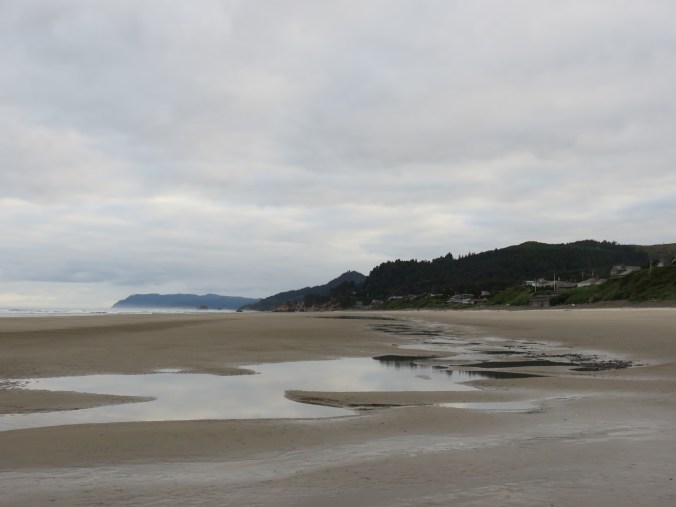
The beach is empty when we go out most days. On weekends there are crowds sometimes. Houses owned by people who do not live here sometimes have a dozen or more “guests.” The world is more crowded, but it doesn’t have to be.
I have always supported abortion rights because I believe all children should be born wanted. No child should be born because their mother made a mistake or a man did or because she had no choice. Despite statistics suggesting that many (or even most) pregnancies are unplanned, it has always seemed to me that a person should not ever be born into this world because of an accident.
An article posted today suggests another reason that birth control and abortion rights are critical:
I simply could not have existed, as I am, in any other preceding time or place. . . I could have been a professional writer at any period since the 17th century in Britain or in France. But I could not have combined this latter with a life as a sexually active woman until the introduction of contraception.—Angela Carter
The third excellent reason, perhaps the most critical reason, comes up in most articles discussing women’s health. When given the choice, women have smaller families because they can do better for two children than for six. For every kid who grew up in a large family, loving every minute there is an overworked parent. For every one of those happy-childhood kids there are a dozen with worse memories, with fewer opportunities, with hunger and necessary neglect. Often the boy of the family is spoiled—so common it is a cliché—because for some reason the parents know that child is the last. Hysterectomy, in past generation, was a common stopping point.
Paley had an abortion when she was married, pregnant for the third time, unwell, and “exhausted with these two tiny little kids; it was just about all I could do to take care of them. . . My whole idea in my heart had always been to have five, six children—I loved the idea of having children—but I knew I couldn’t have this kid.”
The planet could do with fewer humans in it. World population has quadrupled in my lifetime and is chairing ahead toward ten billion before the end of this century. The depletion of resources, global warming, starvation, disease . . . population is always controlled. Better women had the choosing and control.
Yet this morning I read in a national newspaper that Japan is alarmed that women are choosing not to marry and have children. The author puts blame this on a culture where women are expected to shoulder the burden of housework, childcare and elder care. It is possible that men are making the same choice, but the article did not explore that possibility. It is possible, too that overwork makes marriage and child raising a challenge for almost everyone in Japan. Yet, throughout this discussion, the fact remains that Japan is seriously overpopulated, that it is as highly vulnerable to global warming as any country. (Tokyo will not likely be under water in fifty years, but Shanghai and many European and American cities will be. New Orleans anyone?) It cannot produce all the food it needs to feed its population. People choosing to remain single and without children, despite inconvenience to the labor force, is probably good news.
Birth control, reproduction as a choice instead of as a burden is an inevitable result of opportunity. And not everyone wants that opportunity to be available, particularly not for women. Barefoot and pregnant was very much a strategy for keeping women down.
“What men frequently do when they want to manage and govern women,” Toni Morrison has commented, is to “focus on their babies—whether they’re having them or not having them. Reproductive organs become the focus.” Adrienne Rich wrote that “Women are controlled by lashing us to our bodies.”
My community is far more populous than it was when I was a little girl or when my mother was small or before that when only one person lived here alone in the nineteenth century. Of course, he is rarely counted because he was a Native person. None or one or two children. That is what we are entitled to. Having a large family in this world today is a sin against the planet and our future on this planet. I believe that, have believed it since I was a young girl and first understood the population bomb. I watched the woods and pastures where I had played be paved over, split level homes springing up like dragon’s teeth in a terrible mythology.
Give us emptiness. Give us land not relegated to “highest and best use” which translates as development and dollars. Give us wild place of beauty and possibility.
A little peace and quiet please.
VISIT the WC
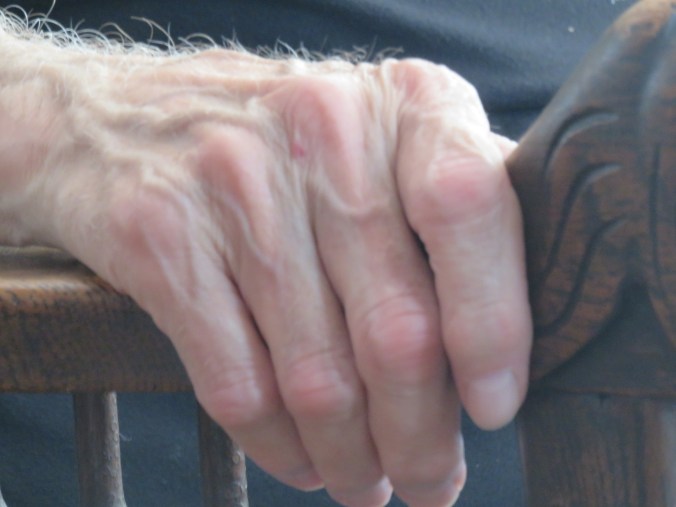
Each of our sons has brought his family for a visit this summer. For several summers we have hosted everyone at once, including cousins. After last year’s reunion, we acknowledged to one another that we were just too old (too tired, too house-proud?) to have thirteen people in our home. We are sorry to let that long weekend go but relieved too.
Friday, our younger son and daughter-in-law brought their two. Ruby has been in the ocean a dozen times, never wearing a bathing suit. She told me she only wears her suit in a pool or “a lake or something.” There has been one dress or another hanging on the line since Friday afternoon. Logan is content digging in sand and collecting crab claws. He is a preschooler and pissed at the cape, well below the high tide line. There is an excuse for little children the better part of half a mile from a toilet.
Last evening, before the sun set and well before darkness, fourteen people and three dogs staying in a local rental house partied on the beach. They were loud and drinking and put an entire log on their fire. One very drunk woman walked up our path and deliberately used our sitting log as a partial screen while she pissed. From my window I watched her reveal her pale butt and simply could not believe it. I walked out to tell them that I lived here and my grandchildren played where she pissed. She said she was sorry. Sorry? “What were you thinking?” I said. “What do you want us to do?”
In November this might not be such an issue. In late fall and winter, the tide washes up high into the rocks above where this woman squatted. But this is August. The tide mostly leaves fifty or a hundred yards of dry sand, with the occasional sneaker not coming anywhere near that spot. Which is to say: We should not be expected to live with her drunken blunder for months.
People on vacation. People out of the city. People to whom the rules of common decency do not apply. They were, perhaps unsurprisingly, a youngish, affluent, white group. Fourteen adults, one of whom could not be bothered to walk back to the rental house to take a leak. People who think it’s okay to piss in public if there is not so much of the public around.
In past summers children have built rock castles in our path, adults have accidentally kicked rocks into it. A man once built a fire in a wind-sheltered spot in our path through our hedge (which is not actually public property). People have come into our yard to take wood for their own beach fire and routinely dismantle laid fires we have set up on the beach.
Clearing our path and setting the log with stones to make it steady was the work of several days. That log has been used by many people this summer. Old couples have rested there. Young couples have sat and watched the sun go down. We have sat on the log ourselves, of course. Gary vows that this is the last year he will build a “fort” for our use. It’s too bad.
STEP 3: moving stuff around
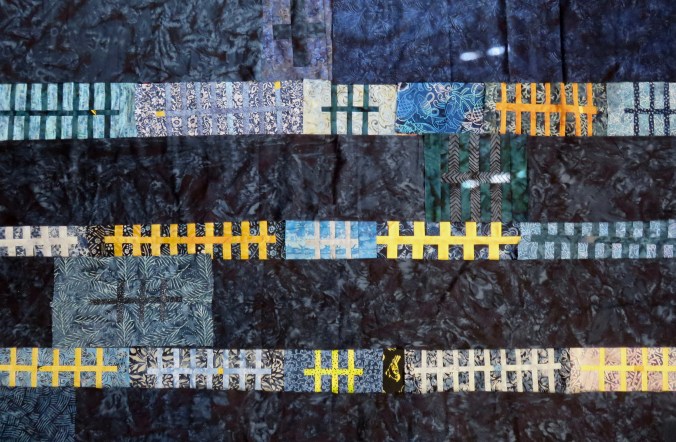
These batiks are entirely from my stash—some of the fabrics are decades old, off cuts from previous work, scraps smaller than a sheet of paper. So far, they are individual blocks that look messy because nothing is trimmed and sewn together. The wider dark bands will not be so wide once they are joined. The lines will be straighter. The colors are close.
This could go on for days or weeks.
About half of my blocks are done—the blue-and-yellows photo shows eighteen of twenty completed so far. I might piece thirty more blocks, but twenty would work for the front.
There are two more lines of narrow pieced blocks to make. And then the dark-on-dark wider strips. I might have all the blocked pieced by next week. Since the pieces are not attached to one another, I can move blocks around. The large wide one in the lower left quarter of the photo looks too light for the wide dark bands. I might cut it down narrower or find another place for it. Perhaps both. Deciding exactly what will go where is an ongoing consideration.
Usually, I end up with more blocks than places to put them in the project they were designed for. I have a strip of pieced squares from a cherry-blossom quilt. I used leftover squares from my grandson’s quilt to make a bank for his stuffed toy. Everything finds a place eventually.
The “Rain” quilt lay on the bedroom floor for weeks while I decided about the stripes, rearranging them, shifting colors. Below, on the left, the first iteration with strips of colors for the center panel laid in place. On the right, the final choices, stitched into blocks but the blocks not yet joined. There would be a double border too, also pieced.


And then there is piecing the backing. (I am already trying to find a way to avoid that task.)
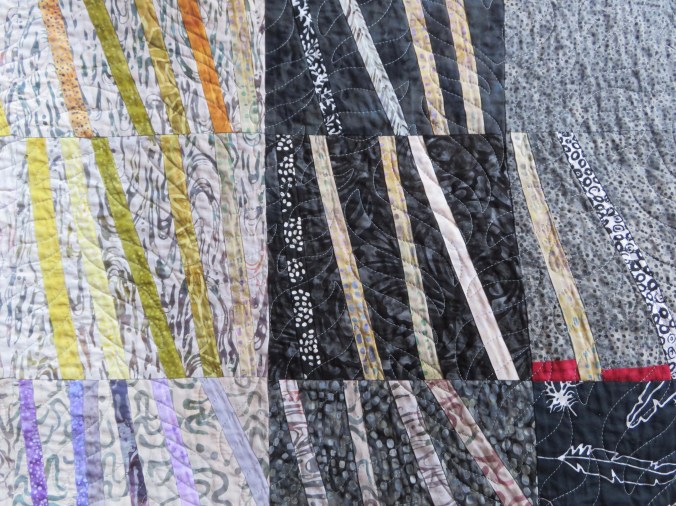
Close-up of “Rain.” Left is center panel, middle is first border, right is second border. I had to purchase only a half yard of dotted gray fabric to complete this quilt, the rest from my stash.

