BIRTH

To my second-born son:

Thirty-six years ago, just now, I was in labor. My first pains were last night and Gary said, “Don’t think about it.” So I didn’t. I went to bed. I got up about now because I couldn’t ignore labor any longer.

At the hospital, a nurse examined me. “Well,” she said, “whatever happened last time you are doing it again.” You were 4 weeks early and I was already close to delivery. I was glad of that because I did not want them to send me to Portland again, or do anything to stop the labor.

I overheard a frantic conversation in the hall outside my room. My doctor would not come for the delivery because it was his day off. This didn’t surprise me. That doc was new and his father was an OB/GYN in Beverly Hills. He didn’t intend to stay in Oregon.

There was literally no doctor in the entire hospital. They called Dr. Larry Zagata, who had been my original doctor in my first pregnancy. He had just come off a weekend on ER duty, but he drove back from Neahkahnie. The baby was coming fast—you—and I recall quite clearly thinking, “It could not possibly have hurt this much the first time, or I would never have done it again!”

They barely got me into the delivery room before you came out, spilled amniotic fluid all over Larry, and then you pissed on him. He laughed. He’d only just showered before returning to the hospital.

So Larry Zagata, your dad and I, and three nurses were there in that moment. We saw you first.

I always figured Larry owed me a birth since your brother arrived in Portland.

I was in a room, showered and elated by 8:30 that morning. My temperature and other vitals were down and nurses kept coming in to check me. They did not tell me they were concerned, but I knew, and I wasn’t worried because a dropped temp is a sign of imminent labor in dogs. I took the birthing classes both times I was pregnant, and they were helpful. I did not scream, I sang during labor (Joni Mitchell’s “Song for a Seagull”), and though I cried on the third day of labor with your brother, I did not cry for you. What most helped was breathing exercises I learned in high school PE (the only useful thing I ever learned in PE) and relearned in classes plus what I learned watching our dogs whelp puppies. It’s called labor because it is hard work being born.

Welcome to the world, my dear boy. I always wanted brown eyes as a child and you were that gift.

love,

mom

MEMORY

my-brain-is-full-1.jpgOne of the assignments I used to give my juniors was to memorize the Preamble to the Constitution of the United States.

We the People of the United States, in Order to form a more perfect Union, establish Justice, insure domestic Tranquility, provide for the common defence, promote the general Welfare, and secure the Blessings of Liberty to ourselves and our Posterity, do ordain and establish this Constitution for the United States of America.

We listened to the School House Rock song (which leaves out four words) and sang it together several times. Then we wrote the fifty-two words on a slip of paper. Students had to write it perfectly, with all the peculiar caps, punctuation and spellings, before they were done. Almost no one got it the first time they tried to write it out. Some needed a dozen tries. For many, this was the first time they noticed the word “posterity” and I had to define the term. Many initially complained it was “impossible.” Yet most of these same students could likely sing the lyrics of favorite songs. Eventually they all got it.

Students routinely underestimated their own capacities in many ways. Memory was one.

In the past, I have used the example of my younger son’s experience as an undergraduate Theater major. Ian will say he is fortunate, and that is likely true, but he is also smart and a skilled performer. He was a gamer from the age of 4 and now makes his living in theater, mostly as a master electrician.

In earlier days, Ian starred in high school musicals, performed in community theater, and while a college student at Portland State he played on every university stage as well as in commercial theater, and starred in an indie film. When the male lead in a local community theater walked off four days before the opening of a play, the director called Ian. He was on stage for the opening, off script and brilliant.

I recently read a new translation of The Odyssey by Emily Wilson. It functions as a comfortable introduction to that ancient story, offering an excellent overview of its background and an attempt at form—the original Greek is in a poetic form that does translate so Wilson chose to use iambic pentameter with shorter lines, which do not allow for all the detail of other translations. But the story is lively and interesting with monsters and divine storms and bloody battles. The claim that most disturbed me was her insistence that no one poet or performer could have memorized the entire epic of over 12,000 lines. I could only conclude she didn’t know theater people.

One of the plays my son performed in college was the restoration comedy She Stoops to Conquer. The play includes many characters and he memorized all the lines—he had little choice since he performed all six of the major male roles in rotation as well as all the unnamed male roles such as “servant.” It is a long play.

So is Hamlet, which contains just over 4,000 lines and anyone playing the lead would likely, by necessity, learn the entire play. It is not enough to know cues, the lines immediately previous to those the actor knows. The actor needs to know more than that. And that is not the only role a lead actor in Shakespeare’s day would have known. In repertoire, where a limited groups of actors perform several plays in rotation, he might be performing a dozen roles. It would not be unusual for a single actor to have 12,000 lines mostly memorized. And then a month later he would have a new play and another and another.

Assuming a minstrel sang only long piece or perhaps a handful learned over a lifetime? To perform 12,000 lines is not “impossible.” It would require 12 hours, be sung over a series of nights. Again and again.

It is, frankly, incredible what the human brain can do.

Many of us struggle to commit a phone number to memory. How about 67,980 digits? That’s how many digits of pi that Chao Lu of China, a 24-year-old graduate student at the time, recited in 2005. Chao uttered the string of numbers during a 24-hour stretch without so much as a bathroom break, breaking the world record.

It is only in modern literate times that we have so underestimated the capacity of the human mind to memorize. Modern research suggests that most people know as few as 10,000 or as many as 35,000 words. A working vocabulary, words we use routinely in conversation, is much smaller, a few thousand words. The Kottke blog (one of the oldest) offers an interesting overview:

In his collected writings, Shakespeare used 31,534 different words. 14,376 words appeared only once and 846 were used more than 100 times. Using statistical techniques, it’s possible to estimate how many words he knew but didn’t use.

This means that in addition the 31,534 words that Shakespeare knew and used, there were approximately 35,000 words that he knew but didn’t use. Thus, we can estimate that Shakespeare knew approximately 66,534 words.

According to one estimate, the average speaker of English knows between 10,000-20,000 words.

True, Shakespeare cannot be considered typical, but words were his business. His command of language was not so unusual, even in Europe. Wordplay was entertainment as well as occupation. Courtiers invented puns on the fly. People got the joke. When my typical Honors students were assigned to read Huck Finn, they often complained about the difficulty of reading Jim’s dialogue and rarely found the book funny. When I read it aloud to my regular English classes, they laughed continuously. They heard all the jokes. My “smarter” readers were not often hearing the language, but skimming.

(A reading specialist once told me that reading under 350 wpm was failure. This represents a misunderstanding of how the brain processes language. True, a very slow reader, sounding out one word on the page after another, struggles to make sense of a sentence. But a very fast reader fails to grasp anything but an overview of content. The fast reader cannot help but resent poetry for the demands it places on the reader, and thus loses the art on the page completely—a complaint for another time.)

The impact of cell phones, audiobooks, and other technology on language has been estimated to be anywhere from debateable to improved. It might result in little change to overall usage or actively cause vocabulary and grammar to deteriorate or even improve usage.

In any event, the memory capacity of the human brain is enormous. There is no danger of filling it up. Whatever we might believe limits our abilities to learn and use new information, we are likely wrong.

People are capable of learning and growing throughout their lives. It is wise for us to do that, a healthy habit. However long we live and any way we look at learning—through formal education, memorization, life experience, or invention—it is what we are meant to do throughout our lives.

Our brains are never full.

SaveSave

SaveSave

DID IT

IMG_2969.jpg

It was raining in Portland. Kids were dancing. The music was fine.

Today is a big day. Sand Castle Day happened in Cannon Beach and Rose Festival in Portland. It was also World Wide Knit in Public Day, so I took my knitting along with me to the Scandinavian Midsummer Festival in Oaks Park. We’d gone to the Scandinavian Festival closer to home, but this was our first time to the one in Oaks Park. The skies poured rain down on us and the traffic was terrible on the way over, but we found the venue without getting lost. I wore my pussy hat to keep my head warm and a huge sport top I borrowed from my son Alan almost 20 years ago and never returned.

It was a wet day, but I finished my swatch for . . . something. I have 7 skeins of a lovely tweedy-painted violet and blue Koigu merino 2-ply and a matching extra fine, silk-and-mohair lace-weight, which is also from Canada. I think I bought them to knit a sweater.

When I got home, the sun was shining, I blocked the gauge swatch, and now I suppose I will have to write up a pattern and actually knit a garment.

BELIEVE ME

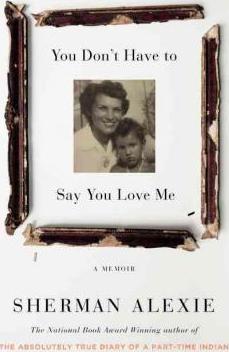
9781478912811.jpgI first wrote a review of Sherman Alexie’s memoir, You Don’t Have to Say You Love Me, in August of 2017 on Goodreads. I continue to be mystified by the glowing reviews of this memoir. It seemed to me that Alexie was busy blaming women for what men had done or for what he, himself has failed to do. I have read many books that attack a woman (a character, a mother) in inexplicable way, as if the suffering of women listed purely to advance the needs and character of men in their live. Zoe Boisierre wrote on the Brevity blog about the recent outing of Junot Díaz as a serial abuser. Given recent revelations about Díaz, Alexie, and other authors, I feel vindicated in my distrust.

Recent news of Alexie’s abuse of women (early 2018), confirmation by no less than Joy Harjo that complaints have been ongoing for years, and especially his semi-apology should not surprise anyone. It is clear in his memoir that his perception of suffering is entirely selfish. He reveal no depth of appreciation for the suffering or pain of anyone but himself. Despite his skill as a writer, I never understood the apparent widespread “love” of this book.

“Believe me, believe me, believe me.” Ever since I read a review of Sherman Alexie’s memoir, You Don’t Have to Say You Love Me, the song has been running through my head. You could find it on YouTube, but if Dusty Springfield’s voice doesn’t come right up out of your memory, best to leave it alone. You may find yourself walking in time to the tune for the next few days. Maybe that isn’t so bad. It’s a great old song, but I would be happy to get it out of my head.

There are short vignettes, longer scenes, words cut into lines and stanzas that sometimes are poems and sometimes have other business. Ultimately this book does not reveal wisdom of hindsight or generosity of objectivity or even modest compassion for the woman who sacrificed so much to keep him alive. This is thrashing. This is struggle. This is self defense.

Alexis calls himself an “urban Indian” who left home to attend an elite private high school and never really came home again. As I read, I searched for commonalities. He was raised poor and on a reservation and, while I was raised on a dirt road with open ditches and poverty all around me, my parents chose that house because the schools were good. My father was also an alcoholic. Maybe. But he worked and brought home his paycheck. We always had milk in the house, even if it was powdered. He died. I loved him very much. We have that much in common.

My friend Kathie lent me her ARC and we invited him to talk to my high school students and to read in Cannon Beach based on that book. (We are a largely rural and poor community, those of us who actually live on the north coast of Oregon. He would not have been available a few months later. His speaking fees were astronomical.) Alexie and his bride stopped off for these events on the Oregon coast before completing their journey home after their honeymoon in Hawaii.

Before telling more I should mention that I have read most of his books. I loved Sherman’s first collection of short stories and the ones that followed. I did not love his novels. My friend taught The Absolutely True Diary of a Part-Time Indian, which has considerable connection to Alexie’s real life, when I was teaching literature I taught his short stories, and this author made my husband cry on that long-ago visit. I bear a grudge concerning that last. I have not forgiven Sherman Alexie any more than he has forgiven his mother. I was not raised in poverty but my husband was. I am not always a kind person, but my husband nearly always is. So I am a skeptic when it comes to Sherman Alexie. I am a fan, but I know enough not to trust him.

The strength in this memoir is the writing itself, which is sometimes brilliant and occasionally even humble when he admits flaws. Too often he is defensive. Mostly he is churning with guilt and anger and not managing any forward movement. He is eager to label himself bipolar. He expresses tremendous guilt and resentment for his estrangement from his mother, for not speaking to her for days and weeks and even years at a time. But he blames her for it. Like many children of bad fathers, he blames his mother. As a woman and a mother myself, I find that bizarre. I take it too personally, you might think. I am a feminist and a class warrior. I am also weary of people who hold their mothers responsible for all the sorrow in their childhood.

Big message here: No ones’s mother is perfect.

She did the best she could.

Alexie’s mother stopped drinking when he was a little child and struggled to support her children and her husband. She also moved onto the living room couch, a move she explains as a step up from memories of being crowded in bed with siblings. At least sleeping on the couch, on a succession of couches, she did not have to share. Alexie accepts and even defends this explanation. I wonder that he never considers the likelihood that she no longer wanted to sleep with her drunken husband, that she did not want to take a chance on another pregnancy? That while she may have still cared for Sherman Senior, she was not willing to sleep with him stinking of “alcohol and vomit and piss and shit”.

Sherman Alexie is an aggressive and angry man. He has suffered in his life, he has suffered terribly, and perhaps that is why he is quick to anger and quick to exact revenge for any real or imagined slight. My impulse is to call his attacks in this book “counting coup” but counting coup is honorable, a show of courage and skill. These attacks are self-justifying, snarky, and often unfair. Sometimes they are not even skillfully written.

I was still young when I first met him, and Alexie was much younger with several books of poetry and only that first collection of fiction when he told my students he wrote prose for the money. If he didn’t need to sell his work he would stick to poetry. That might be the major difference between us.

Like his mother, I am a quilter. My father died in 1986 and my mother died in 2007, a week after graduation from my MFA program. After my mother died I grieved. Everything went dull and even my writing withered for a time. My husband and I had cared for her in her last five years. When she apologized to me: “I was mean to you” I responded with absolute sincerity that she never was. But she was. She did hurt me. She bullied me and criticized and was an imperfect mother. She was also kind and helpful and supportive in most ways. It took some time after her death for me to appreciate that this is the best anyone might hope for.

According to this memoir, Lilian Alexie could be kind and supportive but also verbally combative and abusive. When Alexie’s good friend died his father played hoops with him for hours. When, days later, he was still crying in his room, his mother opened his door and told him to snap out of it. He took his father’s action as proof of love and his mother’s as proof of cruelty. But which one got him out of bed?

Once or twice a year, Lilian would take it into her head to vacuum in the middle of the night. According to Alexie, this was completely inconsiderate, unbearable, and woke everyone in the house. One night, because he was the strong kid willing to stand up to his mother, Alexie got out of bed, grabbed the vacuum and threw it out the door. When I read this vignette, I sided with his mother. Who else ever bothered to vacuum? She is the one who stayed. Alexis ran away and has never really returned. He might at least credit her for her willingness to remain with her family, even if chooses to question her motives.

Immediately after her husband died, Joan Didion wrote her memoir: The Year of Magical Thinking. After a lifetime of journalism and research, Didion did what she had always done. She reported with objectivity and poetry about her experience. The result is truthful and beautiful and a powerful exploration of loss and death.

Alexie has not done so well. He is too angry and guilty, eager to assign blame and to score points on every person who ever hurt his feelings. He is angry at the man who abused him as a child (me too). He wants everyone in the audience to admire and cheer him, not just most. He is also angry at the Indian woman who called him on his claim for being the voice of all Indians. It was a claim he made in my classroom when he was still in his twenties and later speaking on a panel of people about shared issues of people of color. If Sherman Alexie is to be believed, his suffering is the worst, his people have suffered the most, no one else knows the sorrow he has seem. No one but he has the courage to say it. Only he can tell truth. These feelings are not entirely unjustified, but they get in the way. He has been angry for all this time. One of my students was angry that he misquoted Kurt Cobain while claiming Cobain as his. I was put off when he quoted liberally from another Indian author without once naming his source, or even revealing that his rant was not in his own words but the borrowed words of another.

He claims his mother was the last Spokane fluent in the language, but that he never learned a single word of that language. I mentioned that to my husband, who found both claims unlikely. My husband’s parents are both dead too. We are each the oldest in our families. Alexie has cousins, I have none. We have troubled relationships with our siblings. For a while in the 1970s, my husband was one of a handful of fluent speakers of Puget Coast Salish. During a reading he said a name to Sherman Alexie, the name of a Spokane Indian, and my husband pronounced it perfectly. Sherman walked close and demanded, “What did you say?” but my husband would not repeat it. “I have some naked pictures of your mother,” Alexie said. “I would like to see them,” my husband said. His mother had recently died. Two men wounding each other.

I have been paying attention since. Sherman Alexie and I have several mutual friends and acquaintances. Perhaps he is a wonderful father and husband, but he was a neglectful son and he is not a man to tangle with unless you are prepared to bleed. None of us is perfect and most of us have a list of actions we are not proud of, but Alexie might do better to comes to terms with his own failures and his particular cruelty while criticizing his mother for similar behavior.

Like most memoirists, Alexie concedes that his version of events may not parallel versions told by others. Mary Karr warns at the beginning of Liar’s Club that her memories are not the same as her sister’s and mother’s. Mary McCarthy offers a similar disclaimer in Memories of a Catholic Girlhood. In his case, Alexie seems to allow for considerable stretchers. His is a memoir of personal convenience, occasionally confessional, but more often on the attack.

Alexie wrote this book and saw it published in the two years following his mother’s death at 78. He also had brain surgery. All of this is too quick. Unlike Didion, he does not have a lifetime habit allowing him to stand apart from his experience in order to tell his story objectively. He does not even try. These are powerful words and considerable rambling, some poetry and some prose broken into lines and stanzas in a pretense of poetry. There is self-justification and enough fury and blame to waste what little insight this brilliant author might otherwise have shared.

Alexie declares himself an “urban Indian” in a way that is defensive and tough. He had a hard life and survived to move away. He has kept himself strong by keeping apart. There is a lot more guilt here. He needs to forgive his mother. More than that, he needs to forgive himself before he can recognize that he owes her more than forgiveness. She let him out.

He claims he is deliberately repetitive. He claims a lot of things here.

If readers take Alexie at his word, they might find a touching if erratic story of a heartbroken son struggling to come to terms with the death of his “complicated” mother. This book was promoted as a memoir about Alexie’s mother, about grief and family and loss and forgiveness. I found it mostly about getting even.

On the last page: “I don’t know how or when / My grieving will end, but I’m always / Relearning how to be human again.” I speak from experience: The grieving does not end, and the year or so after that loss there is almost no sense to it at all.

My advice to readers: Do not read this or his awful novels. Read The Absolutely True Diary of a Part-Time Indian which is a circuit of stories. Read the short stories and the poetry. Let Alexie come back in twenty years and write about his mother. At the least he may find some kindness. Maybe the truth isn’t funny, and Alexie wants that sharp wit like a stick to poke us. Maybe tenderness makes us vulnerable. It requires a difference sort of courage than a streetlight.

[Just saw an on-air interview with Smiley. Who is this person? Salish is not a single language but many. The scene at Haight Ashbury was over by the 70s. Who is this man abruptly stating the obvious, which is clear but pretty much unstated in the book, that Sherman and Lilian had/have a great deal in common? His manner is so tender and humble. When has he ever been tender and humble? I do not even recognize his voice.]

COMMIT TO ENDINGS

IMG_1704 (1)

I struggle with endings, with hitting the balance between hope and regret. Despite wanting my students to listen carefully, review assignments, and take extra time to perfect their work, I am impatient myself. I always wish I’d done something different, pushed harder, and accomplished more.

Monday, I had my students over for a party at the end of the year. I haven’t done that in years. I think they had a good time and we ate and laughed some. I sent them out on the beach while Gary and I cleaned up, and they came back after a long time, grinning and sandy.

They asked me if I wasn’t glad the school year was over.

I almost never am.

These are graduating seniors, with summer plans of work and travel and college classes in the fall.

I always wish I had more time, that I could have their full attention for another month in order to, as my mother would say, “whip them into shape.”

The truth is, I am slow to get to know my students, and then I value them as people. I wanted them to work harder and mostly they did. They made no more mistakes than I did in high school, but expectations have not been set nearly high enough. They have coasted too much.

An administrator complained to me the other day that these current high school students are afraid of things being too hard, that their parents do not want their children to struggle, and that even some teachers find it impossible to set high standards because doing so makes more work for them too. Everyone wants to make education easier, as if that were possible or even a good idea.

Throughout my teaching career, I have been asked to articulate my teaching philosophy. After 40+ years, I would say it comes down to this: Set a high standard, support incremental growth, and demand excellence. When we show them they can accomplish beyond their expectations, they are capable of pushing on. When we make the work easy, we are telling students that “easy” is all they are capable of accomplishing. We reinforce their belief that struggle is equal to failure.

Many years ago, I heard Kylene Beers speak at an NCTE Conference. I’d been heading into the conference room next door, but the presenter in that room stood outside her door: “Go see Kylene. You’ll be glad, and I am presenting again in the next session.” I took her advice. One of Kylene Beers’ key points was to reveal struggle as a good and natural process. “I struggle when I read the tax forms. I struggle when I read Toni Morrison.”

The choir teachers from my son’s high school days were exceptionally demanding. Do it better, be stronger, try something even harder! Sometimes those teenaged singers would listen to their songs and be simply amazed at how excellent they sounded. They produced professional performances. They gained confidence and ambition as a result of that demand to do the harder thing, that insistence that they do it and do it and do it again, until they have mastered themselves.

Learning is struggle, struggle makes us strong, strength makes us better.

My teaching is done for the time being and I must return to my own work. I still have a warp to wind, a quilt to complete, and a story that wants editing.

This week: Slow down, do better, amaze myself.

LIKE A RUNNER

IMG_1206.jpg

After my 15-16 miles—happy, but hurt.

In August 2011, I ran from my house to school.

It would be the last good run of my life. And it was not good.

I had been training all summer for my second official half marathon that October. I ran long one day a week, working up to 12.5 miles, and 3-6 miles other days, including hills. I was conditioned, but I underestimated the distance to school. I believed I was running about 13.5 miles that day and figured I could take my time and manage that stretch. I’d covered that distance before. The run turned out to be more than 2 miles further than I’d expected. Even so, I might have been okay except that my new runners were sitting in a box at home—saved for the Portland Half Marathon, still six weeks away. I ran the first 5 miles on sand but as soon as I turned off the beach, I realized my shoes were dead flat. By mile eleven on pavement, I was hurting. By mile fourteen I was struggling.

LESSON ONE: Know what you are doing.

I began running after my eldest son ran with the cross country team because the boys and girls teams were so cheerful and supportive of one another. I’ve read plenty of books about running, written by runners, and I was a runner for nearly twenty years, covering a modest 3-6 miles at least every other day.

At the age of 41 in 1994, I began training over a distance less than a third of a mile. I started April 1st. It was a joke on myself that accepted the likelihood I would not be running for long. My plan was never to hurt myself. I am not a believer in no-pain/no-gain. That’s a crock. Pain is an indication of damage. I didn’t want to hurt myself. I wanted to get in shape. I ran every other day and added a couple of hundred feet each day. This schedule of running every other day allowed my muscles time to heal. By August I was able to run strong for six miles. When the cross country team began practicing, I ran with them and could keep up with all but a handful Varsity boys. I was not fast, but steady and capable of distance.

When I set goals for myself, I intend to promise only what I am certain I can complete. When I make a list of task, I pace myself, allowing for flexibility but also for serious deadlines.

LESSON TWO: Make reasonable, doable, consistent plans.

Despite my good planning, I made other mistakes at the beginning. I did not buy any sort of running gear for myself and chaffed my legs between my thighs on cuffed shorts. I didn’t have a running bra. My running shoes were hand-me-down sport shoes that were a full size too small. No muscle pains from my early training, but blisters and sore feet.

LESSON THREE: Buy or borrow the right equipment. 

Once I began working with the cross country team, I picked up race strategies. When I was covering distance, I maintained a steady pace. There was a sweet spot between one and four miles where running felt almost effortless.  Right at the beginning and after the first four or five miles, my effort increased. Another had to do with “running strong” right through the finish line. In other words, resist the temptation to slow when approaching the end, even if I am doing well enough that I believe I could.

When I near the end of a process—the end of the school year, for example—I push myself to sustain my pace. In other work, this is one of my greatest challenges. Sustain attention, quality, and detail right through the end.

LESSON FOUR: Run through the finish line. 

I was not yet 59 years old when I had my last “good” run. I’d become fond of a vision of myself hobbling along at age 72. I gave myself time, went back to running slowly and over short distances. I was careful, but my feet were ruined. I got orthotics and wore larger shoes all day until I could walk without pain. By 2013, at age 61, I accepted that I would not be running again. It about broke my heart.

I considered biking and swimming, belly dance and yoga and gave up. Walking stuck.

There is a memoir about running by the novelist Haruki Murakami, where he describes trying to run at a pace in his middle years that he never trained for in his youth. The entire time I read that section I shook my head. As we age, some goals become unrealistic. I’m not happy about it, no one is. I have a neighbor who is in his mid-70s and still runs the beach. It’s true I can walk faster than he can run, but I admire his spirit and his willingness to continue doing what he loves, even if he has to slow down.

Most of the activities I have enjoyed in my life are still fully available to me. I quilt and weave and go to films. On my morning walk I can see to beachcomb. I read a book every few days, though I need better light to see the page. I lost the habit of 8 hours of sleep at night when I was an overworked high school English teacher. I nap instead. I am careful about what shoes I wear and how hard I pinch because my hands and feet are inclined to ache. I no longer run.

Could I do more? Hubris needles me to answer yes, but common sense wins. I will do what does not hurt me, and that is more than I would have expected for a woman my age.

LESSON FIVE: Accept your limitations.

SaveSave

WHAT’S IN A NAME?

IMG_2963

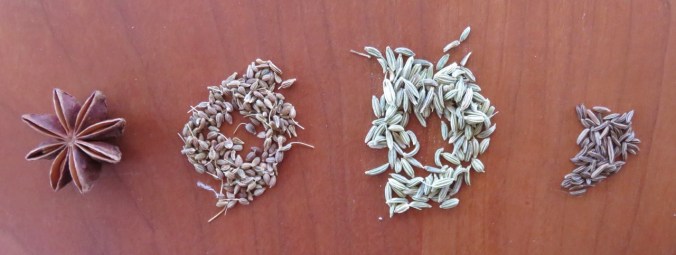
STAR ANISE     ANISE     FENNEL     CARROWAY   

So. If apples are a fruit, and pineapples are also a fruit, then pineapples are a kind of apple. And pineapples are surely similar to pinecones? Then pinecones must also be apples!

Don’t worry, it’s not logical. It’s just the way my day has gone.

I had a peculiar experience today while searching in Whole Foods for aniseed (anise) to bake a seed cake for my students. I reviewed all of what they had. No anise. I found a hapless produce worker and, after apologizing for talking to him when I knew it was not his area, complained that “I can’t find what I want.”

Another employee appeared at my shoulder. “What are you looking for?” He sounded more annoyed than concerned.

“Aniseed.”

“Anise? You want anise? That’s the same as fennel.”

“Is it?”

He pointed to packets of star anise and other packets of fennel. I thanked him, though he still seemed somewhat cross. I got all the way to check-out with fennel seed before I remembered I’d made this mistake before. It’s easy to assume that they are related, but fennel seed and anise, not to mention star anise are not the same spice. Not quite.

Star anise (Illicit serum), found inside a fruit, originally grew on small evergreen trees in China. I have eaten it in tea, but never baked with it. According to Wikipedia it is “a highly fragrant oil used in cooking, perfumery, soaps, toothpastes, mouthwashes, and skin creams. About 90% of the world’s star anise crop is used for extraction of shikimic acid, a chemical intermediate used in the synthesis of oseltamivir (Tamil).” It is sometimes used in the west as a cheap substitute for aniseed.

Aniseed (Pimpinella animus) is from a flowering annual plant native to the Eastern Mediterranean and SE Asia. Wikipedia says it “is widely cultivated and used to flavor food and alcoholic drinks, especially around the Mediterranean. It served as a carminative in herbal medicine.” I love it in pastry. 

Fennel seed (Foeniculum vulgar) comes from a member of the carrot and parsley family found originally in the Mediterranean. The bulb at the bottom is a delicious vegetable I frequently add to dishes. But no, fennel is not the same as anise. They are not even in the same genus, though Wikipedia points out: “In North American supermarkets, it is often mislabeled as ‘anise’.” (I swear I did not post that.) See above. Do they look the same to you? Trust me, they do not smell alike. 

Caraway seed (Carum carve) from another member of the carrot family native to western Asia, Europe, and North Africa. I’ve used this in seed cake, it taste nothing like the others, and is most often found stuck between my teeth after eating caraway rye bread. I put it here because, up close, the shape of the seeds resembles fennel more than aniseed does and because seed cakes are more often made with caraway. The plants of caraway, anise, and fennel all look similar when in flower, to be entirely honest. But they are not the same.

Wikipedia and my nose tell me that fennel, both seed and vegetable, anise, and even star anise all smell somewhat like licorice. (Caraway does not.) While both fennel seed and star anise are sometimes substituted for anise, the scent and flavor are distinctive in each. They are not identical, and none of them are true licorice, which comes from the root of an entirely unrelated perennial legume plant found in southern Europe and some parts of Asia (Glycyrrhiza glare). 

Who knew?

Tomorrow I will bake the seed cake. Photos to follow, if I am successful in emulating the delicious flavors of the Pearl Bakery’s gibassier pastry. I have candied citrus peel on purpose.


SaveSave

IN BETWEEN

IMG_0278

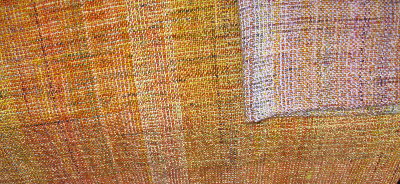
When I am not teaching and when I want a break from writing, or I am feeling wounded and drained (it happens), I weave. Sometimes I quilt.

I have a friend who sells a lot of work urging me to join a group, open an Easy account, or in some way make some money from my work.

It’s not going to happen. I give weaving to friends and charities. I make baby blankets for expectant parents. I give them to friends. New Mexico children’s illustrator and YA author Betsy James, Russian sculptor Marina Globova, and Oregon novelist Molly Gloss have my shawls/scarves. (See below.) I don’t have a photo, but professor of animal scientist Temple Grandin has one draped on the back of her couch in Colorado. My shawls live on shoulders in Alberta and Washington and California. Each one gifted.

I put on warps and choose weft colors specifically to suit what I understand about their preferences.

I make a quilt and knit a blanket for each grandchild at birth. I make another when they turn two. When they go to college, I will make them each another. I try to use their favorite colors, though children change their minds. A sweater begun in July may no longer appear by the time it’s finished in October.

In the mean time, I weave.

Tomorrow, I will begin my first warp of the year. I am thinking red and browns this time. There was a saffron warp a few years ago and I still haven’t found a home for two very special pieces. There was the “Peacock” warp and one for Ruby and seasonal warps where the weft varied to take me through Spring, Summer, Autumn, and Winter. Each warp yield two or three or even four pieces. I like color, but sometimes the more subtle combinations appeal. Each piece is meant to be distinct.

saffron_warp IMG_0778

cropped-img_0404.jpg

I will begin pulling skeins and winding tomorrow.

WALKING IN THE DARK

Pacifica Project Presentations

There was no color essay on Tuesday. I have been busy the past few days because my high school has a graduation requirement that ends with presentations at the convention center. Students have identified a community and a need—a charitable concern such as feeding children, tagging salmon, collecting litter, or coaching kids—then designed a project to address the need, put in dozens of hours, researched a related issue and written a lengthy persuasive essay, and finally, yesterday, presented their projects to the community at the Seaside Civic & Convention Center. Their 12-15 minute talks required visuals and rehearsals beginning last week at school and then all day on Tuesday in their assigned rooms downtown.

I meant to skip the Pacifica Project Presentations this year, its 26th. I was a member of the original team that designed the program, and one year when the mastermind behind it all, Mike Hawes, was unable to be there, I hosted. I always create the program and attend rehearsals. This year, I was tired (more about that some other time). In the end, I managed to see two full presentations and parts of four others. It was, as always, an inspiring evening.

Mr. Hawes made me cry (not the first time) in his opening address about the inspiration of these earnest young people and the need for hope.

Students worked hard, many of them at work on their projects a year or even several years before. More than a few were deeply impacted by their service. One young man who volunteered at a weekly community event found that this forced him out of his dependence on media and into relationships with people face to face. He said it reminded him of the need to see and talk to people, to hear them. A young woman who tagged on to an existing anti-bullying program in another state discovered that she wanted to more and organized a parade in favor of kindness and hope.

I started two blog posts, but was unable to finish either of them because I was so focused on these Pacifica Projects.

This afternoon while my husband was collecting our mail, I heard a father explaining the Golden Rule to his little girls:

“If you want people to be kind to you . . . “

In the mean time, Rosanne Barr tweeted a series of deeply offensive messages (more than just the racist one) and her show was cancelled by a network unwilling to defend or overlook her remarks. Samantha Bee used a horrible word to describe Ivanka Trump and people are scrambling about that one. Trump, who has said equally terrible things without apology, made the recent events about himself, which is to be expected. He has no principles beyond his personal popularity and fortune.

This morning (Thursday), republican John Kasich called for the Senate to get their act in gear and do something about DACA. He wants something to be done. In a CNN interview this morning, he said that Congress should not wait for permission from Trump. It was not their responsibility to pass only what the executive branch wanted. They should, in the end, be doing something, the right thing, he said, and I hope he pulls his people together.

In the interview, Kasich could not resist a partisan remark that he didn’t know what the democrats stand for—which is unfortunate especially since DACA is a program most compassionate people of both parties defend. Still, it is a republican talking point to say democrats do not take a stand. The unfortunate corollary is to wonder if Barr and Trump’s locker-room talk is what too many of these congresspeople stand for?

I believe most republicans are horrified by these ugly comments. I think the vast majority of Americans are decent people who respect Gold Star families, POW, women and children and men of any color and station, and most honor ordinary courtesy.

This brings me uncomfortably to my son’s recent distress about Samantha Bee. Yes, she is a left-leaning comedian, and yes, my husband especially loves her (he has lost respect now). She is married and a mother and she is not polite about politicians she disagrees with. Is it okay for her to be vulgar, but not the president? Is it fair for her to call names she would certainly condemn coming from a politician? It’s worth thinking about.

There is false equivalency coming from every direction. Anti-Nazi protesters are not equivalent to Pro-Nazi protesters, at least not given our world history. And sexualized workplace comments are not equivalent to rape. Any abusive behavior is to be condemned, but on the scale of abuses, there is error and lapse in judgement and there is clear, egregious abuse of power.

Hitting Up

I have always contended that humor at the expense of some individual or group only works when the blow is delivered up. That is, it is fair to challenge and ridicule the richer and more powerful, to laugh at the expense of those with a superior position in society. It’s a cheap shot to ridicule the weak and powerless. It is in Christian scripture to serve the powerless, it is part of our national character to support the underdog, and it is the over-size bully on the playground we are all inclined to dislike.

“With the rich and powerful, always a little patience.”

I am deeply concerned with principle, with doing the right thing regardless of the impact on myself. Nevertheless, I often site my own experiences to explain my positions.

In high school, I used to sneak out of the house to walk all alone. I was depressed and lonely and struggling. Walking in darkness was my way of coping, a way of avoiding death. I felt close to death at times.

The significance of this is not just that when I write about depression, I am speaking from experience. It is also true that in hundreds of solitary walks, I was never attacked, and I avoided people and spoke to no one, even on weekend nights when drunken people in cars were common. I hid in shadows and if I felt something was off somehow, I did not question my own judgement, but took steps to keep myself safe.

A gun would not have served to protect me. I was brought up with guns, taught how to take apart and assemble, load and unload. I do not hate guns, but I do fear the impact they have on frightened people. If I had a gun, the most likely result, statistically, would be that it would be taken from me and used against me. Toddlers kill their parents or a sibling accidentally every year. Police officers, trained to perform, miss their target 72% of the time when they fire in a real life situation. I would not expect to do better than those who have made law enforcement their profession.

Back in my teens, I ducked behind hedges to avoid being spotted by drivers in cars or drunken walkers, and I avoided populated areas. I walked across campus alone in the dark every term I attended the University of Washington. (There were advantages to scheduling an early morning or evening class in those days.) One night I was walking down the hill from Denny Hall, a paved but dimly lit path I followed regularly. That evening, I looked ahead at the mountainous overgrown cherry laurels just ahead and stopped. Something felt wrong. I didn’t hear anyone or see anyone in that dense twenty-foot mound of shrubbery, but I turned aside anyway. Following a more open path cost me seconds and might have kept me safe. Ted Bundy was killing women in those years around Seattle and I fit his preferred victim profile. No one admitted there were campus rape statistics to track in those days, but terrible things happened. I knew of terrible things happening. Maybe it was only luck that I was never  attacked, but I was aware, I wore a rape whistle, I splayed my keys between the fingers of my fisted right hand. I walked like I knew where I was going, and it was true.

Today, America is a dangerous place, and some of the danger comes from people slinging guns around. The responsible gun-owners I know keep their guns locked up, and I honor their family tradition of filling their freezers. I honestly do not want to take away everyone’s guns, but I also do not believe than guns are the only way to be safe. Our national obsession with guns is not a Constitutional right, but something more cynical. The harboring of guns and ammo with no purpose but to kill our fellow citizens amounts to dangerous paranoia. Our nation was founded on many things, a promise of semi-automatic weapons was never part of the original plan.

A small minority of people are terribly afraid of gun regulation. It is ironic, isn’t it? Especially given that the second amendment specifically calls for a “well regulated militia” and this wording refers back to an ancient tradition in Britain of requiring all adult males to train in military skills because the kingdom did not maintain a standing army large enough to defend the country. In case we have not noticed, we have the largest military the world has ever know. It consumes 43% of our discretionary funds—an enormous weight upon our budget and one reason we have little left for education and health care. Yet, we are so frightened we must allow ordinary citizens to have military weapons in their homes?

I’ve been accused of being too optimistic about human behavior. But I see things differently. I recognize that people do terrible things every day. I recognize that accidents happen. People make mistakes. But if we were at heart such terrible monsters as some seem to think, I wonder how I survived my parents’ temper with I was an obnoxious child. (You know I had to have been obnoxious now and again.) We survive because we are social animals, committed to working together for the common good. At least, that is how I was raised to understand my country.