COLD COFFEE

IMG_3313

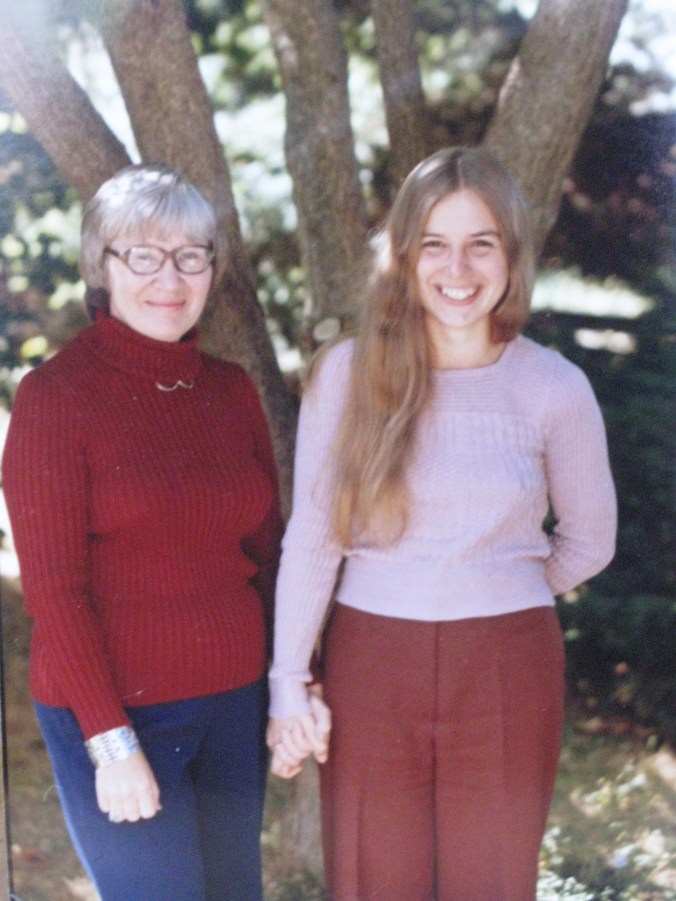
Probably in 1970. I was 17 and Mom would be about 43. I’d forgotten my hair was that long.

My mother would wander about the house looking for her coffee cup. Maybe she left it on the counter or the coffee table, beside the telephone or on the mantel in the living room. It might be on the picnic table in the back yard from when she went out to check on something.  It was usually cold. The cup was always half-full. Sometimes it was in her hand while she searched.

It keeps me awake, but helps my husband to sleep. He is what might today be diagnosed as ADHD. If he wakes in the middle of the night, drinking a little caffeinated coffee allows him to go right back to sleep. That is actually not uncommon. The caffeine allows some people to focus enough that they stop thinking about a thousand things and instead think about one thing: sleep . . . and they do.

Coffee has the more usual effect on me, so I drink two cups of coffee when I first wake and then I stop, unless I want to be staring at the moonlight half the night.

I began drinking coffee in my thirties as a way of drugging myself into alertness when I driving home from night classes. My children were still preschoolers but I had decided I would return to teaching as a Social Studies teacher. When my husband arrived home from work, I would head out for a 45-minute drive to an evening class. The struggle was remaining alert on the drive home. Coffee did it for me.

A few years later, I was hired as an English teacher, but I didn’t give up night classes. I began driving to Portland State for graduate work in their English Department. I also continued drinking coffee.

I like my coffee strong, black, and unsugared. I like iced coffee with whole milk, and the only way I take sugar in my coffee is in ice cream.

You might think that after nearly fifty years, my husband and I would know all there is to know about one another, but we had a discussion about coffee before six this morning and Gary was surprised to discover I do not sugar my iced coffee.

We had been talking about beer.

I’m not sure what my mother loved about coffee. She was not particular about flavor—she thought that instant and fresh-brewed tasted the same. She always had a cup, but didn’t actually drink it much. Maybe she liked the heat of it in her hand. I recall her reheating coffee in a saucepan on the stove. The microwave was a great timesaver. On the other hand, she never drank everything in her cup.

Happy Mother’s Day, Mom.

A BLESSING FROM BOOKS

IMG_2772

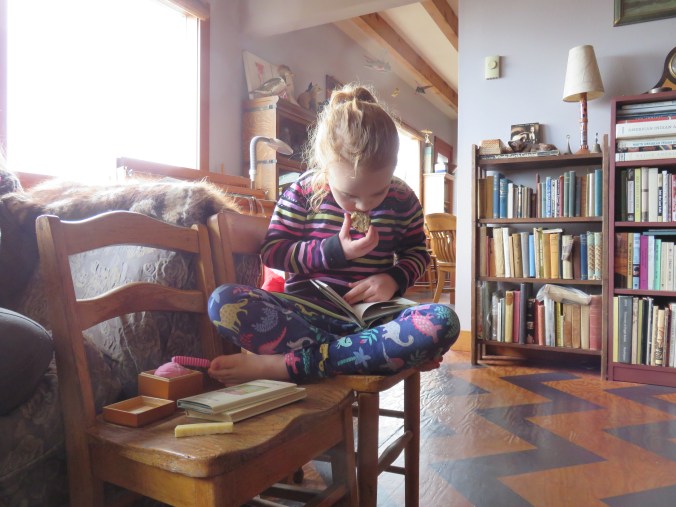
My granddaughter Ruby with her chosen books, cross-legged on a little chair, and making that one cookie last as long as possible.

I buy books. My husband buys books. We have, on occasion, vowed to stop, but we do not stop. We buy more books. Purchasing books is no cheaper than smoking or drug use, but this habit will not kill either of us.

We buy books.

We buy books from second-hand vendors and the local stores and Powell’s Book Store in Portland. We buy from independent small presses. We read about them online.

We buy books that make us suck our breath. Books for the past and future. We buy books that tell us our own story. We buy books that tell us a story we have never heard before. We buy books because we are not in district for the local lending library and the school library has a tiny collection. We buy books because we like to own books, and because the books we want will never be in our local libraries. We buy books because that is how authors make a living. We buy books to reread. We buy books because I write them. We buy books to covet and collect and loan to friends. We buy books for photographs and poetry. We buy books we cannot read because they are in Icelandic or Greek.

We look to books for laugher and tears. We look for education. Inspiration. Peace and hope and joy. Possibility. Truth.

A bird in the house is supposed to foretell death. Books are different. We buy books because research shows that just having books in a house with children will cause them to do better in school. A blessing.

We buy books to find lives we will never live.

We buy books to find ideas we do not have time to explore without help.

We buy books to find the other side.

We buy old books and out of print books and books that contain references we cannot find in the edition we already own. We order books we hear about and books we read about and books we wish we’d written ourselves.

We have books written originally in English and books in translation. We have books we still have not read. We have books bought in duplicate because we forgot we already had a copy. We have multiple translations of the same text, in order to place them side by side and judge for ourselves.

We have books we struggle to read because they are complex. We struggle reading books we do not have the training to understand. We read books that are over our heads and require additional sources to follow.

We never highlight with yellow markers or underline or dog ear—an abuse of pages. We use bookmarks and post-it note, tabs to help us back to the lines we want. We treasure and treat these books with the respect they deserve. All our dreams and goals and desires fit along their lines.

It is not true that you cannot have too many books. We have too many books. I feel a little guilty for having four pairs of black boots, but I do not feel guilty for owning the entire Patrick O’Brian series, even though I have already read them each twice.

We have filled many bookcases, sorted through and organized them by genre, subject, and author. (We do not sort books by the color of their bindings—an abominable habit we would never inflict on friends.) We give books away—we buy new copies to give. We loan them to friends who are gentle with them. When the bookcases become too tight to allow another purchase, we sort and we make the hard choice to allow some to reenter the world outside our door. Then we buy more.

We buy them so that they are ours and belong in our home.

For as long as I have had days, there have been books in my house.

We buy books.

NOTE: It was 85 years ago today that the Nazis burned books. Buy a book and let it burnish your brain instead.


SaveSave

SaveSave

PURPLE

IMG_2032

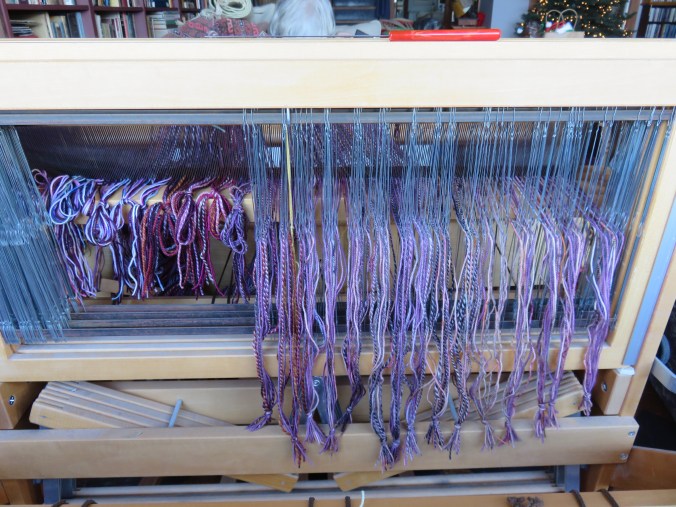
Canadian hand painted and hand spun merino yarn going on the loom.

My favorite pair of gloves are purple. They are not quite dark enough because I want the shade to conceal stains. I want it to work, but I also prefer the shadows. My walls are painted pale tints of plummy gray, but what draws me to purple is the darkness. Purple has a royal association for many people. It is beautiful. It is sometimes called a sophisticated color, but I think of berry stains on my fingers from picking salal. It also reminds me of pain. As one example, I have been thrown from horses, kicked and bitten by them. People do die falling from a horse, but for pure suffering during recovery, I cannot recall anything more painful than that perfect purple-dark bruise risen on my shoulder that took a month to begin fading. That is what I think of first when I think of purple.

Many things that are called purple are not purple at all. Male purple finches have a reddish head. Purple prose is the overblown decorative fluff that gives English teachers an upset stomach. On the other hand, blueberries are more purple than blue. The indigenous blue huckleberries make purple pies. Carrots were originally a purple root—the orange we know today is a sport that became so popular in Europe the original color is an oddity in modern times. Few would consider purple carrots anything but fantasy.

The tall flower spikes of Digitalis purpurea, as its name suggests, is usually light purple. When we were young, my girlfriends and I plucked the hollow flowers from foxglove spires as tall as ourselves. They bloomed on the edge of the woods and we slipped a glove onto each finger. We knew the flowers (and the stems, leaves, and roots) are toxic. Digitalis is the medicine my grandfather took for his heart, and too much can kill, but we ran with our purple-gloved fingers fanned before us in games. I always assumed that the foxglove of childhood games and that I see along my drive to work each June is native. But it is an invasive species, just another European like most of my ancestors. Maybe this is the source of my complicated love affair with purple.

The Purple Heart is a military award for physical injury in the field of battle—implying nothing about the actions of the wounded, other than to honor the wound.

Pretty purple things, amethyst and iolite and tanzanite and the opaque sugilite. The thick petals of orchids can be many colors, but the color “orchid” is violet. I have dyed wool lavender with iris flowers. That iris tint fades in sunlight. It is fragrance as much as hue: violets and lavender, the tuberose, iris, lilac scents. Somehow I associate purple as much with folly as with bloom—the pain bruises.

Yet, as a textile artist, it is the color I reach for, covet, value and strand in weaving. I choose purple to spice yellows or orange in a composition, to spark pinks or green. It is a hue that wants to shove gray around. And that is probably appropriate since purple has a long association with power. The ancient Tyrian purple dye worn by popes and sovereigns for thousands of years was harvested from the mucous of three species of predatory sea snails, known collectively as Murex. The fluid protects the unhatched eggs of the shellfish and drives off predators. It can be harvested by killing the snail, but also through “milking” the mucous gland of the creature. Rare but stubborn, the color, a clear reddish-violet to my modern eye, withstands fading through wear, light, and washing. The dye was already ancient when Aristotle, who was so right about some principles and so very wrong about so many particulars, detailed its production.

In the mid-nineteenth century, a British chemist invented the first aniline dye, originally called Tyrian purple and then marketed as mauve, a delicate, slightly grayed, reddish-purple. It is on the edge of being a cool color, found on the color wheel opposite yellow-greens.

In youth I leaned to warmer colors—orange, vermillion, russet reds, dusty pinks, burgundy, and wine red. My preferences changed over the years and purple moved from a supporting role in accessories to center stage. This shift is reflected not only in what I wear, but in what I want to touch. I wore bellbottoms striped in black, lime, pink, and purple when I was fourteen. I dyed my hair purple when I was sixty, a joke on the old ladies of my childhood who used rinses to counter yellowing that turned their gray hair distinctly violet.

me14c

Purple is the foil that makes paler, more timid tints dance. Purple is the look-at-me color, associated with power, with royalty, nobility, Lent, Easter, and Mardi Gras, but very rarely named as favorite. Studies suggest that it is a color preferred by artistic folk, more often women than men, older adults rather than younger ones, and that was the character of the room.

Sandra Cisneros had to fight conservative design review to paint her San Antonio, Texas Victorian home periwinkle blue, a pale blue-violet tint by my estimation, and proved to be historically accurate. There are painted ladies in San Francisco—not women, but the grand tall Victorian mansions of that city—painted in shades of violet. A favorite house in Seattle is a smokey violet shade I found on a paint chip called “Steson” with a bright red door. Hyacinth macaws are purple, and the queen of England is known to wear tints of that particular blue-violet. It is stitched into the border of a a sari or the facing of an Afghan dress.

It makes a pattern in concrete sidewalks. Clear glass pavers were made with manganese to clarify the glass, but eventually the iron that once clouded the glass swaps ions with manganese and over years of exposure to sunlight, the clear glass turns purple. City sidewalks built with glass “prisms” faceted to direct light to anyone working in the spaces beneath. There are such sidewalks across the country in Texas and British Columbia, Seattle and New York City. Many have been damaged over the years, but the surviving glass in sidewalks is generally quite purple.

Violet is on the edge of wavelength in light that humans can see. Shorter X-rays and gamma rays and ultraviolet exist beyond the visible violet, just as microwaves and radio waves lie on the other side of the light spectrum beyond red. The rainbow shows purple inside the sweep to fairy gold. Some gifts seem the work of the supernatural. In The Color Purple, while discussing their view of God, Shug tells Celie she thinks God wants to be loved, “I think it pisses God off when you walk by the color purple in a field and don’t notice it.” We are supposed to appreciate the gift.

We are supposed to appreciate the gift of that richness and precarious pleasure, the flower that blooms for a day, the shellfish that guards its eggs with purple mucous, the semi-precious gemstone, the pebble in the water, and even the fresh bump on an elbow, the toxic flower cups that fit on fingertips, the fine line between the violet we can see and the next shade over that is invisible to our eyes. There is beauty, but concealment too, a warning both ways. My purple gloves are meant only to protect my hands from the cold. In sunny weather I require some other protection. It is ultraviolet that burns our skin.

IMG_0778

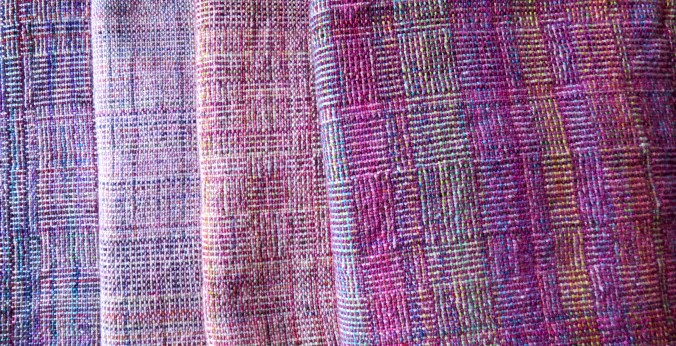
Four scarves woven on the warp shown at the top. The weft is completely different in each.

READING MEN

d5wxnck0quim9bosyfdo.jpg

Book Scales by Quint Buchholz (1991)

So now it’s Junot Díaz accused of abusive behaviors toward women.* I wish I could say I was surprised.

Karina Maria Cabrera wrestled with how to respond to the news, with how to reconcile her own ugly experience with Diaz and her indoctrinated impulse to make excuses for him, and to resent the accuser who called him out. In “The Reckoning: What Junot Díaz Teaches Us About Internalized Misogyny” she writes:

“I had to reevaluate my anger towards Clemmons and examine why I wanted—for even a brief second—to justify Díaz’s actions. I told my mom about wanting to write about my reaction; she metaphorically clutched her pearls and said ‘No. Don’t do that! If you do, you better say he was very respectful towards you. Don’t add flames to the fire.’

“That’s when it clicked: The root of the issue is in the way women are wired to think. It is a systematic modus operandi that has been passed down to us from generation to generation. . . .

“As a child, I did not always feel protected, because we were taught to ‘save face.’ But I want my daughter to feel protected, and I want her daughter to feel empowered, and I want her daughter to feel invincible. If that means going against the grain and saving ourselves instead of saving face, then that’s exactly what we should do.”

Today, we can tell our stories and the stories can be believed. We are willing to hear voices and read beyond the chosen perspectives I was offered as a child.

As a student, the only novels ever assigned to me were written by men. Anne Frank was still part of the public school canon, but all the fiction was by white men such as Hemingway, Goldman, Twain. This barely changed in graduate school. A college class on African Arts (literature, music, visual art) gave me Things Fall Apart, but my MFA program gave me the excellent short stories of Ron Carlson and Stuart Dybek. I had to find women such as Jane Austen, the Brontës, Dorothy Sayers, Alice Munro, Maxine Hong Kingston, and Toni Morrison on my own. A student gave me Middlemarch. There is an enormous list of authors, men and women of many races, ethnicities, nationalities, and sexual orientations I can recommend. My shelves (and I have thousands of books) represent a huge range of perspectives, but I hope there is nothing bigoted or deliberately cruel pressing up against my favorites.

At the top of this post there should be an image of great authors representing a range of voices instead of merely the ones I was taught. I tried to find such a collage of authors. I searched a thousand images and mostly found composites of author images are white and male. (For composers too.) I nearly chose Virginia Wolf in the midst of 29 white men. Where is George Elliot? Where is Jane Austen? Linda Hogan? Le Guin? Erdrich? Shields? Silko? Or in alphabetical order—Atwood, Byatt, Chopin, Cisneros, Drabble . . .

We need more. More voices. Unheard voices.

Some much-praised authors wear thin. As a woman I find that my existence barely registers in the brilliant novels of Cormac McCarthy. I read the Border Trilogy and that was enough. Some authors are so hostile toward women, I have avoided their work altogether. Juno Díaz was one of those. I did try. My impression was not so unreasonable. I felt my existence demeaned. I set it down. Don’t I already get that every day of my life, everywhere I look?

Sometimes it is possible to see it coming.

Recent news of Alexie’s abuse of women, confirmation by no less than Joy Harjo that complaints have been ongoing for years, and especially his semi-apology should not surprise anyone either sheers. It is clear in his memoir that his perception of suffering is entirely selfish. At no point in this memoir does he reveal any depth of appreciation for the suffering or pain of anyone but himself. Despite his skill as a writer, I do not understood the apparent widespread “love” of this memoir. His short stories are often brilliant and that is why I have slogged through his earlier unfortunate novels.

“Believe me, believe me, believe me.” Ever since I read Sherman Alexie’s memoir, You Don’t Have to Say You Love Me, the song has been running through my head. You could find it on YouTube, but if Dusty Springfield’s voice doesn’t come right up out of your memory, best to leave it alone. You may find yourself walking in time to the tune for the next few days. Maybe that isn’t so bad. It’s a great old song.

Alexie’s memoir is likely to stick around in my head for a while too. I don’t have much in common with Alexie since he is an “urban Indian” and a man and fifteen years younger than I am. He was raised poor and on a reservation and, while I was raised on a dirt road with open ditches and poverty all around me. My parents chose that house because the schools were good. My father was also an alcoholic. Maybe. But he worked and brought home his paycheck. We always had milk in the house, even if it was powdered. He died. I loved him very much. We have that in common. But I am a woman and a mother and faithful to my marriage. I often blame myself for my parenting mistakes. We might have that in common. Sherman blames his mother.

The memoir offers short vignettes, longer scenes, words cut into lines and stanzas that sometimes are poems and sometimes have other business. It began strong, but ultimately this book does not reveal the wisdom of hindsight or the generosity of objectivity or compassion. This is thrashing. This is struggle. This is aggressive self defense.

I loved Sherman’s first collection of short stories. My friend Kathie Werner lent me her ARC and we invited him to talk to my high school students and to read in Cannon Beach based on that book. We are a largely rural and poor community. Alexie and his bride stopped off for these events on the Oregon coast before completing their journey home after their honeymoon in Hawaii.

Disclosure: I should mention that I have read his books, that my friend teaches The Absolutely True Diary of a Part-Time Indian, which has considerable connection to Alexie’s real life, that when I was teaching literature I taught his short stories, and this author made my husband cry. I bear a grudge concerning that last. It is unfair, probably, but I have not forgiven Sherman Alexie any more than he has forgiven his mother. But then, Alexie is not in my family. I was not raised in poverty, but my husband was. I am not always a kind person, but my husband nearly always is. So I am a skeptic when it comes to Sherman Alexie. I am a fan, but I do not trust him.

The strength in this memoir is the writing itself, which is sometimes brilliant and occasionally even humble and honest. Too often he is defensive. Mostly he is churning with guilt and anger and not managing any forward movement. He is eager to label himself bipolar. He expresses tremendous guilt and resentment for his estrangement from his mother, for not speaking to her for days and weeks and even years at a time. But he blames her for it. Like many children of bad fathers, he blames his mother for his sad childhood. As a woman and a mother myself and not his, I find that bizarre. I take it too personally, you might think. I am a feminist and a class warrior. I am also weary of people who hold their mothers responsible for all the sorrow in their childhood.

Big message here: Everybody’s mother dies. None of us is perfect.

Alexie’s mother stopped drinking when he was a little child and struggled to support her children and her husband. She also moved onto the living room couch, a move she explains as a step up from memories of being crowded in bed with siblings. At least sleeping on the couch, on a succession of couches, she did not have to share. Alexie accepts and even defends this explanation. I wonder that he never considers the likelihood that she no longer wanted to sleep with her drunken husband, that she did not want to take a chance on another pregnancy? That while she may have still cared for Sherman Senior, she was not willing to sleep with him stinking of “alcohol and vomit and piss and shit”?

Sherman Alexie is an aggressive and angry man. He cannot stand outside himself in order to see his experiences fairly. He has suffered in his life, he has suffered terribly, and perhaps that is why he is quick to anger and quick to exact revenge for any real or imagined slight. My impulse is to call his attacks in this book “counting coup” but counting coup is honorable, a show of courage and skill. These attacks are self-justifying, snarky, and often unfair. Sometimes they are not even skillfully written.

I was still young when I first met him, and Alexie was much younger with several books of poetry and only that first collection of fiction when he told my students he wrote prose for the money. If he didn’t need to sell his work he would stick to poetry. That might be the major difference between us.

Like his mother, I am a quilter. My father died in 1986 and my mother died in 2007, a week after graduation from my MFA program. After my mother died I grieved. Everything went dull and even my writing withered for a time. My husband and I had cared for her in her last five years. When she apologized to me: “I was mean to you” I responded with absolute sincerity that she never was. But she was. She did hurt me. She bullied me and criticized and was an imperfect mother. She was also kind and helpful and supportive in most ways. It took some time after her death for me to appreciate that this is the best anyone might hope for.

According to this memoir, Lilian Alexie could be kind and supportive but also verbally combative and abusive. When Alexie’s good friend died his father played hoops with him for hours. When, days later, he was still crying in his room, his mother opened his door and told him to snap out of it. He took his father’s action as proof of love and his mother’s as proof of cruelty. But which one got him out of bed?

Once or twice a year, Lilian would take it into her head to vacuum in the middle of the night. According to Alexie, this was completely inconsiderate and unbearable since woke everyone in the house. One night, because he was the strong kid willing to stand up to his mother, Alexie got out of bed, grabbed the vacuum and threw it out the door. Alexis here, as in nearly every scene, is the hero of his story. When I read this vignette, I sided with his mother. Who else ever bothered to vacuum? Who else was working, supporting the family, cooking and cleaning? She is the one who stayed. Alexis ran away and has never really returned. He might at least credit her for her willingness to remain with her family, even if chooses to question her motives.

Immediately after her husband died, Joan Didion wrote her memoir: The Year of Magical Thinking. After a lifetime of journalism and research, Didion did what she had always done. She reported with objectivity and poetry about her experience. The result is truthful and beautiful and a powerful exploration of loss and death.

Alexie has not done so well. He is too angry and guilty, eager to assign blame and to score points on every person who ever hurt his feelings. He is angry at the man who abused him as a child (me too). He wants everyone in the audience to admire and cheer him, not just most. He is also angry at the SW Native American woman who called him out for his claim to be the voice of all Indians. It was a claim he made in my classroom when he was still in his twenties and later speaking on a panel of people about shared issues of people of color. If Sherman Alexie is to be believed, his suffering is the worst, his people have suffered the most, no one else knows the sorrow he has seem. No one but he has the courage to say it. Only he can tell truth. These feelings are not entirely unjustified, but they get in the way. He has been angry for all this time.

I was put off that he quoted liberally from another Native American author without once naming his source, or even revealing that his rant was not in his own words but the borrowed words of another. The man has an amazing memory, but even I recognized long passages from Vine Deloria.

He claims his mother was the last Spokane fluent in the language, but that he never learned a single word of that language. I mentioned that to my husband, who found both claims unlikely. For a while in the 1970s, my husband was one of a handful of fluent speakers of Puget Coast Salish. During a reading he said a name to Sherman Alexie, the name of a Spokane Indian, and my husband pronounced it perfectly. Sherman walked close and demanded, “What did you say?” but my husband would not repeat it. “I have some naked pictures of your mother,” Alexie said. “I would like to see them,” my husband said. His mother had recently died. Two men wounding each other.

I have been paying attention since. Sherman Alexie and I have several mutual friends and acquaintances. Perhaps he is a wonderful father and devoted (if unfaithful) husband, but he was a neglectful son and he is not a man to tangle with unless you are prepared to bleed. None of us is perfect and most of us have a list of actions we are not proud of, but Alexie might do better to comes to terms with his own failures and his particular cruelty while criticizing his mother for similar behavior.

Like most memoirists, Alexie concedes that his version of events may not parallel versions told by others. Mary Karr warns at the beginning of Liar’s Club that her memories are not the same as her sister’s and mother’s. Mary McCarthy offers a similar disclaimer in Memories of a Catholic Girlhood. In his case, Alexie seems to allow for considerable stretchers. His is a memoir of personal convenience, occasionally confessional, but more often on the attack.

Alexie wrote this book and saw it published in the two years following his mother’s death at 78. He also had brain surgery. All of this is too quick. Unlike Didion, he does not have a lifetime habit allowing him to stand apart from his experience in order to tell his story objectively. He does not even try. These are powerful words, considerable rambling, some poetry, and some prose broken into lines and stanzas in a pretense of poetry. There is self-justification and enough fury and blame to waste what little insight this brilliant author might otherwise have shared.

Alexie declares himself an “urban Indian” in a way that is defensive and tough. He had a hard life and survived to move away. He has kept himself strong by keeping apart. There is a lot more guilt here. He needs to forgive his mother. More than that, he needs to forgive himself before he can recognize that he owes her more than forgiveness. She let him out.

He claims he is deliberately repetitive. He claims a lot of things here.

If readers take Alexie at his word, they might find a touching if erratic story of a heartbroken son struggling to come to terms with the death of his “complicated” mother. This book was promoted as a memoir about Alexie’s mother, about grief and family and loss and forgiveness. I found it mostly about getting even.

On the last page: “I don’t know how or when / My grieving will end, but I’m always / Relearning how to be human again.” I speak from experience: The grieving does not end, and the year or so after that loss there is almost no sense to it at all.

My advice to readers: Do not read this or his awful novels. Read The Absolutely True Diary of a Part-Time Indian which is a circuit of stories. Read the short stories and the poetry. Let Alexie come back in twenty years and write about his mother. At the least he may find some kindness. Maybe the truth isn’t funny, and Alexie wants that sharp wit like a stick to poke us. Maybe tenderness makes us vulnerable. It requires a difference sort of courage than a streetlight.

Believe him?

Like too many powerful men, he used his position and power to abuse women. This is how it goes. Men are abused, most often by other men, and then they take out their pain on women, and too often, we women accept it. It’s what we have been socialized to do.

I saw an on-air interview of Alexie with with Tavis Smiley where they talked about his memoir. They were soft-spoken and charming, but I found it impossible to believe either of them. Then Smiley himself was yanked from the air in response to accusations of abuse.

Who do I believe? Sometimes I trust my impressions. I trust my gut. I refuse to blame myself. And I prefer, when I get right down to it, reading authors who seem not to hate me.

*Junot Diaz Accused of Misconduct, and Responds, “I Take Responsibility for My Past”. “On Saturday, the Sydney Writers’ Festival said that Diaz had withdrawn from his remaining scheduled appearances at the event. The organizers emphasized their committment to providing a ‘supportive and safe environment for our authors and audiences alike.’ They noted the line in Diaz’s recent New Yorker essay—’Eventually the past finds you’—and stated, ‘As for so many in positions of power, the moment to reckon with the consequences of past behavior has arrived.’ “—Publishers Lunch

SaveSave

SaveSave

SaveSave

SaveSave
‘The Things I’ve Lost’ from Brevity

lost.jpgBrevity 22 

The Things I’ve Lost

by Brian Arundel

Fleece hat and gloves: in the backseat of a Boston cab in 2002, before driving back to Maine. Round, purple sunglasses: in an Atlanta pool hall over drinks with Ashby, whose wife was determined to save their marriage by having a baby. A measurable dose of self-skepticism: at about 14, when I realized I was very good at both playing violin and baseball, while not necessarily everyone else was. A school-wide presidential election in sixth grade, after I was drafted to run by Mrs. Sticoiu, the most frightening teacher in the school, while I was out of town. A copy of The Little Prince, in Mrs. Sticoiu’s class the previous year. A floppy disk that contained my paper on ideological subversion in Wendell Berry, the first essay I’d written after returning to graduate school following a four-year respite. A black scarf from Pigalle: somewhere in Maine before moving west.

The chance to kiss Leslie Wertmann, and, later, that redhead in seventh grade with a smile that could buckle steel—Kim, Christine, or Kathleen maybe—and the blonde at the freshman dance because I couldn’t recognize flirtations, even when told that I looked like Bruce Springsteen. My virginity: in 1980, a couple weeks short of 16, in a ritual so brief, awkward and forgettable that I have, in fact, forgotten it. My heart, or so I thought, in 1985, when Susie dumped me; my naivete, three months later, when I learned that she’d slept with at least three other guys I knew while we’d been dating.

Belief that my mother was somehow more than human: in 1972, the first time I saw her fall down after getting drunk. Belief that my father was more than human: a few months beforehand, after learning that he’d had an affair and was being thrown out of the house. The belief that my sister was stable: 1976, when she began pointing at random objects and saying their names, a few months before getting arrested, the first of many times, for disturbing the peace by refusing to leave a Western Union office until they gave her a job. A ten-dollar bill on a DC subway in 1985, on my way home to my friend Tommy’s, where I was staying after leaving my father’s house—after he’d moved back in, once my mother remarried and moved south.

The chance, in 1986, to meet Raymond Carver: the only person invited to sit in on an interview, I instead drank all night with friends and overslept. A quarter-inch off the tip of my left thumb, in 1987, while slicing Muenster cheese on an electric Hobart slicer. My shit, figuratively, that same summer when Bob Weir sang “Looks Like Rain” just as my acid trip was peaking at a two-night Dead stand in Roanoke, Va. The Buick a friend had given me as a tax write-off in 1996, which I let someone take for a test drive without holding collateral.

The thought that officials were somehow more evolved than those who elect them: in 1972, listening to my father explain the Watergate burglary. Faith in politics—particularly a two-party system relegated to fundraising contests perpetuated by shallow sound bites, mudslinging and outright lies for the Mindless American Voter so that each party can pursue a majority with which to repress the other, with complete disregard for actually trying to improve the lives of citizens: gradually over time, culminating in 2000. Fundamental hope that Americans really would overcome their vacuity, fear and greed to evolve beyond sheep determined to re-elect George W. Bush: 2004.

The ability to drink until late at night and go to work the next day without feeling like I need to be zipped inside a body bag: sometime in my early thirties. General insecurity and inadequacy: during the past seven years, as I’ve tried to allow myself to be loved without guilt or judgment. Self-pity and -importance, at least most days, while striving to look beyond the borders of my own desires in a steady ascent that some might refer to as maturation. The desire to remain in this country: since 2004. A black beret: in a Minneapolis bar, just a few days before relocating to Georgia in 1993. A taste for soy sausage patties: inexplicably, sometime in the past six months, leading up to a Saturday brunch three weeks ago.


Brian Arundel received an MFA in creative writing from Louisiana State University, and his fiction and nonfiction have appeared in numerous journals, including Mid-American Review, Under the Sun, The Strange Fruit and Bryant Literary Review. He works as an editor in Seattle, where he lives with his wife, Manuela.

from Brevity


The obvious thing is to make a list of things you have yourself lost. It was my first impulse, but at risk of being sentimental, I want to feel better, not sadder.

Do something else: consider what have you found.

Brainstorm a list of things you found: Your way out of the woods when you were seven years old; a rock with pinkish crystals; a lost kitten who eventually went home; a missing sock; single earrings, a gold chain, how to forgive yourself for losing your temper . . . make your own list of what may not even have been noticed as lost before it was found.


And perhaps most important—go read Brevity!

PASSPORTS + FIELD TRIALS


IMG_2870

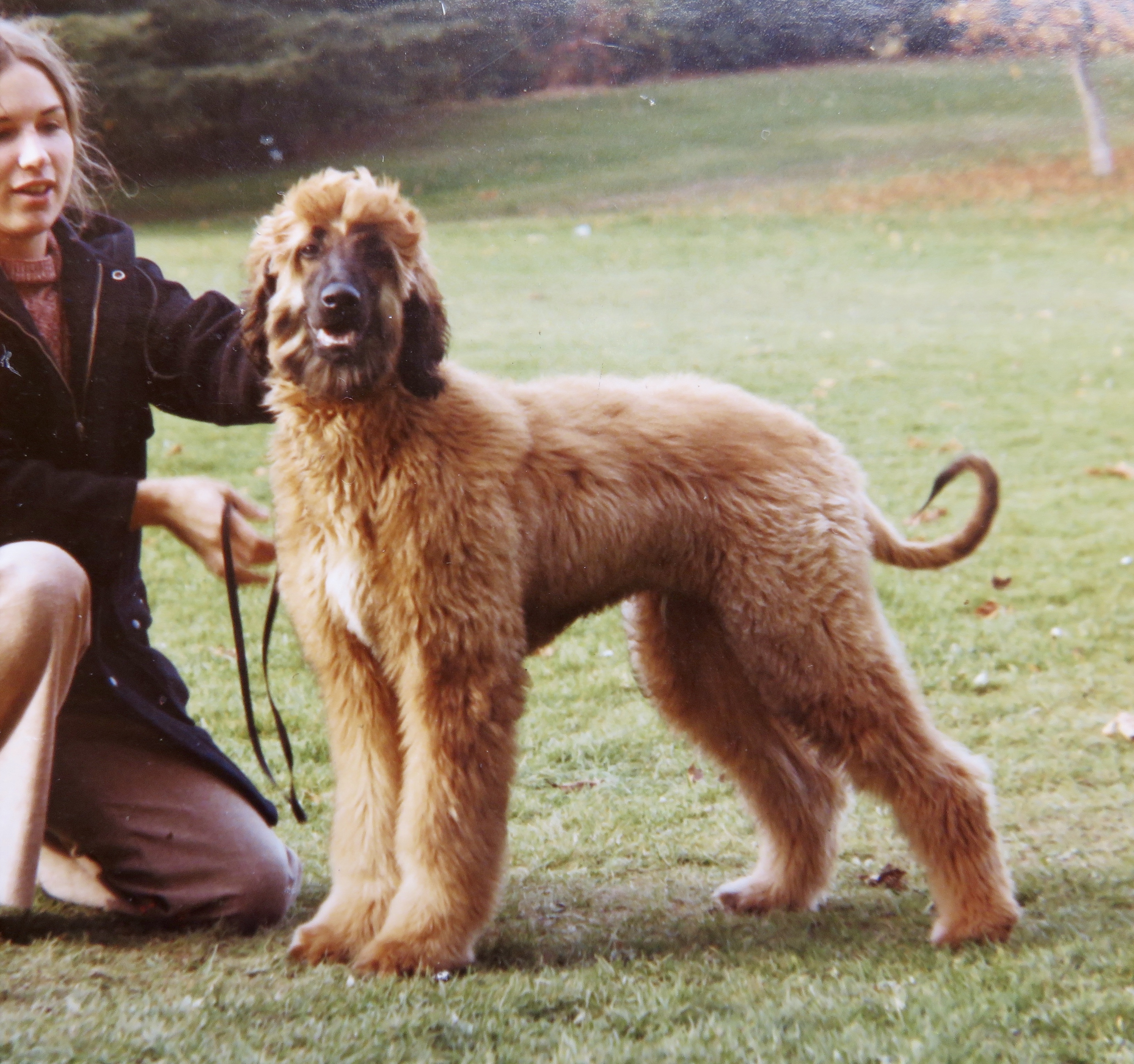
Gary with his dog, “Manny.” He’s clipped down after we moved to the beach in 1979. Manny was an American and Canadian Field Champion.

We went to Canada last month for two nights. It was a lovely time, made lovelier, I suspect, because we took no photos and accomplished nothing but rest of the best sort: we ate well, walked, napped, and read.

The point was to use our passports, that were a week or two shy of expiration and had never been used.

Gary and I used to travel to Canada often, back in the days when all we needed was a rabies certificate to bring the dogs we were showing back into the US. I showed our Afghan Hounds in dog shows and judged field trials and the dogs ran in them. For a time in the 1970s and 80s, our dogs were well known by the running crowd.

Gary was known.

Some terminology: Sighthounds are dogs that hunt primarily by sight—they chase what they see moving. Greyhounds are the sighthound most people know, but recent genetic testing finds that Afghan Hounds and Salukis are among the oldest dog breeds, existing for thousands of years in the Middle East. Lure coursing allows a formalized “hunt” of a shredded white plastic garbage bag. The dogs are smart enough to know it’s a lure, but most enter fully into the game.

The sport of lure coursing began with the American Sighthound Field Association which probably owed its existence to Lyle Gillette, a dog fancier best known for his Rancho Gabrielle Borzoi, the hounds also know as Russian wolfhounds, which were actually used in packs to hunt wolves in the Steppes. Lyle was a sweet man and I stayed with him while I was participating in a field trial in northern California. I was traveling with my friend Heather Loube, a citizen of Canada. This was the early 70s.

The previous year, I had traveled with Heather and her husband Jeffrey and assorted dogs to Colorado for the inaugural Colorado Grand National. One hundred and four dogs of various breeds ran that day. I slipped Wielki Sezlem of Nightwatch who was a show and field champion. I yanked the slip collar toward me when I released him (a mistake), the heavy brass ring hit me in the face, and a hour or so later I had eight stitches in my upper lip. I could show you the scar.

The upshot was that when Gary picked me up from the airport, he was tall enough to look right down under my bandage and see my stitches, and he about freaked out right there in the airport. I had not warned him.

This was not the first time I’d had an injury to the face. One of Heather Loube’s dogs had jumped up to kiss my face, while I was backing up and Heather was trying to pull him away. His tooth met my tooth and my tooth lost. Heather’s dentist came into the office on his day off, treated me gently and at no cost.

[Don’t ever tell me that the Canadian health care system is inferior to ours. Years later our youngest son, then not four years old, had an abscessed tooth and our dentist would not come into the office to treat him. He had no emergency care referral in place, and I called every dentist in the county before I found one willing to see my sobbing child. I got better care from a Canadian who owed me nothing.]

Heather and Jeff Loube founded the Canadian Sighthound Field Association with help from a few other early enthusiasts, including Gary and me. Gary and I were ourselves instrumental in starting field trials in the Pacific NW.

All of this to get to Gary mowing an eight acre field with a push mower.

We liked running hounds on rough ground, but grass approaching two feet made visibility of the lure near impossible. The field in a local park had to be mowed. No one in our breed club would help or even offer equipment. After the first day, word got around, and Denny showed up. Whippet and Borzoi and Deerhound fanciers showed up. Five or six people with gas-powered mowers. Eventually someone got ahold of the parks people and the park manager came out to see what was happening, shook his head, and lent us the sitting mower, and the mowing was completed in no time. Four days of hard labor and then no time at all.

That first meet used a drag machine. The lure was attached to the end of 100-pound braided dacron fishing line, which was connected to a spool that wound up the line. The course made a huge S shape with a long straightaway in the middle, cornering on pulleys set flat on the ground, over a total distance of about 900 yards. That course was strung by hand. Someone took the lure in hand and ran around the huge S, catching the line on the cornering pulleys. That someone was also Gary.

Most clubs used a motorbike to string the lure. Later, continuous loop machines ran the line with one end of the S joining up to the other in one continuous loop. (I was present at the first use of a continuous loop machine, also in California. My girl, Onika, skinned the inside of leg running right along the line—a rubbed patch the size of my palm inside her stifle. We learned to keep a continuous loop tacked down close to the ground to avoid these injuries.) Some courses were different shapes of course. I designed many.

Gary ran the lure around for each course at our first meet. Three dogs running in each and wearing identifiable jackets in yellow, pink, or blue. (We used red, black, and white, in early courses, but this caused confusion—was it the red dog in the black jacket? or the black dog in the red jacket?)

Gary ran many miles. The Canadians brought beer for after.

Over the years, we met semi-pet raccoons, rare sighthound breeds, people from all over the world, because of our dogs. I went into labor the first time while on Vancouver Island BC, judging a field trial. I drove all the way home and was in the hospital a few hours later. You might not believe it, but that is one of my favorite memories.

I miss the dogs terribly sometimes. We had sighthounds and were active showing and running for decades. Gary still misses Manny.

We traveled across the U.S. and to Canada for dog shows and the far more entertaining field trials. You can guess which events the dogs preferred.


THRASHED

IMG_2872

This is Gary’s dog, Manny, as a puppy in 1976. He was the first Afghan Hound we bred, shown in puppy coat. We kept him all his life. He was a smart boy.

I thrashed the kitchen the other day and Gary had to clean it. It’s what he does most days. It had been hard that day. His brother called to complain and then hung up on him. This brother doesn’t like Oregon’s Governor Brown and believes Hitler went to Brazil, and worries that Gary is “leftwing.” Gary told him we like Governor Brown (the brother is a resident of Washington) and Hitler is dead. Yeah, and we’re leftwing. My husband’s brother was diagnosed schizophrenic when he was fifteen.

He is at the age where the general mental health of some schizophrenics improves. This has not happened for him. He is not worse than he was as a teenager, but he is not better. He still tends to rant about things a good deal, has no interest in anyone’s opinion unless they are agreeing with him, and he hangs up on people if they disagree, or might have taps on their lines, or for other reasons too convoluted and absurd to go into. He has never been on meds, has never been institutionalized, is sometimes banned from call-in radio shows, but otherwise does not cause trouble. He argues with people but has not spent time in jail that I know of.

On the other hand, another relative has been arrested and convicted of abusing his spouse, began court-ordered therapy in his late forties, and with good behavior had that conviction wiped from his record. He is not schizophrenic but has anxiety and phobias and perhaps borderline personality disorder, which is not nice, but he can be charming and he is very smart. He has been institutionalized only briefly, and has been on meds and in therapy for many years. He is also not better. He is, some might judge, worse.

He is depressed and rarely leaves his home and is lonely and claims he has driven away all his friends. He is angry and blames people for failing to behave better. All this is likely true, though I have not spoken to him in a long time.

I was reminded of this just the other day when I called to make a reservation at a charming coastal hotel. There was some confusion about who I was. And the story came out about repeated reservation cancelations. The person I talked to was charmed, but anxious herself about those cancellations. I promised I would not cancel.

So. A cake, some sadness about our family members, and a clean kitchen.

IMG_0683

SaveSave

SaveSave

COLOR BLIND

IMG_1117

The online test was supposed to diagnose my ability to see colors. I stared at the screen and searched for the number hidden in a forest of little circles. I passed that one. I am not color blind. Then, a few days ago I took one that was supposed to identify a minority of humans who can see colors that almost no one else can see. Another test offered to determine whether my eyesight is acute enough for a military pilot. I would feel enormous pride if I were found to possess exceptional perception of color. I do not. I am deeply disappointed when I fail such evaluations. In a rainbow, I see colors from the violet through red, and the ordinary hues between that most people see. I easily distinguish between red and green—the most common form of color blindness. I can nearly always detect subtle variation in color. My perception of the color red fades first in waning daylight, just as it does for all humans.

IMG_2173

My eyesight is normal, at least insofar as what colors I see. The rods in the back of my eyes which distinguish light and darkness are likely fading as I age so that my vision at dusk is less clear than it was when I was a girl. Most people lose some degree of night vision as they age. It is why my husband Gary still does not like to drive in the dark. It is another reason why the elderly are more at risk to stumble on their way to the bathroom in the middle of the night. And it is also a contributor to older people giving up reading. They cannot see as well without brighter task lighting, but they fail to connect their struggles reading with poor lighting in their homes.

The loss of rods in the retina can be addressed with a lamp. The loss or lack of cones, the light-sensitive cells that read colors, is more problematic. Cones allow people to distinguish between the three colors of light: red, green, and blue. Some color vision, like light vision, is lost with age, and the ability to see color accurately may be lost due to trauma or illnesses such as leukemia or Parkinson’s. Cataracts, for example, impact color perception, turning skies pallid and strange. (The sky turned back to sky blue after Gary’s cataract surgery.) When cataracts are surgically corrected, color vision returns to normal, but most color blind people are born with a lifelong handicap. And for about one in twelve men in the world but only about one in two hundred women, it is genetic.

An adaptation of our diurnal ancestors was color vision. Scientists assume that early lifeforms were nocturnal and completely color blind. As we woke to the day, our senses included color. Birds have a rich range of perceived colors and perhaps that is understandable in species that rely on color to navigate, eat, and find mates. This makes me wonder about owls. As nocturnal birds, do they lack color vision? The cone cells that detect color are blind in low light.

Among people of color, especially from sub-Saharan Africa, color blindness is uncommon, while among white people, especially from Scandinavia, the incidence is higher, especially among men. About nine million British citizens have some degree of color blindness and nearly all of those people are men who inherited the condition from their parents. Men are at a disadvantage because, while blue is inherited on a non-sexual chromosome, the red and green color-perceiving cones are carried only on the X chromosome, and thus men have only one shot at inheriting what they need to see what I can still see quite clearly. Christmas colors.

IMG_2587

Ordinary color blindness limits a human’s ability to see one or more of the three colors of light—red, green, and blue. Most people who suffer from color blindness are blind to two of these colors, but only half are moderately or severely color blind. The most extreme color blindness, no color vision at all, is extremely rare. In my county in northwest Oregon of less than forty thousand people, almost two thousand are likely to be color blind. These people are not truly blind to color, instead they have some impairment of their ability to see the full range of colors. With an overwhelmingly white (90%) and significant Scandinavian population, this is not surprising. The defect is most common in people with European ancestry.

About half of these local citizens, shy of 2000 people, color blindness is moderate to severe—they do not see a particular color well or at all. Of the people likely to be colorblind in my county, 250 would have some level of the most common form of red-green color blindness that confuses those colors (deuteranomaly), about 50 would lack some degree of red perception (protanopia), 50 would lack blue (tritanopia), and in our richly wet and verdant landscape, 50 would see green trees as washed out, yellow, or gray (deuteranopia). Perhaps in my state of almost 4 million people, about 180,000 people have some degree of color blindness. More significant. 120 people might have true color blindness (rod monochromacy) and are unable to distinguish any color at all.

Does color blindness make a difference day to day? A fair percentage of people even in first world countries survive youth completely unaware that they see less than their peers. I recall a television show I was invited to participate in as a teenager. One of the other teen panelists announced just before we went on the air that he had enlisted that day and discovered he was color blind. “I didn’t even know,” he said. I asked him the color of the dress I was wearing. He looked it over carefully and replied, “Sort of beige?”  All these years later, I can guess he had protanopia, the form of color blindness that limits perception of red and would have made my bright orange-juice-colored dress appear pale muddy yellow.

Most color blindness is a mild inconvenience. Even with his limitation, the new recruit had learned the light at the top of the signal indicated he needed to stop. And then at eighteen he understood he would struggle forever to determine whether a steak was raw or cooked, whether a Marine uniform was merely dirty or smeared in blood.

That boy had gone through most of his teens unaware that the rest of the world saw something different from what he saw.

This is not unusual. Researchers find that many children fail to notice that their vision is hindered, and those children who do are most likely to disguise their handicap. Parents may note their child making unusual, perhaps creative color choices with paint sets, and these children may struggle to identify colors. The child may complain of headaches or smell his food because he cannot tell from color what he is offered on his plate.

The conversation with my colorblind peer must have had an impact on me, because it was about that time that I was first tested for color blindness myself. I had not shown any symptoms of limited perception. I think I asked for the test. The doctor brought out a series of cards with variously sized and colored dots, one similar to the original Ishihara test invented in 1917. Slight color differences revealed numbers on each card. I was shown only a few out of the stack—Do you see a number? I did. This one? Another? Then the doctor declared my vision normal and put the cards back into their folder. I recall being disappointed that I was not allowed to look at all of the cards. Such tests are still used today to identify color perception.

IMG_4028

Color blindness can create challenges in reading a map or recognizing whether someone is sunburned in time to warn them; they may not see the difference between a blue-eyed dark blonde and a green-eyed redhead, or be able to use color-coded test strips for water quality. A salad might have the appetizing hue of shredded cardboard. Most people cope, but how would I have placed my crayons in rainbow order without normal color perception? This distresses me. Did I embarrass some grade school boy by pointing out his colors were out of order, when he was himself unable to see that order? Worse, how would a colorblind person distinguish red lights or others warnings if there were not additional cues such as words or location. LEDs might all look the same. A red warning light might look identical to the green one assuring that everything it fine.

Physical capacity to see color is at the basis of much of what I do each day. I am deeply invested in color—the colors I paint my walls, the clothes I choose to wear, the play of hue and value in patterns, the way daylight alters everything. I enjoy subtleties of the jar of hundreds of agates plucked from the shore, the bright Sharpies in an orange tea mug on my desk, the handpainted yarn I weave. I would miss color. My world would be immeasurably impoverished without it.

For my entire childhood, my family’s only television was black and white. I did not miss color then, and indeed films were still made in black and white. We went to a family friend’s house to watch The Wizard of Oz in color, and the instant Dorothy opens the door, I noted the technical flaw. The door itself turns from gray to muddy brown. How old would I have been? Seven, eight? I understood immediately how the trick was done—it is not that everything past the door is in color, but that everything is abruptly filmed in color—maybe that is why there was nothing overwhelmingly magical in my memory of that experience. I went home to watch our black and white set without feeling deprived. Color was everywhere: in the carpet, my mother’s glass mosaics and enamels on copper, and just outside our door, the world was always in color.

But I do not see everything there is to see. What colors I can see comprise only a narrow band in the entire range of the colors that exist. Insects see a far broader range of colors invisible to my eyes, and though dogs are famously colorblind, my dog can see in the dark while I am tripping over furniture.

Still.

What I see is not all that I receive. My connections to colors are more complicated. Pale blue and and green and gray and glowing white are the colors of my sky and the sea outside my window, a soothing mix of gentle hues sometimes at war with the weather, with wind and lightning and raging surf. Green is the color of trees and growing things, and I see it wherever I look, because this is the coast of Oregon. The sun might be yellow, but I do not see it up in my sky today. Sunsets are most often glistering orange, while a sunrise wraps pink a full circle around my horizon. Violet is fading bruises and the yarn under my hands.

What I see is what is there to my human eyes, and also everything else I have ever seen that shares the scent, shape, texture, and color of that surface.

Red is the color of blood and lipstick and Oklahoma roses. My own blood dripping down from my knee to white ankle socks, my grandmother’s thick red lipstick, the roses Papa planted along the driveway. When I see a octagon sign, I don’t need red or even to see the letters to know I must stop. Green is home, the long-sleeved dress I loved as a child, trees, and tight furls of opening pine needles. My vision is not special, not rare or strange. A tiny percentage or perhaps even most other women may have, along with their double dose of X chromosomes, the extra ability to perceive colors no man can.

Recent studies find some women expand the seven hues most people identify in a rainbow to include dozens more. These colors are mostly a conflagration of greens—green is go—and that would be something to see.

IMG_1685

SaveSave